“Inna” was met at a depth
The Herrenknecht S-772 TBM with the beautiful name “Inna” on September 14 completed the excavation of the left running tunnel with a length of 3244 meters on the north-eastern section of the Big Circle metro line. The shield passed underground from a round pit located on site No. 17 to site No. 24 - dead ends behind the Savelovskaya station BKL.
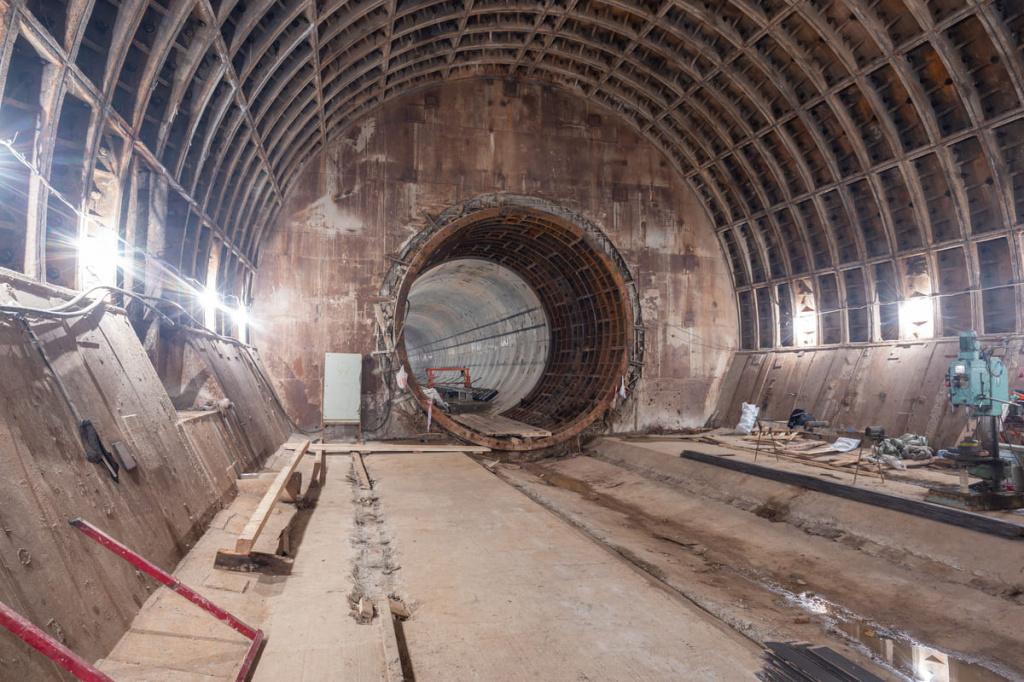
The tunnel opens into a dismantling chamber at a depth of 60 meters
“Inna” walked along a difficult route at a depth of 45 to 70 meters in clays and marl sandstones, including under the tracks of the Oktyabrskaya, Moscow and Riga railways. In these places it was necessary to strengthen the ground “iron” by laying additional rails and sleepers. “Inna” also passed under existing stations and structures of the Moscow Metro.
The excavation was carried out by specialists from Tunnel-2001 under the leadership of site manager Valery Borodulin. “Pilot tunnels” were built at the site of the future stations “Rizhskaya” and “Maryina Roshcha”, passed through by transit. Their diameter will subsequently be expanded from 6 to 8.5 meters for the side station tunnels. To unload rock from the round pit, a vertical conveyor specially developed by UMM was installed.
“In my practice, a vertical conveyor was used for the first time during excavation,” said Valery Borodulin. “At such a great depth, soil was released along the belt, and then buckets took it into the dump. The soil was then lifted up for further disposal.
He explained that the usual method - the conveyor - was not suitable for the construction of these tunnels. Borodulin also called the TBM's exit into the dismantling chamber underground unique. Usually the shield exits into an open pit. Here, “Inna” was left in the dismantling and installation panel chamber (DMSC) at a depth of 60 meters.
It is possible to get into this chamber only by going down a vertical shaft and overcoming several forks in the mine workings with a narrow-gauge railway.
To install two DMSCs (left and right), builders from SMU-8 built approach corridors almost by hand. More than 2.5 thousand cubic meters of soil were unloaded onto the surface. It was delivered by trolleys along haulage tracks and floor-mounted diesel locomotives.
The underground shields moved quickly, and their subsequent acceptance also required efficiency. On June 4, the Herrenknecht S-771 TBM with the name “Elena” entered the right chamber.
“The workers used all their skills and diligence,” said the head of the SMU-8 section, Artem Loza. “It was especially difficult to construct the left dismantling chamber. It took two months to build its lower vault. The explorers tried to make it in time for the meeting with “Inna”. The employees coped with the task and managed to accept the shield.
Now “Inna” will be slowly pushed into the chamber itself, then dismantled and taken away by diesel trucks to site No. 17. After repair and refurbishment, the shield will be sent to build new tunnels.
At the same time, a drainage system is being built at site No. 24, which will receive water from Savelovskaya and Maryina Roshcha and will not allow it to accumulate underground. A ventilation chamber is also being built in this area. All work at site No. 24 of SMU-8 is planned to be completed in 2022.
BTW
The design, assembly and installation of the vertical conveyor took about nine months by the UMM design department. Its use made it possible to simplify the process of soil extraction by automating it, and also to significantly speed up the excavation of the distillation tunnel.
The Herrenknecht S-772 “Inna” TBM traveled a total of 9.1 kilometers, constructing five tunnels. Prior to this, the complex built tunnels on the northern section of the extension of the Lyublinsko-Dmitrovskaya line from the Okruzhnaya station to the Seligerskaya station, then on the northeastern section of the Big Circle Line, the Elektrozavodskaya - Lefortovo and Nizhegorodskaya - Aviamotornaya running tunnels were built.