Museums underground
In March, it was a year since the Great Circle Metro Line was put into operation, which became the world's largest underground ring. It took builders more than ten years to build 31 stations, nine of which were built by Moscow Metrostroy. A colossal amount of architectural and finishing work was carried out by specialists from the Mosmetrostroy Special Works Department.
The history of the USR began in 1950. In pursuance of the order of the Council of Ministers of the USSR dated February 9, 1950 and the order of the Minister of Railways dated February 15 of the same year on the organization of Zhilpromstroy as part of the Moscow Metrostroy, the Office of Special Works of the Zhilpromstroy trust was organized from June 1, 1950 for finishing housing and metro facilities. In accordance with the order of the Ministry of Transport of February 14, 1978, the Office of Special Works of Mosmetrostroy was renamed the Office of Special Works.
Today, about 500 people work here, 87 of them are engineering and technical personnel, the rest are workers. Among them are masons, mechanics, plasterers, tilers, painters, turners, stonemasons, carpenters, electric welders, etc.
There are many labor dynasties in the Ukrainian SSR. Families worked here. Even in the difficult 90s, employees took vacations at their own expense or temporarily moved to other non-metro construction organizations in order to later return to their home team. The Kamardin dynasty is known, which began with the head of the family, Ivan Ivanovich (came to Metrostroy in 1977), the Isaev dynasty - Nikolai Pavlovich and his wife, Tatyana Nikolaevna, whose total work experience at Metrostroy is 84 years. There are many long-lived workers in the Special Works Department. Site foreman Olga Zarubina and painter Lidiya Stepanova have been working in the organization for 52 years, painter Nadezhda Varlamova - 44 years, stonecutter Ivan Grigorenko - 42 years, site technician Elena Izgarsheva - 41 years.
Over the years of activity, USR employees have made a huge contribution to the construction of the Moscow metro. Architectural and finishing work was completed at many stations, which were completed on time and with good quality.
Continuing traditions
Of the 263 operating metropolitan subway stations, Moscow Metrostroy has built just over 200. Most of them were built with the participation of USR specialists. Let's talk about just a few of them.
At the Salaryevo station, designed in the constructivist style, more than 5 thousand square meters were laid. m of natural stone, 450 sq. m installed. m of slatted ceilings and more than 2 thousand sq. m. m of cellular suspended ceilings of the “Grigliato” type.
A large volume of architectural and finishing work was completed on the northern section of the Lyublinsko-Dmitrovskaya line from Butyrskaya to Fiztekh. For example: at Seligerskaya alone 8,640 square meters were laid. m of natural stone, installed 4320 sq. m of hinged and suspended panels, completed 1440 sq. m of painting and plastering work. A giant panel measuring 160x5 meters with a scene of the celebration of the 800th anniversary of Moscow was installed at Yakhromskaya. Volumes of work performed – 8071 sq. m of natural stone and 7038 sq. m of hanging panels.
Of course, the contribution of USR specialists to the launch of the Big Circle Line, where a variety of stations appeared, will be felt. In the style of hi-tech and avant-garde, with mosaic panels and sculptures, monumental and restrained. The authors of the projects continued the established traditions of the architecture of the Moscow subway, a kind of underground museum.
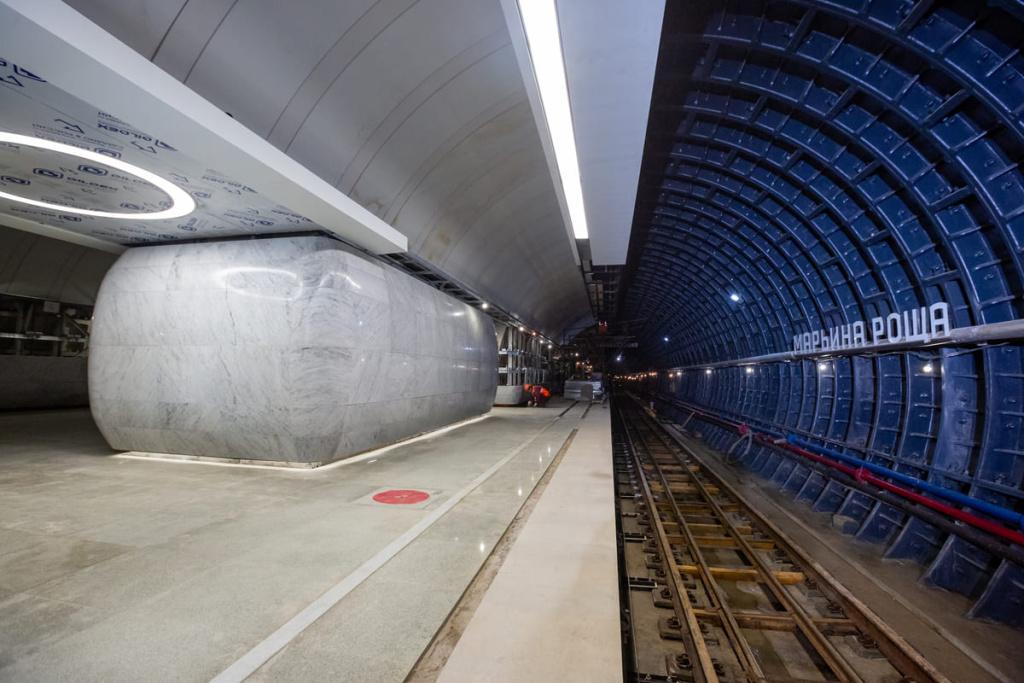
The design of the Savelovskaya, Maryina Roshcha and Rizhskaya stations is stylized as a metro tunnel. The track walls of the platforms are cast iron tunnel tubes weighing up to a ton each. Preservation of open tubing lining is a unique phenomenon in the Russian metro. For the construction of Savelovskaya, 6840 square meters were used. m of natural stone, 6080 sq. m of suspended panels, completed 2280 sq. m of painting and plastering work. The volumes of “Rizhskaya” and “Maryina Roshcha” are comparable: 4919 sq. m and 9503 sq. m of natural stone, 5400 sq. m and 7141 sq. m of hanging panels.
At the Elektrozavodskaya station of the BKL there is a panel “Battle of Heroes”, dedicated to the image of the defenders of medieval Rus'. This is the largest panel in our metro: length – 163 m, height – 7 m. The volume of architectural and finishing work at this station is impressive: 10,096 sq. m. m of natural stone cladding, 7401 sq. m of painting and plastering work, 2830 sq. m of suspended ceilings made of aluminum panels and 1710 sq. m of lining the track wall with aluminum panels.
This list goes on and on. Passengers called the Sokolniki BKL station a museum of metro construction. Its design is dedicated to the hard work of Komsomol volunteers who donated 13 beautiful stations of the first stage of the metro in the 1930s. On the track walls and ceiling there are numerous panels dedicated to the feat of the heroic metro builders. On the former Kakhovskaya line, commissioned back in 1969, with the participation of USR specialists, the Kakhovskaya, Varshavskaya and Kashirskaya stations were reconstructed, and their historical appearance was preserved.
Numerous reviews from passengers that the capital’s metro is the most beautiful in the world are true. And this is the merit of the specialists of USR - one of the best finishing organizations in Moscow.
MORE HALF OF LIFE IN USR
On July 9, the 60th anniversary was celebrated by the director of the Department of Special Works of Mosmetrostroy, Honored Builder of Russia Alexander Bondarenko.
Alexander Yakovlevich has been working in the USR since 1987, for 37 years now - this is his only place of work. He went from a mortar pump operator to the director of an organization.
Bondarenko took an active part in the construction of many Moscow metro stations, where a colossal amount of architectural and finishing work was carried out, in the construction of the Moscow Center for Infectious Diseases in New Moscow, as well as in the construction of the Memorial complex in Dushanbe, dedicated to the anniversary of the Republic of Tajikistan.
The editors of the Metrostroyevets newspaper join in the warm congratulations to Alexander Yakovlevich from the management of Mosmetrostroy. We wish you good health, spiritual harmony, long life! May good luck and success accompany you in all your endeavors, and may your family and true friends be nearby!