The first tunnel to “Stromynka” is ready
The Herrenknecht S-755 “Natalya” tunnel boring complex successfully finished on March 21 in a specially prepared chamber at the “Stromynka” station under construction. The Metrostroevets correspondent observed the exit of the shield and learned the details of the long and complex tunneling.
In the technological chamber at site No. 8, only the roar of crumbling concrete and the hum of a working tunneling machine can be heard. The rotor of the 480-ton Natalya TBM, biting into the wall of the pit, comes out.
The shield started on June 30, 2017 from the ramp chamber on site No. 5.2, located on the territory of the former Metallurg stadium. This is already the fifth underground route for the 79-meter Natalia. She walked almost 2.5 kilometers of the left running tunnel, which connected the Rubtsovskaya and Stromynka tunnels under construction.
UNDER THE MOSCOW RAILWAY, MULDA AND METRO
The difficult path of the shield ran at an average depth of 30 meters. At first, the miners moved in transit through the Rubtsovskaya pit, which had not yet been developed. Then - six meters above the existing Elektrozavodskaya station. We crossed the route under the tracks of the Kazan direction of the Moscow Railway, on which safety bags were installed for safety. We also passed under the Yauza River.
After a short break at site No. 18, where the fourth section of TO-6 was transferring the necessary equipment, the shield started again. Now he had to walk in water-saturated limestone, where the water inflow reached 350 cubic meters per hour. Then there was the most difficult tunneling under the trough.
– A trough is a cone-shaped accumulation of rocks, an “underground bowl.” Stretching 400 meters at its widest part, it was filled with flooded sand. If there were a breakthrough at the bottom point of the “bowl”, the entire mass of soil would move into the tunnel, dragging the above-ground buildings with it, explains site manager Vasily Kostromenkov, who is in charge of the excavation.
Leaving the trough behind, “Natalya” moved through an area saturated with communications and buildings. The final serious test for the TBM was the excavation under the Sokolniki station. In case of unforeseen situations, we set up a headquarters for round-the-clock monitoring. Traffic was temporarily closed at five stations on the Sokolnicheskaya Line.
SURROUNDED WITH A CURTAIN
The foundation pit for vestibule No. 2 is used as a chamber for acceptance and subsequent launch of the TBM. At its bottom, the fifth section of TO-6 prepared reinforced concrete foundations and 60-meter beds. One at a time, the shield will be dragged to the opposite wall. From there, SMU-1 will lead Natalya towards the Rzhevskaya Big Circle Line, which is under construction.
Two more pits of “Stromynka” - the station one and for the entrance hall No. 1 - are currently being developed. Their “Natalia” was in transit. Along the perimeter of all three pits, an anti-filtration curtain (PFC) was installed using jet-grounding technology. It is necessary due to the proximity of building foundations and the geological features of the area.
– From a depth of seven meters, a layer of water-saturated sand begins here. When developed, it fills everything that builders dig out, attracting neighboring horizons,” says Boris Kazantsev, deputy general director of SMU-12. – To prevent this, we created a PFZ from two rows of jet piles. This soil-cement mass replaced the sand and made it possible to develop a pit.
The verticality of the piles was checked by inclinometry using expensive equipment. It was used for the first time in domestic metro construction.
"SOFIA" IS NOT LEGGING AWAY
Meanwhile, the "Sofia" shield continues to operate in the right ferry tunnel. She set off on her fourth route from the same site, but a month and a half later.
At the end of March - beginning of April, the TBM passed under the Sokolniki station. After exiting, it will also be dragged to the opposite wall of the pit, through which the shield will go to Rzhevskaya. “Sofia” will continue its path under the leadership of TO-6.
EVENT
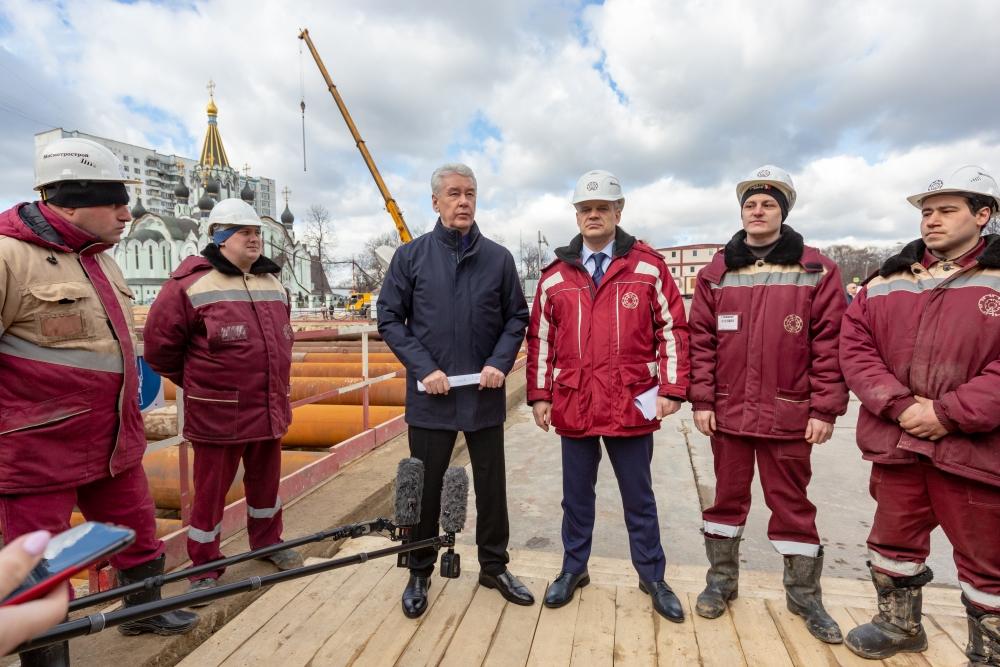
Moscow Mayor Sergei Sobyanin visited the site where the Stromynka station is being built on March 20. The mayor inspected the progress of the work and talked with metro construction workers. The head of the city also promised that after construction is completed, the linden alley from the Sokolniki metro station to the park will be restored. “We will not only restore it, but also plant more trees, of better quality. So everything will be landscaped and done as the residents asked,” the mayor assured.