I will build as long as I have strength and opportunity
We are opening a new section “The Work of Life”. She will talk about those who devoted themselves to the construction of the metro, who walk hand in hand with Metrostroy. Its first hero was Alexander Sergeevich Seslavinsky. Many remember him from his work at the Moscow Metrostroy, some know him from the Moscow Metro. His thirty-five-year work history is closely connected with the construction of the city subway. Alexander Sergeevich is an honorary builder of Russia. On the eve of his 60th birthday, he shared with the readers of Metrostroevets how he lived and worked all these years.
I was born and raised in Moscow. In a family where my mother, Elena Maksimovna Seslavinskaya, started as a foreman in the KSR (as USR was previously called), was the chief engineer there, and then worked in the Metrostroy Department. And my father, Sergei Ivanovich Seslavinsky, worked at the Metrogiprotrans Institute as the head of the highway department, and in the late 80s he was elected director of the institute by the staff and headed it until the late 90s. On the advice of my parents, I decided to become a builder and began preparing to enter MIIT.
INSTITUTE YEARS
I prepared to enter the institute using the notes of my friend, who had already entered the Geological Prospecting Institute a year earlier. At that time, I was seriously involved in sports - rowing, and on the Rowing Canal, in between training sessions, I crammed notes and solved problems in mathematics and physics.
He entered the Faculty of Railway Construction with a specialty in Track and Track Management. We were taught industrial and civil engineering, bridges and tunnels, geology and, of course, the basics - track and track management.
The period of study at the institute coincided with the 1980 Olympic Games in Moscow, where we, MIIT students, like students of other Moscow construction institutes, worked on the construction of sports complexes in Moscow. The Miit students worked at the Olimpiysky sports complex on Mira Avenue, so I studied not for 5, but for 5.5 years. Little did I know then that some time later I would be working here for many years, next to the Olimpiyskiy, in the Moscow Metro building!
In December 1983 he graduated from the institute, and already in January 1984 he was assigned to work in TO-6 of Metrostroy as a shift engineer on the railway section.
METROSTROY
The first area of work was the running tunnels of the Zamoskvoretskaya line, which was then under construction, from Kantemirovskaya to Krasnogvardeyskaya, where we had to work almost seven days a week. Then - a sleeper impregnation plant in the Nizhny Novgorod region, where I was sent for the whole summer with a small railway crew to select wooden sleepers for Metrostroy.
From the Putivsky site I was sent to the construction of shaft No. 916, through which the distillation tunnels of the Timiryazevsky radius were built between Petrovsko-Razumovskaya and Vladykino, the site manager was Ivan Petrovich Retyunsky, I am still friends with him. The shaft was driven by the method of immersing the lowering support in a thixotropic jacket. The rings were assembled at the top and then pressed down with hydraulic jacks. After the knife ring entered the hard rock, it was dismantled and the classic blast or hammer drilling of the shaft began.
Together with colleagues from SMU-8, we built a section from Chekhovskaya to Tsvetnoy Boulevard, and together with SMU-14 at Chekhovskaya we built an extension of the middle hall with an inclined run. On the Polyanka - Borovitskaya stretch, where SMU-1, SMU-5, and SMU-6 of Metrostroy worked, TO-6 specialists laid the track superstructure (VSP). On the stretch from "Teply Stan" towards "Yasenevo" they carried out a tunnel with a shield with cutting partitions and built a ventilation shaft on the stretch.
Then there were training courses for the reserve of management personnel of the Ministry of Transport. My diploma work at these courses was “Tunneling in unstable soils using a tunnel-boring complex with hydraulic loading of the face.”
The head of TO-6, Viktor Vasilyevich Sidortsev, and the chief engineer, Georgy Vasilyevich Makarevich, entrusted me with managing the section that was supposed to carry out preparatory work for the installation of the TBM at the construction site, and to conduct tunneling in the transition section from shallow to deep from Kozhukhovskaya to Dubrovka using the Weiss und Freitag tunneling complex received from Germany. & Freytag) in watered soils, that is, in quicksand. This was a great opportunity to put my knowledge into practice.
A special team had to be recruited to work on Weiss. The difficulty was that in order to service the rotor, cutters and pipe for releasing rock, it was necessary to go into the bottomhole zone, which was kept from collapsing by increased air pressure - a real caisson. For such work they were selected as cosmonauts. Under my leadership, only one stage was successfully completed. The second one took place without me, by that time I was already the head of the site at SMU-6 of Metrostroy for the construction of the STP and the Chkalovskaya BTP. Then he worked at SMU-5 of Metrostroy on the construction of the second Petrovsko-Razumovskaya and the stages from Krestyanskaya Zastava to Dubrovka.
METROPOLITAN
In 1994, Igor Sergeevich Rukavishnikov invited me to work at the Moscow Metro as an inspector for quality and acceptance of work in the production department of the Directorate of the Metro under construction. I supervised SMU-12 of Metrostroy during the construction of the Kozhukhovskaya, Volokolamskaya, Myakinino stations and the metro bridge in Myakinino, which was built by Mostootryad No. 4. In 1994, a section of the Lyublinskaya line from Chkalovskaya to Volzhskaya was put into operation, and the following year - from Lyublino to Maryino. For almost the next three years, due to a lack of budget funds, there were no new launches.
Trains passed the Dubrovka station on the Lyublinsko-Dmitrovskaya line on the stretch between Krestyanskaya Zastava and Kozhukhovskaya without stopping; it was opened only at the end of 1999. Due to the steam pipeline of the tire plant, which ran next to the future station vestibule, the soil around the inclined passage had to be additionally frozen, and the design documentation had to be adjusted in terms of excavation of the inclined passage and construction of the vestibule.
During this period, a group was created in our production department to relay communications, clear the construction area for metro facilities and connect to the networks of permanent power supply, water supply and sewerage. I led this group of four people.
In 2000 there was “Academician Yangel Street”, in 2001 - “Annino”, in 2002 - “Dmitry Donskoy Boulevard”. In 2003, the Butovskaya line and Victory Park were put into operation.
I was appointed deputy chief engineer of DSM in 2004, supervised the department of engineering preparation for construction and the construction of new stations and lines.
The second vestibule of Mayakovskaya in 2005 was built in difficult hydrogeological conditions by SMU-8 specialists; the connection to the existing Mayakovskaya station was carried out under the building where the Ministry of Economic Development was located at that time.
Having devoted 23 years to the Moscow Metro, I ended my work as Deputy Head of the Metro - Head of the DSM.
OUR DAYS
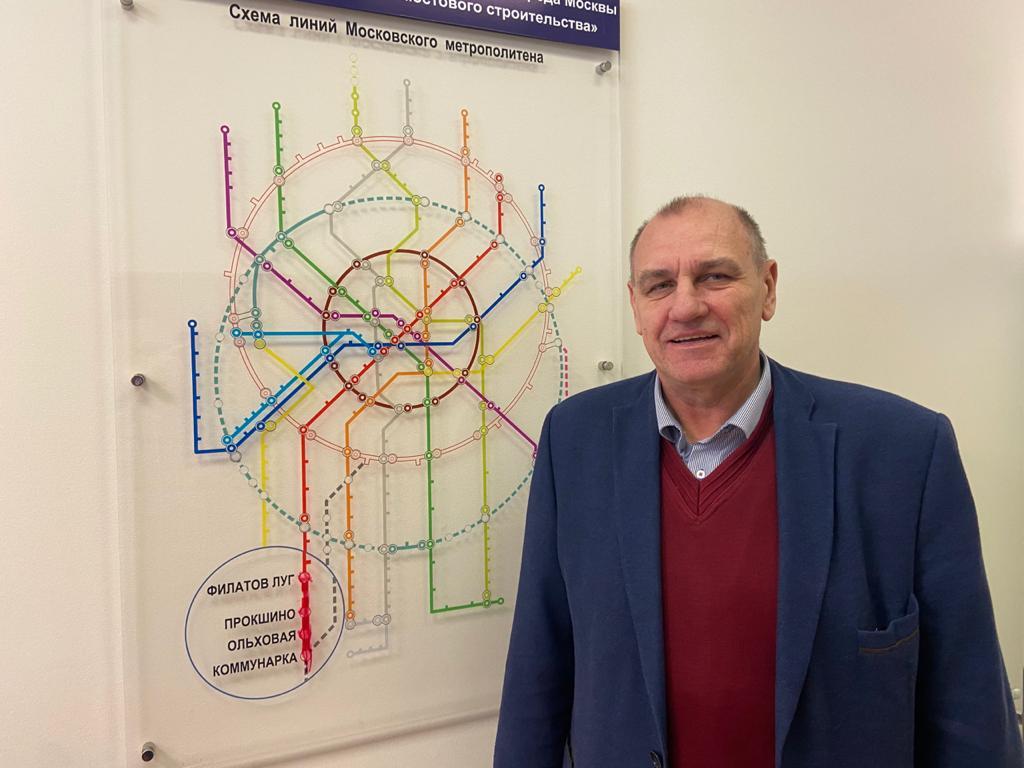
For the third year now I have been working at the State Treasury Institution “Department of Road and Bridge Construction” (GKU “UDMS”). We are building a metro in New Moscow. In 2019, together with the Moscow City Construction Department, four stations were put into operation on the extension of the Sokolnicheskaya Line: Filatov Lug, Prokshino, Olkhovaya and Kommunarka. Projects for further development of the metro in New Moscow are currently being considered.
The metro is already a part of me. I will probably build it as long as I have the strength and opportunity to apply it to this, in my opinion, important matter. Therefore, in response to your congratulations addressed to me, I would like to wish all of you, my colleagues and friends, truly great success in our common work. And besides, of course, health and happiness to all metro builders!