I won’t leave Metrostroy anywhere
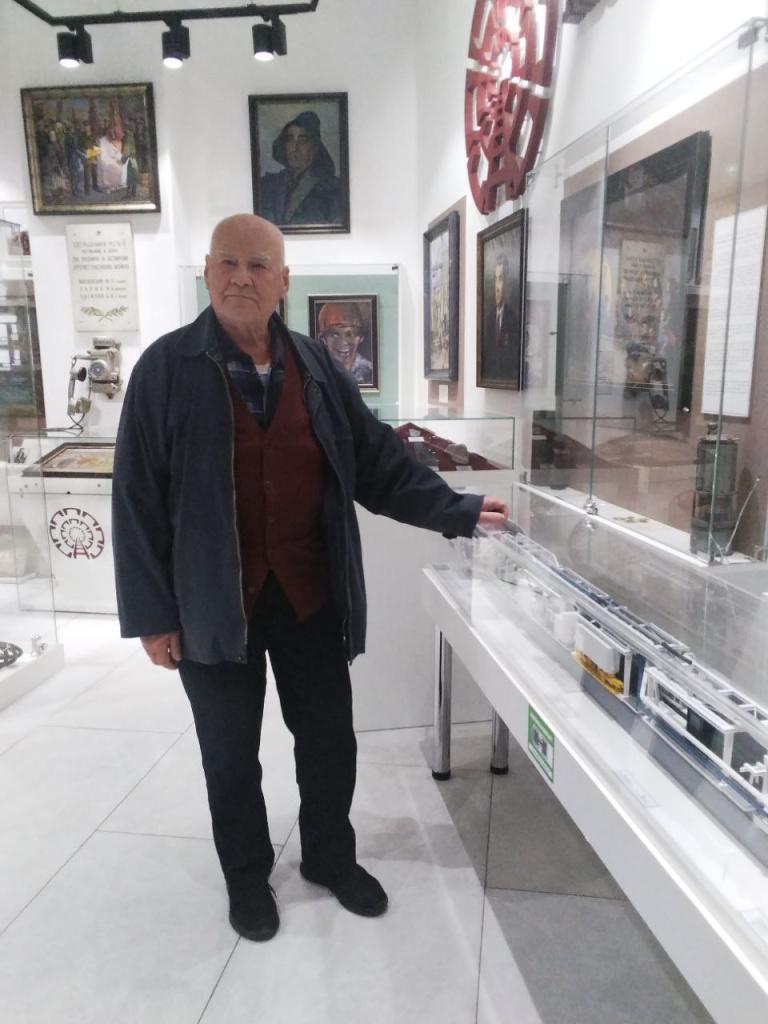
The life story of Anatoly Polosin
When Anatoly Polosin entered the editorial office, I couldn’t believe my eyes: standing in front of me was not an elderly man of 94 years old, but a strong, youthful man of about 60 years old with a clear look and a smile on his face. He apologized for being late: he had not been on Tsvetnoy for a long time and did not realize that he should have thought about parking in advance: it turned out that Polosin arrived for the interview in his own car!
All the prepared questions disappeared by themselves. What came out of my mouth was: “How?!” Either jokingly or seriously, Anatoly Alekseevich replied: “The advice is simple. Women, don’t fry on the Sochi beaches, relax underground.
I haven’t seen the sea for 70 years: we worked on Saturdays and Sundays and spent almost all the time in the mine. I think my body was preserved by working underground: the temperature there is 7 degrees...
I didn’t overuse it, although there were occasions every day: someone had a wedding, someone had a birthday, a launch. The director was always invited. When I felt my tongue was going numb, I left in English. When I was appointed director of SMU-1, the head of Mosmetrostroy, Pyotr Vasyukov, said: “We know that you are a sober person, you never lose your head, you are independent. Hold the team tightly."
Half a century underground
In Metrostroy, laureate of the USSR State Prize, holder of two Orders of the Red Banner of Labor, the Order of the Badge of Honor, and the Order of Honored Builder of Russia, Anatoly Alekseevich Polosin worked for 50 years. He came in 1951 after graduating from the Yelets College of Railway Transport with a degree in bridges and tunnels.
“To Metrostroy,” said Anatoly Polosin, “they sent 12 people - a whole group, gave them military uniforms and lieutenant shoulder straps, we really liked it. I ended up in SMU-6, for the construction of the Smolenskaya station. Just at that time, water broke into the mine. So on the very first day of work I was “baptized” with ice water in difficult geological conditions.
The head of SMU-6 at that time was Dmitry Lazarevich Stern. For me he was God. I was 20 years old, and his fame was thundering throughout the country. A man of great intelligence, qualified, honest, punctual, demanding. They were afraid of him, but they listened to him and respected him. He cared about people in a fatherly way. I experienced this myself: when in the first days of work I could not get into the dormitory, Stern allowed me to spend the night in his office.
During the construction of the Smolenskaya station, young specialists - Alexey Kryukov, Boris Frantskevich, myself and others - went through a good school, received strong training and gained invaluable experience.
Polosin always tried to work conscientiously - on duty, as a shift supervisor. He had two faces under his command. His success was noticed by the correspondent of the newspaper “Metrostroyevets” Margarita Petrovna Nevolina and took patronage over the leader. She talked about her achievements and printed photographs.
After Smolenskaya there were the Sportivnaya, Frunzenskaya stations, caissons, Taganskaya... At Taganskaya, Yuri Anatolyevich Koshelev became the head of SMU-6, who relied on the young.
–I, – explained Anatoly Alekseevich, – studied in absentia at MIIT, received a diploma, and I was immediately appointed head of the section. Yuri Anatolyevich taught us not only how to lead a team and construction skills, but also to love life, the main thing is to love Metrostroy.
I have other pleasant memories associated with Taganskaya. I remember when the professors looked at my graduation project for the construction of the Taganskaya station, they said: “Yes, your project can go straight to construction!” “I’m already building,” I answer, “I’m doing the finishing.” And he invited them to his station. Received an excellent grade.
When Yuri Anatolyevich left for promotion, SMU-6 was headed by Nariman Aleksandrovich Prostov. In appearance he was gentle, but in his work he was demanding, even tough. I was already the chief engineer. We worked together with Nariman Aleksandrovich and were ready for any promising changes.
SMU-1 created from scratch
In 2003, as a result of the merger of the subsidiary enterprise SMU-1 Mosmetrostroya and the subsidiary enterprise SMU-14 Mosmetrostroya, LLC SMU-1 Metrostroy was organized, headed by Polosin. The team had to be created from scratch: the newly appointed boss had neither people nor a base.
Anatoly Alekseevich quickly found engineering and technical workers: he took some from SMU-6, some from other divisions. The main thing is that competent, proactive engineers came: Igor Buchinsky, Sergey Moiseenkov, Vladimir Sosnovsky, Valentin Strogonov, Valentina Razumova, Tatyana Pustoplesnova and others.
–For me, the main thing when forming a team, said Polosin, was work activity and the ability to work in a team. Without these qualities, it is difficult to find yourself, receive satisfaction from work and be useful to the team.
When the engineering staff was recruited, all that remained was to find workers. The decision came immediately: Polosin sent personnel department specialists to military units. Soon about 400 demobilized soldiers and sailors came to SMU-1. Polosin himself talks about that period as follows:
–When we organized SMU-1, Nina Sverchkova, now my wife, came to the personnel department. I sent her to military units to agitate those demobilized for Metrostroy. She was 35 years old. Gorgeous. She recruited an entire battalion of military sailors. Everyone arrived on the same train, we met them. I couldn’t hug everyone, but I managed to hug the first ones.
From then on, for all their needs they went not to me, but to Nina. It was she who told me who should be given an apartment, who should be sent to a sanatorium, who should be placed in a kindergarten. And I complied with her requests. Until now, when people meet her, they thank her for her attention and care.
Polosin led SMU-1 for 25 years. Its specialists built stages in the area of the Sviblovo station, Orekhovo, Shabolovskaya, Teply Stan, Pechatniki, and Maryino stations. Wonderful complex teams worked in Polosin’s division: Eduard Arushanov, Viktor Shiryaev, Vyacheslav Sochkov, Gennady Lelyanov and others.
One of the last stations SMU-1 “Timiryazevskaya” is the only single-vault deep station in Moscow. Excavators, bulldozers, and electric forklifts worked at a depth of 60–70 meters. In terms of production work, Polosin considers it unique:
–“Timiryazevskaya,” Anatoly Alekseevich is convinced, “has been undeservedly passed over for recognition.
Favorite station “Nagatinskaya”
Every metro builder has a favorite station. For our hero it is “Nagatinskaya”.
–At “Nagatinskaya,” recalls Anatoly Alekseevich, “my energy, skill, and experience showed up. For the construction of the Nagatinskaya station with a metro bridge, I became a laureate of the USSR State Prize. Construction, one might say, began in an open field. Or rather, in an abandoned and swampy area where pigs were grazed. To connect the new building with the Avtozavodsky district, a bridge was built over the Nagatinsky straightening. I made approaches, the area came to life and today, in my opinion, it is the most beautiful.
People spoke enthusiastically about our work, they knew me by sight. I remember my wife and I came to a restaurant, and its visitors filled our table with gifts. It was at this station that I made a vow to myself: I would never leave Metrostroy. But at that time I was called both to foreign intelligence and to the virgin lands as the director of a state farm. But I felt and saw how people need the metro, how they are waiting for the opening of new stations, what role Metrostroy plays in this and how much the country needs it.
Anatoly Polosin participated in the construction of more than 15 metro stations and tens of kilometers of tunnels. For eight years he worked in the Administration of the North-Eastern Administrative District of Moscow. Under his supervision, the Severnoye Medvedkovo microdistrict was reconstructed, about 30 new residential buildings were erected, and 50 five-story buildings were resettled.
The chief accountant's denunciation was checked for six months
One day Polosin found out that his chief accountant was involved in extortion: “If you supply a bottle,” he told the next miner, “you will receive a salary.”
When Anatoly Alekseevich found out about this, he fired the chief accountant.
“In retaliation,” Polosin calmly recalled, “he wrote a denunciation against me that I was drunk and taking bribes. The slander fell on Mikhail Sergeevich Solomentsev, at that time the chairman of the Party Control Committee under the CPSU Central Committee. He instructed the colonel to check everything.
Six months later, the colonel called me and the chief accountant to his place. “We,” he said, “interrogated 200 witnesses and thoroughly checked every point of the accusations. No facts were found discrediting Director Polosin. We congratulate Comrade Polosin on this and wish him success in his work. And you,” the colonel turned to the chief accountant, “if you take up paper again and slander, we will hide you somewhere where you won’t find even a piece of paper.”
When we left the colonel, the chief accountant fell on his knees in front of me: “Sorry,” he said, “I don’t even have enough to drink. Help." I wrote him 300 rubles and let him go.
They were statesmen
Anatoly Alekseevich respectfully recalls the heads of Metrostroy with whom he worked:
–I was lucky enough to work with Nikolai Alekseevich Gubankov, Vasily Dementievich Polezhaev, Pyotr Aleksandrovich Vasyukov, Yuri Anatolyevich Koshelev, Nariman Aleksandrovich Prostov - an amazing person and an excellent specialist.
Knew Gubankov poorly, he was still a young man, Polezhaev - well: he had both a soft and a hard hand. If I filmed someone, I made sure to explain why. We loved him, when we found out that he was dying, we were shocked. Respected Pyotr Aleksandrovich Vasyukov. We were friends with Yuri Anatolyevich Koshelev to the last. Koshelev is powerful, tough, but fair. Will never offend anyone. The main thing is that I didn’t let Metrostroy collapse. I am proud that I worked with these people in such an illustrious team for more than 50 years.
I remember how Koshelev and I argued with Yuri Luzhkov over the monorail, trying to prove that its construction was inappropriate. At that time I was building the metro line at VDNH. All that remained was to complete it. But Luzhkov cut it down and built a monorail between Timiryazevskaya and VDNKh, ruining the entire area. Today it is clear to everyone that it has not become a full-fledged form of public transport.
90s blew up Metrostroy
Polosin spoke with bitterness about what happened to Mosmetrostroy in the 90s.
–What happened at Metrostroy after Koshelev—parasitic private property—is a disaster: failures, theft, looting and betrayal. By the way, in order to protect her, they even prepared a letter to higher authorities; they asked me to sign it, but I didn’t. I welcome the transfer of Mosmetrostroy to the state.
Private property is not suitable for the Russian people. In China, for example, it exists, but at a certain level. In Russia, strategic industries and production must be owned and managed by the state.
Mosmetrostroy used to be a state within a state. In each mine there was a first-aid post, a canteen, and after lunch at the face there was a 15-minute rest. I noticed that after a snack people rest. Since then, I tried to create a nook in the mine next to the dining room, in which one could have a snack, relax, and talk. This has become the norm.
Metrostroy had a powerful social policy. We built housing for workers: for example, I live in a house that I built myself, the houses are beautiful, everything is landscaped, like in the Kremlin. We had an excellent House of Culture, a museum, a medical unit, sanatoriums, clubs, technical schools. Now there is only a children's summer camp left - thanks to the former general director of Mosmetrostroy Sergei Anatolyevich Zhukov, he defended it.
I found out my ancestry in the early 90s
Polosin's parents come from a remote village where only namesakes lived.
–When Peter the Great was building a fleet near Voronezh, explained Anatoly Alekseevich, for some merits he gave the village the name Polosin. My grandfather headed the church parish. One of his brothers was a general under Nicholas II or I in St. Petersburg - I don’t remember exactly. And the portrait of the third brother still hangs in the corridor of the Russian National Research Medical University named after N. I. Pirogov (RNRMU named after N. I. Pirogov) as one of the founders. During the revolution, the general was shot, my grandfather and grandmother were either shot or exiled.
My father hid this from me. I learned my ancestry only after 1990. The father was a war invalid. When he returned, he was appointed chairman of the collective farm in the village of Svishni, Novolukovsky district, Lipetsk region. He wanted to join the party, but, as an enemy of the people, he was not accepted and was asked from the chairmen. He worked there as an accountant until the end of his life.
Mom was a workaholic. She worked on a collective farm, on our farmstead. We kept a cow, pigs, sheep, chickens. I followed them too followed. When everyone was plump from hunger, we ate well.
I remember in our village, on the Kursk Bulge, military convoys were formed. I, a 10-year-old boy, brought water in flasks to the Red Army soldiers, and for this they treated me to something. When I asked my mother what it was, she said: “Sugar, eat it.” The second time I started eating sweets was at the age of 19, when I arrived in Moscow.
They prescribed statins for cholesterol, but my cholesterol remains low no matter what I eat. The doctors don’t believe it and say that this can’t happen. I answer: you don’t understand anything. Immunity is developed in childhood. As a child, I watched both cows and pigs. The meat was sent to the state, and the bones were kept for themselves. I loved beating the brains out of them, which supposedly increases cholesterol, and I created such an immunity that nothing can take me. True, 50 years underground took its toll on my legs. No matter how I treat them, nothing helps. Maybe walking: it saves you from many diseases. If I lie down for a long time, I begin to walk poorly.
Of course, my wife, with whom we have been together for 40 years, and children support me. We have four of them: two of mine and two of my second wife. We live together, we don’t divide our children into ours and those of others. And at the dacha together, in the fall we go to the Belaya Rus sanatorium, where we have a wonderful rest. I know many sanatoriums, but there is no such infrastructure as there.
I remember my native Metrostroy, whenever possible I visit and with pleasure meet those who have not forgotten me.
Natalya Dolgushina