We are not losing the brand of the workshop
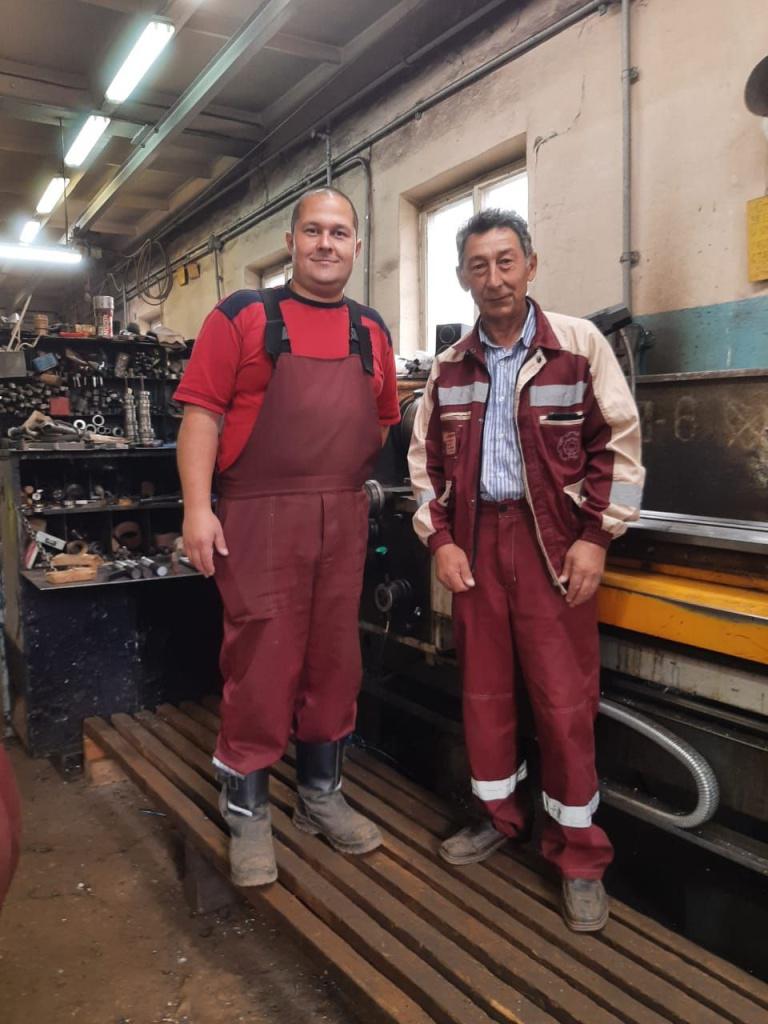
Ibragim Fayzullin has been serving Mosmetrostroy for almost 30 years: in 1995 he came as a turner, since 2011 he has been the head of the workshop. And while he is here, “in SMU-6 everything is spinning and spinning,” as First Deputy General Director of Mosmetrostroy Mikhail Arbuzov explained to the high commission that came to SMU-6 to get acquainted with the implementation of the contract and the working site of the mechanical shop.
Safety instructions are written in blood
There is something to see. A pile of, at first glance, scrap metal - the most valuable mechanisms that support the work of all metro construction services - from tunneling to the SMU and Management - are temporarily out of order.
For example, a “barrel with a lid” is SO-241 - a primary injection mortar pump, a “barrel on wheels” is SO-50AM - a control injection mortar pump. They are used after penetration - “driving the solution behind the tubing.”
There are many reasons for breakdowns: the electric motor may burn out. If the blades break in the SO-241, then the diaphragm breaks in the SO-50AM. It happens that the human factor comes into play: if the unit is dropped when moving it to a new location, some unit becomes deformed. Repairmen will inspect each mechanism, make a diagnosis - and get to work.
“You can’t imagine how many times we repaired each of them and brought it to fruition,” the workshop manager, Ibrahim Akhmetchatovich, answered my silent question. – From two non-working winches, you can make one working one. And so with every mechanism. You should never scrap something that can still serve you.
And this is not the only rule of Ibragim Faizullin. He takes his work responsibly. He teaches this to his repairmen and his son Ildar, who works at SMU-6 under his supervision. The main thing is to follow safety rules. You need to hold the tool in your hands so that, if something happens, it does not cause a wound - take care of your arms, legs and stomach so that the grinder passes you by, the disc fragments do not hurt you, and the file does not get into your hand or stomach. Even if you tighten the key, your hand should pass by. When you get to work, have a meter of free space behind your back so you can take a step back. These rules are written in blood.
Ibrahim also refers to the atmosphere in the team as safety precautions. Does not allow any squabbles or hostility. At first there were such cases, but he punished the entire team for swearing. The “old people” especially suffered: they were unable to influence the youth and stop the conflict. If a young blacksmith messed up, his experienced mentor received a reprimand: he could not really explain what and how to do correctly.
He doesn’t tolerate “yesterday’s”: if you have trouble standing on your feet or can’t focus your eyes, it’s better to go home and get yourself in order. The next day, such a comrade will write an application for leave at his own expense. If he can’t cope, it’s better to let him quit: he’ll remain intact, and the management won’t let him down under the article.
And no one is offended by their boss: they know that they will not punish anyone in vain, they will sort everything out and regulate the work process so that everyone can work and be able to do it.
Two long-lived inventors
– “For 30 years,” said Ibragim, “Igor Ermolov, a mining equipment installer, helped me a lot. He has been working in the shop for 32 years; he came here after graduating from vocational school. He and I are long-lived. We went through difficult times. They worked despite the delay in wages. The equipment was being repaired: I knew that sooner or later it would be needed. And so it happened. Today the workshop is working normally, there are orders.
Ibrahim Fayzullin and his right hand Igor Ermolov have made several rationalization proposals over the years. For example, factory-made pumps work well, but if they break, they are difficult to disassemble and repair. And they figured out how to fix it.
Anatoly Adadurov, then deputy director of SMU-6 for production, was surprised when he saw how the repairmen improved the mortar pump for primary injection, from which the mortar flowed through the coupling. At the factory, the “hole” is welded, which is inconvenient for repairs, but the guys made it so that the cement laitance does not leak out, and the pump became easy to disassemble.
Another example. Grouting discs for grinding concrete on which waterproofing is placed are bought for dollars in Canada, and Ibrahim and Igor came up with a device that does the same thing, but “for rubles.” Igor has been helping Ibragim Akhmetchatovich solve complex problems for 30 years: the shop manager knows that if he says it, Igor will do it.
Recently, frames, a crane for the approach adit to the Dostoevskaya station, cable brackets for Fili have been made in the mechanical shop; welding and drilling work is required here. Mandrels are made on machines, either the holes do not match, the bushing is worn out, the pin is broken, or the bolt has a non-standard thread.
Turners turn everything and lubricate it. They will clean the crack with a grinder and weld it: they have electrodes for cast iron, aluminum, and steel. Some parts can only be made by hand. The protective casings of control discharge pumps often break: they are made of brittle steel-graph paper. The blacksmith straightens everything, or cuts out and installs a new casing.
–We are not losing the brand of the workshop, says Fayzullin Sr.
The craving for iron has won
The head of the workshop does not make any concessions to his son Ildar, who after a short hesitation followed in his father’s footsteps, but makes him a real blacksmith. When he was still a schoolboy, he brought his son to the workshop. The boy liked it here, he enjoyed watching the turners at work, loved working with pieces of hardware, and as he grew up, he became interested in motorcycles and cars. Although my first education is as an ambulance paramedic - a tribute to my mother, a nurse. He served as a paramedic in the army. When there was no blacksmith at SMU-6, the father called his son to come to him. Before he was admitted to the machine, Ildar graduated from the training center. Now he can do everything. He makes brackets and blades for pumps, the design of which the shop craftsmen also changed: they made them convenient for repair. The son has adopted everything from his father, but has not yet caught up with the children: the father has three of them, the son has two daughters so far.
Ibrahim, jokingly, complained about his son: “He comes to me, tells me, he, you see, has his own ideas. And you can agree with them. Sometimes I tell the guys: Ildar will come, as he says, we will do so.”
He recently made a unique bucket for the subway drainage system. Water should be drawn into it and poured out. Millimeter steel had to be bent so that everything would work. And Ildar did it.
“The volumes of work and objects we have are varied,” explained Ibragim Fayzullin. – We repair shutters, make boxes for documents like mailboxes. They are also made of thin metal. Client: Metropolitan. Ildar does everything with high quality, the customer likes it, and there is no need to redo it.
Pioneer Akhmetcha Faizullin
Ibrahim’s sense of duty comes from his father, Akhmetch Khamidulovich, who, on a Komsomol trip from distant Siberia, went as a miner to Titano-Magnitka near the city of Zlatoust to mine titanium carbide. Then the miners were offered to go to the city of Miass: a new lime quarry was opening there. When melting metal, limestone is used to separate slag. And the country really needed metal, especially during the war. Therefore, the lime quarry, like Metrostroy, also recruited Komsomol members by conscription. So Ibrahim's father is also a pioneer. During the war he had a reservation. When the norm for limestone extraction was 10 tons, he extracted 50. His fingers did not bend.
Ibragim Faizullin’s mother, Khayat Khadyevna, worked in the quarry loading. And her father, a tall, strong man, managed not only to exceed his quota, but also to help her during loading. And when the beautiful Hayat Khadyevna fell ill with malaria, Akhmetcha Khamidullovich carried her to the slaughterhouse in his arms for two months, fed her, and looked after her. Two children, born 37 and 39, were left at home alone. Dad left them food and two tins to go as needed.
“They told him more than once: hand her over somewhere, she won’t survive anyway,” recalled Ibrahim Akhmetchatovich. “My father sent people like that to hell.” And he left my mother.
He recruited boys into his brigade whose parents had gone to the front. When their hands were cold, I took off my mittens and gave them to them. They shared every piece of bread they received with a ration card. Many could not stand it and ran to the front: work in the quarry was hard...
When modern technology began to develop, my father completed courses on a “cube” - a cable-percussion drilling unit - to become a driver.
In retirement he was involved in social activities. He was a judge, and many people turned to him for help.
Mom felt sorry for everyone. Children from disadvantaged families lived with them in winter. Their mother washed them, fed them and looked after them until their natural mother came out of her drinking bout.
Missed the sailors
Ibragim Faizullin was born in the city of Miass, Chelyabinsk region, where Ural cars are produced, in a large family: his parents had 9 children. After school he entered the Sevastopol Naval School: his older brother served in the Northern Fleet, another graduated from the Leningrad Higher Naval School named after M.V. Frunze. Ibrahim also wanted to become a sailor. But he didn’t. Nobody knows where the family’s attraction to the sea comes from: dad never saw the sea, but he ideally made mast ships with sails for little Ibrahim.
The second attempt - to enter the Chelyabinsk Agricultural Institute - was also unsuccessful. The older brother warned: “Don’t take the cheat sheet, you have a smart head.” And during the math exam, Ibrahim was asked to give it to someone. Which is what he did. The examiners did not sleep: the chain was tracked and all participants were expelled.
Ibrahim returned to his father's house. Helped parents with housework. In September, he submitted documents to the Research and Production Association, where he was accepted as an apprentice turner. He didn’t waste his time: he went to a driving school and received a category C driver’s license. In 1978, he repaid his debt to his homeland: he served in Estonia in a training regiment in the engineer troops. Six months later he was assigned to Lake Khanka in the Primorsky Territory. He served as a mechanic-driver of a stacker and went home as a gunner.
Ibrahim was lucky in his life to have good people who gave good advice. One of them is to work and study at an evening technical school. Take exams in military uniform. He did just that.
I came for my math exam and my badges were as shiny as the Generalissimo’s. He was asked if he wanted to study. Ibrahim wanted. And he was allowed to take the next exam - the Russian written one.
Ibrahim’s niece found essays on various topics and helped sew pockets on the uniform, in which they put the essays. “I came to the audience and took a ticket,” says Ibrahim with a chuckle. – It has three themes. One of them is in my breast pocket. Of course, I copied everything I needed, and they didn’t make any comments to me. This is how I received a student ID as an aircraft engine mechanic-technologist. Everything was connected with the secret Sarmat missile. The year was 1981. I got involved in my studies, studied with interest the course of higher mathematics according to Zaitsev, and aircraft - according to Yangel. He studied purposefully and defended his diploma with honors.
Long way to Metrostroy
Ibrahim came to Moscow thanks to his future wife Gulnur Khametovna. During the war, her relatives were evacuated to the Urals with the ZiS plant where they worked. We met Ibrahim's parents. When we returned to the capital, we invited him to visit. He arrived, talked to their daughter, and they started having a “shurum-burum” conversation. Gulnur didn’t go to the Urals; she had to move to Ibrahim.
In the Urals, he worked at NPO Elektromekhanika. Participated in competitions for machine operators, formed under the auspices of the Ministry of Medium Machine Building, and took second place. The diploma he received helped him get a job at the Union Research Institute of Instrument Making from the Ministry of Atomic Industry as a turner. Instruments for submarines, icebreakers, and nuclear power plants were manufactured there. Measuring instruments were made for Chernobyl to determine the level of radiation. The device was lowered into the reactor on a cable, and with its help, scientists found out the temperature in the reactor. The devices burned out like matches. Turners spent several weeks, without leaving work, making these devices so that scientists could monitor the processes in the reactor in real time. At SNIIP, Ibragim Faizullin was awarded the title “Veteran of Labor” - for several rationalization works.
“Turning,” said Ibrahim, “I was good at it.” During a shift I managed to make two or three parts, although according to the norm it should take eight hours to complete.
When we switched to self-financing and there were fewer orders, the shop manager suggested that I go to the OGM - Chief Mechanic Department, where they repaired machines. I could make a part of any complexity.
One morning I came to work and there was a whole delegation in our workshop. A woman and a man in a white coat show me a broken part from an American device. They say the same one needs to be turned out. It turns out that in the hospital on Peschanaya Square there are patients on artificial kidneys. And the device broke down. It must be restored within three hours.
I look: this part has six inputs and outputs at different angles. It’s good that they also brought the parts that screw into these holes.
I assessed the complexity of the work, figured out how to do it, and completed it in two hours. Made it from bronze. Thank you, the men helped: they sharpened the incisors.
When the shift was over, one of the men at the checkpoint pointed at me to a couple and said: “This is the one who saved the lives of your parents.”
When the children - and Ibragim, besides his son Ildar, had two daughters, Ilmira and Ilnura, had to go to school, there were no orders at SNIIP, and salaries were delayed. The former head of the personnel department of the Petukhov Institute, who went to SMU-6 of Metrostroy, began to agitate the virtuoso turner to follow him. Ibrahim agreed. The year was 1995.