Sergey Kamyshov: my awards are my stations
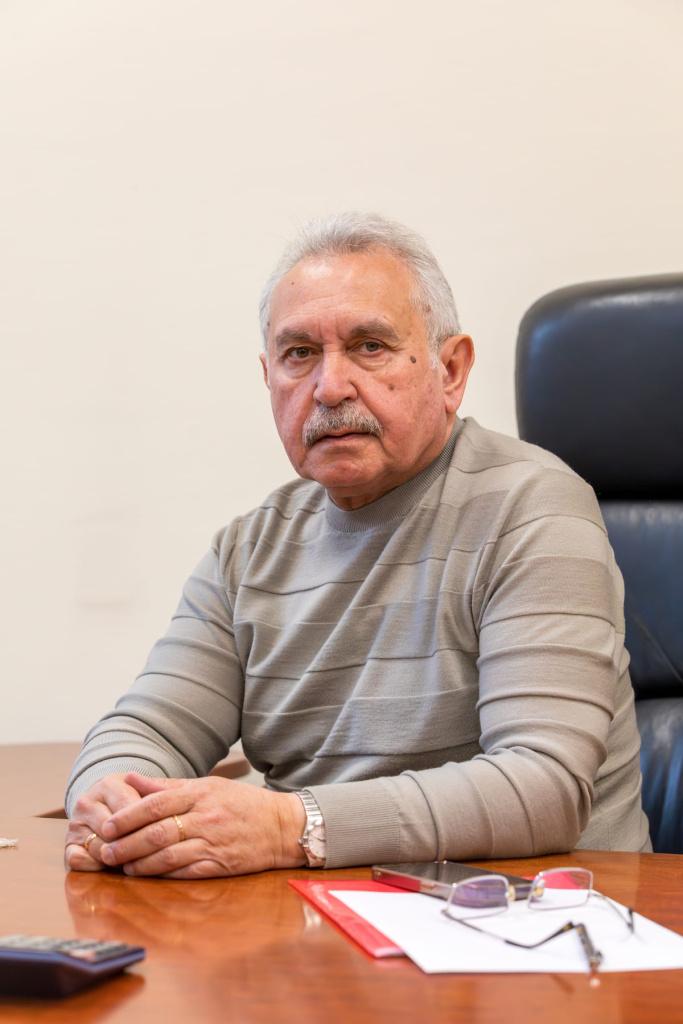
Deputy General Director of Mosmetrostroy Sergey Kamyshov is a metro builder with 47 years of experience. Laureate of the Prize of the Council of Ministers of the USSR, Honorary Builder of Moscow, Honorary Transport Builder of the USSR, Honorary Builder of Russia. He built subways in Tashkent, Leningrad, Chennai (India) and Moscow. Knows everything about him. If in Tashkent Sergei Georgievich built 7 stations, then in Moscow - more than 20. On March 25, 2025, he retired. She dreams of traveling and cheering for her favorite hockey team, CSKA, wherever she plays. He has such experience: Sergei Georgievich repeatedly shouted “hurray” to our hockey players from the stands of different cities and countries.
They didn’t speak Uzbek in Tashkent
Sergey Georgievich comes from the Uzbek city of Almalyk, a famous mining and metallurgical plant of Union significance, where mainly non-ferrous metals were mined. The 120 thousand population of Almalyk was practically Russian-speaking. The City Executive Committee was headed by a Russian, and the first secretary of the City Committee was an Uzbek who spoke excellent Russian.
Sergei Georgievich’s father was the chief accountant of this plant, and his mother was a pediatrician and was in charge of the clinic.
“When I graduated from school in 1973,” he recalls, “my dad dragged me to the financial and economic institute, and my mother to medical school. And I said that I wanted to build a metro: in Tashkent they started talking about its construction as part of the plan for restoring the city after the 1966 earthquake. As a schoolboy, I paid attention to posters calling for the construction of the Tashkent metro, and saw fenced areas with a large letter “M”. She probably hooked me.
I can’t understand how I managed to convince my strict father, but I entered and graduated from the Moscow Mining Institute in 1978. Became, as it is written in the diploma, a mining civil engineer; specialization - “construction of underground structures for special purposes.” First, I was sent to the Tuva Autonomous Soviet Socialist Republic to work in cobalt mines, then to Tashkent.”
Sergei Georgievich worked on the construction of the metro in Tashkent for 20 years. He worked his way up from a mine surface foreman to the head of the SMU. It’s amazing how quickly time passed: in 1978 I started working, in 1981 I was already the head of the site, in 1985 - the chief engineer and in the same year - at the age of 29 - I became the head of the SMU.
“The Tashkent metro,” says Sergei Georgievich, “is mainly of shallow construction. The geology there is very complex and the rocks are unstable. The most difficult thing is to build a reliable foundation pit. Tashkent stands on clay. If water does not get into it, it will stand for centuries. As soon as water gets in, the clay begins to flow, and it happened that pits collapsed.
The stations are beautiful. Various architects worked on them; several stations were built by Lithuanian specialists. If you are there, visit the “Prospekt Kosmonavtov” station, “Alishera Navoi”, where more than three kilograms of gold leaf were spent. Very beautiful station.
At that time, no one spoke Uzbek in Tashkent. There were two such cities in the Soviet Union: Tashkent and Baku. A very bright, kind, good time.”
The Aybek station was assembled like a construction set
“I,” Kamyshov continued the story, “was the head of the station at the Aybek station, named after the writer, poet and translator Musa Tashmukhamedov. “Aibek” is his pseudonym. His son and his grandchildren and great-grandchildren came to the launch of the station. We were very pleased.
For the implementation of a new technical solution, the station received the Prize of the Council of Ministers of the USSR. We assembled it like a designer in eight months: we assembled 4-6 volumetric structures - three meters of the station are ready. This method was invented by scientists from TsNIIS - the Central Research Institute of Transport Construction, Igor Dorman and Valery Merkin. About 10 people became laureates of the Prize of the Council of Ministers of the USSR and received 800 rubles each: in 1988-1989. an impressive amount. After us, no one received such awards.
When the USSR collapsed, problems began in Uzbekistan with cast iron, which was produced in the Union at three factories: Lentrublit, Dneprotyazhmash and the Ural Heavy Engineering Plant. Then the Tashkent Tractor Plant developed its own - the most advanced at that time - machine for the production of tubing. If at Lentrublite cast iron was poured into the ground and the workpiece was polished for a long time on machines, then at the Tashkent Tractor Plant cast iron was poured into a mold and almost finished tubings were refined down to the micron on a machine. They were of exceptional quality and assembled like toys.”
No one has surpassed Lenmetrostroy's world sinking records
In 1998, the head of Tashmetrostroy, Gennady Yakovlevich Stern, moved to Moscow and a year later became head of Mosmetrostroy. Several specialists went after him.
Sergey Kamyshov went to work at Moscow Metrostroy on July 1, 1998 to the position of deputy chief engineer of SMU-15. Its first object is the Kutuzovskaya transport interchange.
“I arrived,” he says, “when everything was just beginning. Then there was the 940th mine on the central section of the Lyublinsko-Dmitrovskaya line and part of the Annino station.
When I turned 50, Gennady Stern suggested that I take up engineering in the construction of the Serebryanoborsky tunnels. I had to master engineering systems, ventilation, drainage, fire alarms, etc.”
On March 1, 2006, Sergei Georgievich became deputy general director of Mosmetrostroy.
Over the years of his work in the metro, construction technologies have changed a lot.
“If,” he recalls, “in 1978 we were excavating with hammers using block laying machines and covered a maximum of 4-5 meters per day, then modern German tunnel boring machines from Herrenknecht AG, on which we work, go at a speed of 20 rings per day.
Any mining or tunnel boring complex is created in relation to the geological features of a particular site. For example, we spent six months building a metro in India in the city of Chennai, formerly Madras. According to the scale for determining the rock strength of professor of the Moscow Mining Institute M.M. Protodyakonov from 1 to 20 units, 1 is, conditionally, sand, 19 is corundum, and 20 is diamond. In Chennai, the bed of the tunnel, the chute, reached the fortress 15. Such rocks are passed mainly by explosive methods. But the Indians are conservative guys, they weren’t allowed to blow things up in the city, so in Chennai they made us as many as four shields: in a rock of such strength they quickly became unusable.
For the sake of truth, I will say that two world records for penetration, unsurpassed so far, by Leningrad metro builders were made with shields produced by the Donetsk Yasinovatsky plant: 840 and 1040-1080 meters per month. As a student, I worked there at the Grazhdansky Prospekt station, and the guys told me how these world records were made: the entire Lenmetrostroy worked for them.”
A wetsuit won't save you
Sergei Georgievich believes that the miners in St. Petersburg have ideal conditions: “They say,” he explains, “the city was built on a swamp. So it is on the surface, and the metro is being built at a depth of 70-80 meters. The trunks in St. Petersburg are much deeper than in Moscow. At this depth there is a large thickness of Cambrian clays of a bluish-lilac color. To catch this layer, you need to be an experienced miner. If you catch it, it will be easy to work; If you don’t catch it, you’ll have to suffer with a jackhammer: the soil there is on the M.M. scale. Protodyakonov 4-5 units. But not a drop of water seeps through this clay. The only thing where it is difficult in St. Petersburg is when the metro route goes from a deep part to the surface, from closed areas to open ones, or when a train leaves a depot - there they actually cross quicksand and swamps.
During my student internship, I had to work on the shafts of the Raspadskaya and Kuzbassrazrezugol mines in the city of Mezhdurechensk, there was so much water there! No matter what wetsuits the miners put on, there is no escape from it: it flows along the walls, splashes from all sides. You come to the surface, and your boots are full of water. In Moscow, too, you rarely find yourself in a dry area.”
A city with a million population needs a metro
“The construction of the metro,” Sergei Kamyshov is convinced, “is a necessary and important thing. Moscow, for example, would choke without the subway. It, of course, must be built at a high pace, but within a realistic time frame. And in this matter we need to listen to metro builders: in Soviet times, 5-6 stations were built per year, with a maximum of 9.
There are many million-plus cities in the country that need a metro: Saratov, Samara, Nizhny Novgorod, Kazan. And there it is being built at a meager pace. About 10 years ago I went on a business trip to Novosibirsk. They made one line and wanted to extend it. We discussed everything, but there is no money for it.”
Sergei Georgievich spoke about a problem related to the metro, unusual for modern people: “In Chennai, with a population of more than 13 million, there was no metro. I saw with my own eyes trains and buses, surrounded by people on all sides. It's unclear how they held up. Plus everyone has mopeds, motorcycles, bicycles. Underground transport was necessary. But the managers of the metro construction explained: “Building the metro is half the battle; you need to decide how to let people into it: they are so dark that they are afraid to go down into the metro.”
Something similar happened in Tashkent. My wife worked at an institute where Uzbek women worked and said: “After the metro was launched, one Uzbek woman invited her mother-in-law to go down to the metro - the entrance was next to the house. And she answered: “So that I can go underground with my feet?!” Only after death."
Preserving traditions is sacred!
Sergei Georgievich is proud that Mosmetrostroy preserves and enhances the traditions of its predecessors: “This is sacred,” he believes. – The work of the Council of War and Labor Veterans of Mosmetrostroy and its chairman Boris Prigoda is invaluable here. Every year, our veterans lay flowers on the graves of the legendary leaders of Mosmetrostroy, visit memorials to the defenders of the Fatherland in 1812 and 1941-1945 in Borodino, meet with Afghan metro builders, descendants of honored pioneers, Heroes of the Soviet Union. Boris Filippovich puts all his energy and soul into this business. Recently he gave me an award from the honored metro builder Grachev, who has not worked for ten years, but should receive an award for conscientious work. When the opportunity arises, I will, of course, hand it over.
Many thanks to the former general director of Mosmetrostroy Sergei Zhukov, who now heads Mosinzhproekt. Sergei Anatolyevich achieved the establishment of Metro Builder's Day. He is fighting for a monument to metro builders to be erected in Sokolniki. He not only initiated the publication of books dedicated to the pioneers and his predecessors, but also set up a museum in the former wardrobe. Several interesting exhibitions have already been held there. Sergei Anatolyevich ordered to take out from the storerooms paintings painted by metro builders in 1930 - 1950, Nina Leonidovna Manizer, daughter-in-law of the famous sculptor Matvey Manizer, Honored Artist of Russia, restored them. The opening of the exhibition “Under the Wing of Metrostroy” was attended by the descendants of those depicted in the paintings of Vasily Polezhaev, the head of Metrostroy in 1958-1972. and the hero of the Soviet Union, metro builder Ivan Vishnyakov.
Not going to sit at home
For 47 years of experience in metro construction, Sergei Kamyshov has one award - the Prize of the Council of Ministers of the USSR. True, when he arrives at the Annino station or drives through the Serebryanoborsky tunnel, which he built, he believes that they are his rewards. No others are needed.
Although there is a question for legislators: why does the title of laureate of the Prize of the Council of Ministers of the USSR not give privileges, for example, to increase pensions? Someone thought that the USSR Council of Ministers Award was not governmental and did not include it in the list of state awards. Kamyshov believes that this is a mistake: isn’t the Council of Ministers of the USSR a body of state executive power of all-Union significance?!
Sergei Georgievich is not going to sit at home: “I,” he shares his plans, “love trips, new places, traveling. I traveled all over Europe and realized that there are many beautiful places at home too! In Karelia I reached Medvezhyegorsk, traveled through the Smolensk and Pskov regions, and visited Valdai and St. Petersburg. I noticed how beautiful our roads are.
I love hockey, I support CSKA. I attended all the world championships; my wife accompanied me on my trips. My team plays with Khabarovsk “Amur” and Vladivostok “Admiral”. I have not been to these cities yet. So I’ll fly to the matches: I’ll see the cities and see the hockey.”
Natalya Dolgushina