The breaking of the blockade has come nearer
Under the leadership of the Hero of Socialist Labor Ivan Zubkov, they began to build a metro in Leningrad, erected defense structures, and laid roads under the blockade. And yet, the outstanding builder received his first experience as an engineer in Moscow.
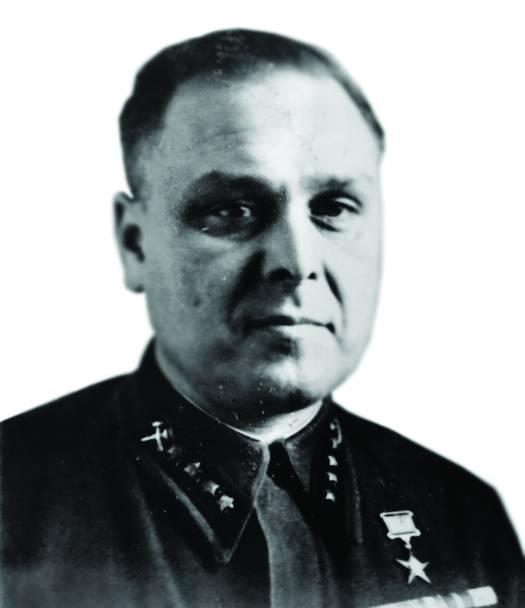
Portrait of the Hero of Socialist Labor Ivan Zubkov
Don Cossack Ivan Zubkov was born on July 26, 1904 in the city of Essentuki. Before the revolution, he graduated from the cadet corps and the first workers' faculty at the Polytechnic Institute in Tiflis. Choosing his life's work, he followed in the footsteps of his father, a track engineer on the Trans-Siberian Railway, who laid the famous Circum-Baikal Railway.
From a young age, Zubkov worked as an auxiliary worker, a mechanic's assistant, and a hammer hammer. He restored the Donetsk railway, built bridges and tracks. At the same time, he graduated from the Kharkov Technological Institute.
In 1931, he got a job as a shift engineer at Mosmetrostroy. Afterwards he was deputy and chief at Mines No. 8, 9, 31-32, 54-56. He supervised the construction of the Alexandrovsky Sad station, opened in 1935.

Construction of a bridge across the Neva on the Polyany-Shlisselburg line
AT THE SOURCES OF THE LENINGRAD METRO
As a leading specialist in the field of metro construction in 1940, Ivan Zubkov was sent to Moldova to transfer experience, and then to Leningrad, whose residents have long dreamed of a metro.
Without approved design documentation, with temporary plans, Zubkov led the construction of the Leningrad subway. Under his leadership there were 10 factories, 11 thousand people.
As if sensing that time was short, Zubkov set a rapid pace. During six months of work in conditions of powerful quicksand, the metro builders passed 11 vertical shafts and 700 meters of tunnels. They began to build the first underground vestibule. But the launch never took place - 1941 came.
“HE LIVED BY THIS”
With the beginning of the Great Patriotic War, Zubkov froze construction, brought equipment to the surface and mothballed the tunnels.
– The Leningrad metro was not just his father’s dream, he lived it. And when the war began, he was incredibly sad that such a team of several thousand could be disbanded in one day,” recalls Georgy Zubkov, the son of a metro builder who became a famous international journalist, in the “Cultural Layer” program.
The team was preserved thanks to the efforts of the leader. Metro construction workers were sent to build defensive structures around Leningrad. Zubkov was tasked with organizing a pontoon crossing to transport tanks to the left bank of the Neva. He was wounded by shell fragments, but remained at his combat post.
ROADS THAT SAVED THE CITY
At that time, the only connection with the mainland for the dying besieged city was a road on the ice of Lake Ladoga. Zubkov was entrusted with building railway tracks here. Under continuous bombing, with shifting ice, the construction of a 30-kilometer overpass began around the clock. The first test train along the “road of life” passed in 1942. Zubkov receives the Order of the Red Star.
In 1943, Soviet troops managed to break the blockade. Zubkov’s brigade was transferred to the construction of the Shlisselburg-Polyany railway, the so-called “victory road”. Thirty kilometers of travel in marshy areas strewn with mines, including bridges over the Nazia, Chernaya and Neva rivers. The first train from Polyany station on February 7, 1943 brought provisions to the Leningradsky station for hungry townspeople. In March, Zubkov was awarded the Order of the Red Banner.
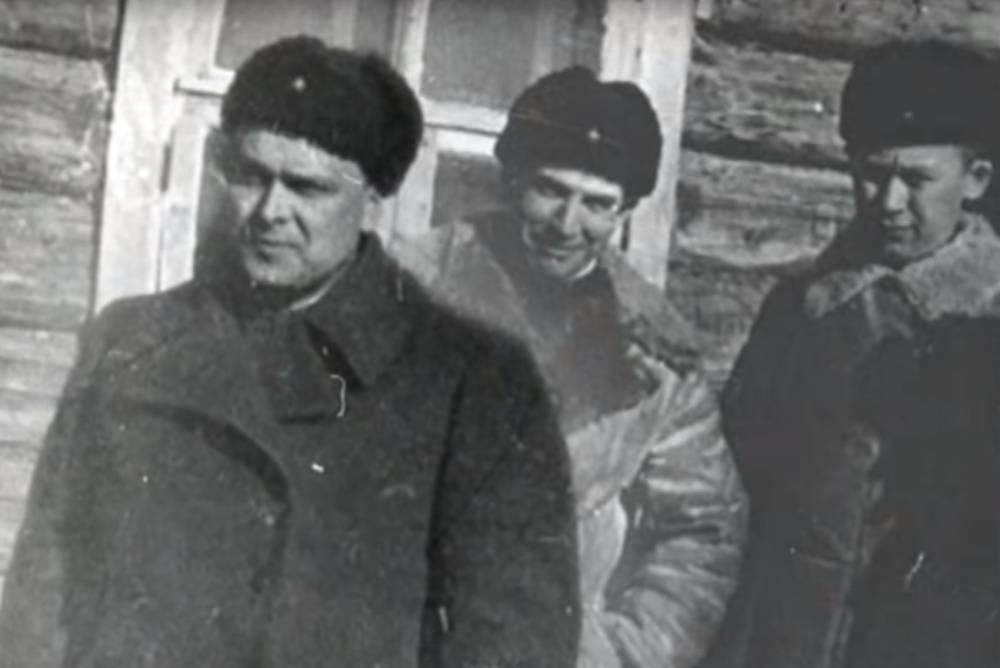
Ivan Zubkov during the construction of the “road of life”
DIED IN THE SKY
Director General of Railways and Construction of the 2nd Rank Ivan Zubkov never returned to the construction of the metro. In November 1943 he was awarded the title of Hero of Socialist Labor. And soon Zubkov’s life was cut short. He died on June 28, 1944 while on duty, returning from inspecting a new bridge over the Svir River. The stricken plane fell just a few hundred meters short of the airfield.
The monument to Zubkov was erected in the Alexander Nevsky Lavra. Metro builders come here every year to honor the memory of the former leader and lay flowers. In the Metrostroy building on Zagorodny Prospekt in St. Petersburg, a memorial plaque was placed in honor of the Hero. In 2014, a street next to one of the very first stations of the St. Petersburg metro “Avtovo” was named after him.
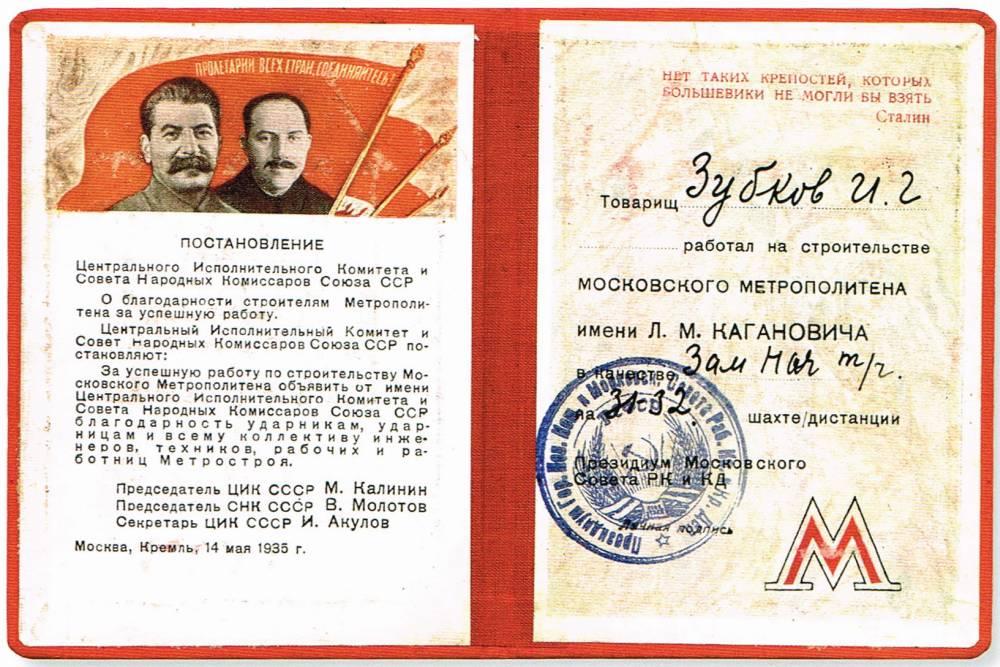
Zubkov was on the list of those to whom the top leadership of the USSR expressed gratitude after the launch of the first stage of the Moscow metro
INTERESTING
Based on the biography of Ivan Zubkov, director of the Lenfilm Film Studio Viktor Sokolov made a film "Meet me in the subway." The film was released in two series in 1985. The role of the head of Lenmetrostroy Andrei Zarubin was played by Pyotr Velyaminov.
In 2014, a documentary story by Pyotr Alalykin about Ivan Zubkov called “Soldier of Metrostroy” was published. It contains memories of contemporaries about the talented engineer.