Rothert. a word about the great civil engineer
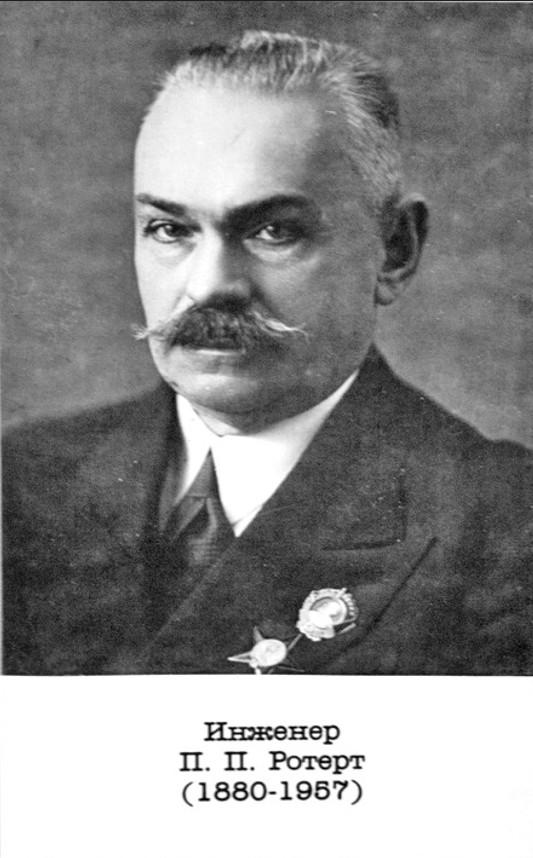
October 15, 1934, the first test train passed in the Moscow metro. The train, led by engineer Mikhail Shpolyansky, began its journey at 20:20 from the Severnoye depot. Three minutes later he was at the Komsomolskaya metro station. The first flight went at a low speed - 20–25 km/h. A total of six flights were made that day and the speed was increased to 60 km/h. The launch was still a long way off, but the first train gave confidence and moral support that the launch would soon take place. A test ride in the cabin of the first train was made by Pavel Rotert, the first head of Metrostroy.
Before Metrostroy
The undoubted merit of the Soviet government is the deployment of training of a large number of specialists in the thirties, without which a technical breakthrough would not have been possible. True, this also had another side: the devaluation of the title of engineer. Before this, an engineer was, so to speak, a piece product. Suffice it to say (since we are talking about the metro) that at the time of the formation of Metrostroy in August 1931, only a few people were familiar in detail with the practice of foreign metro construction. Let's name them, people should remember them. They made a huge contribution to the creation of transport that we use every day. These are Semyon Rozanov, Victor Nikolai, Konstantin Finkel and Joseph Shelyubsky. Of course, there had been tunneling engineers and miners since ancient times, but building railway tunnels in the mountains or mining operations in the steppe was completely different from creating an underground transport system in a city. And so, when the question arose of who to put in charge of a new and complex construction project for the country - the creation of the Moscow Metro - the choice fell on Pavel Pavlovich Rotert.
What was Rothert known for in the early thirties that earned such trust from Ordzhonikidze himself? An ethnic German, Rotert was born in 1880 in what is now Poland (then part of the Russian Empire), in the city of Bialystok. He received his education in St. Petersburg, at the Institute of Civil Engineers. He joined the labor movement and supported the revolution. His first work was related to railway transport in Ukraine; after the Civil War, he was engaged in restoration and construction work.
Rotert's star rose when in 1925 he was offered to lead the construction of the State Industry building in the capital of Soviet Ukraine, Kharkov - a unique complex of high-rise reinforced concrete buildings, the likes of which were not seen not only in the USSR, but, perhaps, in Europe. And now the buildings of Gosprom amaze the imagination, but in those days the construction seemed absolutely fantastic. Having started construction with a wheelbarrow and a shovel, in conditions of a monstrous severe shortage of materials and equipment, by the end of 1928, Rotert had achieved the highest level of mechanization. During the construction of Gosprom, Rotert became closely acquainted with the architect Samuil Kravets, co-author of the project for the Gosprom building. Several years will pass, and Rotert will invite Kravets, who raised a galaxy of young talented architects at the Kharkov Polytechnic Institute, to the position of head of the Metrostroy architectural bureau.
Then there was the second great construction project in the biography of Pavel Rotert. This is Dneprostroy. When talking about Dneprostroy, we first of all imagine the DneproHPP. In fact, the construction was much larger. It included virtually the entire extensive infrastructure: the creation of a network of roads, railway bridges across the Dnieper, metallurgical enterprises, a new city... The construction was nearing completion when the chief engineer Rotert was summoned by telegram to Moscow by Ordzhonikidze. The discussion was about the construction of the Moscow metro. Grigory Konstantinovich sent Rotert to Lazar Kaganovich, who at that time combined the posts of secretary of the Moscow Committee and the Moscow City Committee of the All-Union Communist Party of Bolsheviks.
“I didn’t think then,” Rotert wrote about his recent foreign business trip (in 1930), “that I would ever have to build a subway, but I knew that this construction was already in our queue; This circumstance convinced me even more that Soviet technicians should be familiar with the construction of such tunnels. From that day on, I began to become acquainted with the construction of tunnels in America, with the construction of subways in New York, Philadelphia, Paris and Berlin. Proposal by L.M. Kaganovich did not take me by surprise in this way...”
From August 1931, Rotert headed the newly formed Metrostroy or, as it was then called, the “Department of Impact Construction of the Moscow Metro under the Presidium of the Mossovet.” By the way, when in July of the same year the Politburo was deciding the question of the future head of Metrostroy, the choice was between Rotert and the head of Dneprostroy, Alexander Winter, by an amazing coincidence, Rotert’s fellow countryman and also a German.
Head of Metrostroy
At the beginning of 1931, the authorities of Moscow and even the country realized that the deplorable state of transport in the capital was not only a serious obstacle to the lives of citizens, but also slowed down the industrialization that had begun. From January to May, the Moscow Committee and the Moscow City Committee of the All-Union Communist Party of Bolsheviks were looking for ways to solve the transport crisis. Various options were considered. The Soviet Union already had experience in electrifying suburban traffic (Baku, 1926; Moscow-Mytishchi section, 1929). Based on it, as well as on the idea of Professor V.N. Obraztsov about “deep entry”, Kaganovich, who stood at the head of party organizations in Moscow and the region, proposed limiting himself to the reconstruction of the Moscow railway junction with the connection of the Northern (Yaroslavl), Kursk and Gorky roads with a line passing through the center of Moscow. Stalin ordered to consider the possibility of building a subway. As a result, both theses were reflected in the resolution of the June Plenum of the Central Committee of the All-Union Communist Party of Bolsheviks.
In August 1931, Pavel Rotert was offered to head the design and construction of the metro in the capital (however, he was not yet relieved of his duties as chief engineer of Dneprostroy); Metrostroy was formed. The scope of this article does not allow us to touch on the background of metro design in Moscow. Let's just say that Rothert managed to attract to Metrostroy almost all the specialists who participated in the previously completed work on metro design by the subdivision of the Moscow City Railway (tram trust). Rotert rescued some engineers from prison.
Rotert completed the first sketches of the project within a few days together with his deputy Finkel, who participated in the construction of the metro in Berlin before the revolution. Another engineer, Shelyubsky, also had Berlin experience. Two other members of Rothert's team, professor Semyon Rozanov and engineer Victor Nikolai, were familiar in detail with the practice of subway construction in Paris at the very beginning of the 20th century, and the former at one time held the significant position of head of technical services of the Paris Metro. A group of Metrostroy specialists began by carefully studying two metro projects developed in the 1920s: the Moscow City Railway project and the project of the German company Siemens-Bauunion, which had fundamental differences in construction methods and in the designs of tunnels and stations. It must be said that by the 1930s, three completely different schools of metro construction had emerged in the world: London, Paris and Berlin. This was due to both the different soil conditions of the three capitals and national approaches to construction and technological capabilities.
Rotert did not intend to use the most progressive English approach to the construction of a deep subway using tunneling shields and lining tunnels with cast iron tubing due to the extremely limited capabilities of Soviet industry. The Parisian (closed, mountain) method of constructing tunnels seemed to him dangerous and labor-intensive in the conditions of Moscow (in Paris there were cases of damage and destruction of buildings due to ground sediments, and the geology of Moscow with unstable water-logged soils was much more complex than the geological conditions of Paris with durable limestones). In addition, the method required the participation of a significant number of skilled tunnel workers. Thus, only the Berlin method of constructing tunnels and stations in open pits or using trenches remained. But here, too, not everything was simple: the narrow crooked streets of Moscow, unfavorable mining and geological conditions, the lack of a general plan, the acute housing crisis, which did not allow the demolition of buildings that were interfering with construction, the shortage of steel profiles for fastening the walls of pits, the almost complete absence of earth-moving equipment, the requirement of the People's Commissariat of Railways for the increased size of the tunnels, in which the combined movement of metro trains and commuter trains was originally planned - all this did not allow organize work similar to how it was done in Germany.
The only thing that did not raise any special questions was the directions of the first and subsequent lines, since the choice of route was dictated by the highest passenger flows in ground transport.
In the indicated conditions, the excellent builder and organizer Rotert, at the same time wise, but also cautious, even before the development of the technical design of the first line, decides to begin the construction of an experimental tunnel on Rusakovskaya Street - attention! - according to the Parisian method. The choice of location was predetermined by the following:
- a place remote from the center, where construction could not significantly interfere with the life of the city;
- a wide street with low-rise buildings, under the odd side of which a shallow tunnel should pass;
- a very significant slope of 35 thousandths (conventionally 35 meters per 1000 meters of path);
- passage of a tunnel under the Mitkovskaya railway line, which was not vital for the railway junction (in case of a possible accident).
If the experiment was successfully completed, Rotert could be confident of the possibility of constructing the most difficult areas in the city center using the Parisian method - where the Berlin method would not be applicable.
Work began in November 1931 with the construction of a barracks for workers (and at the same time a construction office) on the right side of Rusakovskaya Street, approximately on the site of the modern building 14/16. In December, on the opposite side, they began constructing an inclined overpass for unloading trolleys and an approach road to the future tunnel - the Bremsberg. The general technical supervision of the work was carried out by Professor Rozanov, the documentation was developed by a young engineer, Veniamin Makovsky, and the work was carried out by a very young technician, Vadim Pikul, a relative of the writer who later became famous (Pikul would later graduate from MIIT and become a prominent tunneling scientist).
In the last days of December 1931, the Moscow City Committee approved the routing of the priority line. Rotert was given six months to develop the technical project, until May 1932. At this time, Metrostroy was engaged in preparatory work: carrying out additional geological exploration, creating a base for the extraction of materials in deposits near Moscow, etc. At the same time, Rotert is negotiating with specialized universities to begin training specialists in metro construction. At the same time, the technical department developed a project using the Berlin method. The accident at the experimental site, although not very serious, further convinced Rotert of the need to build tunnels and stations using the pit method.
Only one engineer in the technical department - young Veniamin Makovsky - was a supporter of the London method of constructing the subway with shields at great depths. Looking ahead, we can say that life has proven him right (already the second stage of the metro was built mainly with shields), but specifically in those conditions of the initial period, Makovsky’s idea was practically unrealizable. The main advantages of shield tunneling were that the routing could not be tied to the streets, and the grandiose construction project had a much smaller impact on the life of the city. Unable to find support from his colleagues, Makovsky secured Khrushchev’s approval and in March 1932 published an article in Pravda, “How to Build a Metro.” Of the scientists, Makovsky was supported by Alexander Passek.
Stalin liked the idea of building a metro at great depths; Rothert was unable to convince the party leadership, and a week after submitting the technical design of the shallow line on time, he had to start redesigning the subway for a deep layout. According to Khrushchev’s memoirs, Stalin was attracted by the idea of using deep stations as bomb shelters, as well as the idea of using new lifting machines - escalators. All this, as well as additional geological exploration in bоgreater depths, and the subsequent examinations (three foreign and one domestic) led to a significant delay in the development of construction, which, according to original plans, was supposed to be completed in 1933.
In areas with a deep line, the excavation of mines began, which immediately encountered enormous difficulties. It turned out that it was impossible to simply transfer the old mining methods to a densely built-up city with extremely unfavorable mining and geological conditions: the settlement of the ground surface, which is so common in mining, is completely unacceptable in the city, as it leads to the rupture of underground communications and the destruction of buildings. In addition, the deep line was supposed to be built not with shields (!), for which the country had no currency, but with a labor-intensive and dangerous mining method with temporary wooden support for the mine workings. Under these conditions, Rotert, continuing to insist on the open pit method, stopped work in the mines. Kaganovich considered it necessary to intervene.
Based on the joint decision of the Moscow Committee and the Moscow City Committee of the All-Union Communist Party of Bolsheviks, as well as the Presidium of the Moscow Soviet of February 1933, a reorganization of the management structure took place in Metrostroy. Along with this, the planned length of the deep section was reduced and limited to the gap between the Red Gate and the center, which was more consistent with the real capabilities of Metrostroy.
In 1933, on Kaganovich’s initiative, Kaganovich’s longtime acquaintance Yegor Abakumov, who was relieved of work at the Donbass Coal Trust for organizational failures, was appointed Rotert’s first deputy. Abakumov turned out to be “one of the people” - both for ordinary metro workers and for the party leadership - Khrushchev and Kaganovich, the supervisors of the construction. Taking to work energetically, he showed good organizational skills. He attracted a large number of workers and engineers from the Donbass coal mines. The work of Metrostroy gradually began to improve, and the introduction by specialists of completely new methods of excavation for the country - in a caisson and with artificial freezing, the use of soil consolidation using the silicatization method - made it possible to cope with unstable aquifers and successfully drill both mines and deep tunnels. The forced use of two shields at the final stage of construction - a foreign one (which we still had to purchase) and a domestic one - made it possible to build the most complex 444-meter section under large collectors and the erosion of the Neglinka River.
Rothert paid great attention to metro architecture, which, one might say, did not exist in the world before the Moscow metro. He invited Samuil Kravets from Kharkov to head the architectural bureau of Metrostroy, and he, in turn, brought the group of young architects he nurtured, who set the tone for underground architecture.
On October 15, 1934, Rotert took a test ride in the cabin of the first train, driven by engineer Mikhail Shpolyansky.
As you know, the first stage of the Moscow Metro, 11.6 km long with thirteen stations, opened on May 15, 1935. The day before, at a ceremonial meeting in the Hall of Columns of the House of Unions, a large number of metro builders were awarded government awards. “For the successful implementation of the decisions of the party and government, ensuring the Bolshevik pace of work and for the timely completion of the construction of the first stage of the Moscow metro - award:
ORDER OF LENIN:
1) Khrushchev N.S. - Secretary of the Moscow Committee of the All-Union Communist Party (Bolsheviks),
2) Abakumova E. T. - Deputy Head of Metrostroy,
3) Starostina K.F. - party organizer of Metrostroy,
……. (total 37 names).
ORDER OF THE RED STAR:
1) Bulganin N.A. - Chairman of the Moscow City Council (as previously awarded the Order of Lenin),
2) Rotert P.P. - head of Metrostroy (as previously awarded the Order of Lenin for Dneprostroy) ...
In 1935-38 under the leadership of P.P. Roterta designed and built the second stage of the Moscow Metro.
After completing his work at Metrostroy, Pavel Pavlovich took up scientific work, but did not lose touch with the construction of the metro. To this day, Metrostroy maintains the tradition of visiting Rotert’s grave at the German Cemetery, paying tribute to the great civil engineer - the first head of Metrostroy. A street in Moscow is named after Rotert. But the best monument to Pavel Rotert is, perhaps, not only the first stage of the Moscow Metro, but the entire metro, for the ideas, principles and solutions boldly and insightfully laid down in it by the first designers under the leadership of Rotert in the distant thirties do not lose relevance even now.
Vladimir Goraychuk