Behind his sternness hid a kind heart
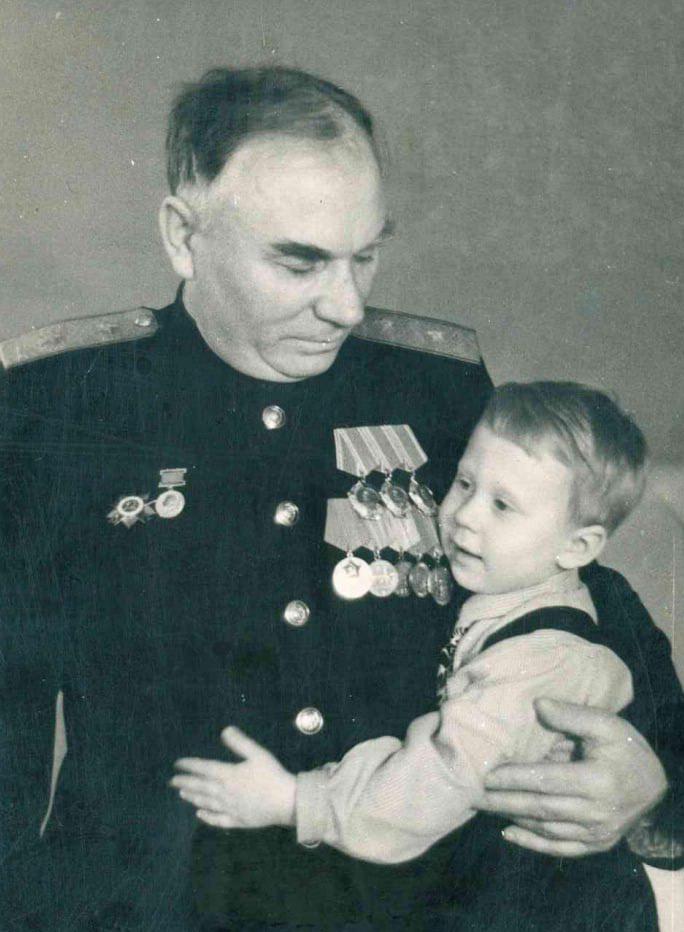
Mikhail Samodurov is a Soviet engineer, a specialist in the field of tunnel construction, and the fourth head of Metrostroy. His daughter, Irina Vasilyeva, shared memories of her famous father.
– Irina Mikhailovna, your father headed the Metrostroy of the People’s Commissariat of Railways of the USSR from 1941 to 1945. Perhaps in the most difficult period for the country and metro construction. Tell us what he was like - son, husband, father, boss?
– First of all, responsible. Born into the poorest large family, the first-born. I learned early what work is. He gave everything he earned to his mother, whom he loved very much; he saw how hard it was for her to raise her brothers and sisters, and he had two brothers and four sisters, and they all had to be fed, clothed, put on shoes, and ready for school. Often everyone had one pair of boots. Dad never grumbled or complained and always knew how to help the family. My father's father, my grandfather, died early. Therefore, caring for orphans fell on his shoulders.
I learned with interest that, it turns out, he studied at the Yasnaya Polyana school with Leo Tolstoy. From the great Russian writer I first heard about the Patriotic War of 1812, the Caucasian and Crimean battles. Lev Nikolaevich called his students little people and told them many fairy tales and epics. He taught me to read using his “ABC,” from which my dad learned about the famous physicists Michael Faraday and James Joule.
It is quite possible that Lev Nikolaevich instilled in his father a craving for exact sciences, which determined his future fate and helped him choose a profession and his life’s work.
When dad graduated from school, the family moved to Ukraine, to Zhmerinka. He loved to reminisce about the years he spent there. He began his working career at the Zhmerinsky Iron Foundry as a foundry worker, then went to the railway depot and trained as a mechanic. But the thirst for knowledge won: he rushed to Kyiv and entered the Kiev Polytechnic Institute. After receiving his diploma, he got a job as a senior engineer at the South-Western Railway, where he worked until he was sent to Moscow to build a metro.
– In seven years, Mikhail Afanasyevich went from a shift engineer to the head of Metrostroy. It's not easy.
– Especially considering the time in which he started. I assume that he was helped by the hardening he received from childhood, perseverance and determination. In 1933, the metro had not yet appeared; preparatory work was underway. An unsettled life and hard work forced many to give up everything and look for a better life. The father resisted. He went through the Metrostroy school, acquired the necessary skills, and earned the authority and respect of the government. The pre-war and war years left a special imprint on the choice of leader, including Metrostroy. They must be not only a competent specialist, but also a person devoted to his country and cause, capable of coping with any difficulties. Father was exactly like that.
– The older you get, the more surprised you are at how the country not only survived during the war years, but also built a metro!
– During the war, six stations were built! The construction of the metro in those years was one of the areas of work of my father’s department. Metro builders preserved rebuilt and unused tunnels, built defensive structures, temporary tunnels, concrete pillboxes, anti-tank and command posts; restored destroyed mines, bridges and tunnels. Metrostroy specialists were sent to the troops and as miners: they worked professionally with explosives.
– I heard about many secret objects built by metro workers during the war years. Can we talk about them today?
“During his lifetime, dad never talked about them. Today in the press there is no, no, and information about this or that secret bunker or government building near Moscow will flash. From archival materials I know that metro builders began building them even before the war. For example, in one of the Stalingrad bunkers, today a museum built on the eve of the war for command personnel, the thickness of the walls is 2 meters. Even an air bomb wouldn't have taken him. Future marshals could safely sit in it for at least two months: the bunker had a supply of water, food, even a toilet and sink. The doors were sealed, and the air was purified by a powerful forced ventilation system. The Battle of Stalingrad showed that the metro builders coped with their assigned task perfectly.
If we talk about the construction of government tunnels, then they were supposed to be extended out of the city up to one hundred kilometers. My father was responsible for the construction of No. 10 A. People who had gone through fire, water and copper pipes were recruited there. And I'm proud that dad was one of those.
I don’t think there will come a time when everyone will know about them: secret objects should remain so, in my opinion. World peace has not yet arrived.
– One of the main tasks of Mikhail Samodurov at that time was the construction of bomb shelters.
- You're right. In addition to the construction of defense facilities protecting the capital, Metrostroy had to prepare shelters for the population, for this they used unfinished radii. They had to be preserved so that the tunnels would not fall asleep or flood, and it would be safe for people to stay in them. And it was done.
Let me remind you that concern for people was manifested not only in the arrangement of bomb shelters. At one time, I was proud to learn that, on my father’s initiative, housing was built for metro construction workers, a children’s camp and kindergartens, a Palace of Culture, and a stadium where they could play football and swim in the pool in the summer appeared.
In January 1942, my father, driving around the defensive structures near Mozhaisk, on the Borodino field, drew attention to the destroyed state farms in Voroby and Tarutino. And he came up with the idea of restoring the state farm and taking patronage over it. To build a departmental pioneer camp nearby. To speed up the process, he gave the command to build a barracks for the builders from the forest fallen by the explosions. If by spring, the father thought, the state farm was restored, he would provide the Metrostroy children with milk and fresh vegetables. And so it happened: in the summer, in the canteens of Metrostroy there were products from the sponsored farm, and three years later the departmental pioneer camp “Berezki” received its first noisy guests in Balabanov.
– In 1942, the Germans stood 10-15 kilometers from Moscow, and the government thought that by 1943 it was necessary to complete the construction of the Zamoskvoretsky radius! Such was the belief in our victory.
- By 1943, the Zamoskvoretsky radius - the Novokuznetskaya, Paveletskaya, Avtozavodskaya stations - was truly completed! This news spread all over the world.
To meet the deadline, in 1942 it was decided to build tunnels of a smaller diameter. To do this, it was necessary to make 12–15 new shields. It was impossible to do this in a short time. Therefore, it was proposed to reduce the number of links in the support and knife rings of the shields. During the year, three stationary and seven distillation panels were produced. The problem was solved!
A year later - on January 18, 1944 - the Pokrovsky radius was opened - the stations "Baumanskaya", "Elektrozavodskaya", "Semyonovskaya", "Izmailovsky Park". It began to be built in 1938, but due to the difficult situation during the war, construction was frozen, and a bomb shelter was built in the tunnels. When the threat of the capture of Moscow passed, work continued. True, the men who went to the front were replaced by women at the tunneling site.
- Speaking of women. How did Mikhail Afanasyevich meet your mother, because she is a ballerina, and he spent almost all his time underground!
– We met underground. He is 20 years older than her. A child of the street, one might say, from a large family, he became a farm laborer at the age of 7.
My mother, an only child, grew up in a wealthy family, studied well, studied music, went to a choreography school - she dreamed of becoming a ballerina. When my parents were destined to meet, my grandmother worked at Metrostroy in the personnel department. Mom's ballet school was being prepared for evacuation. Mom didn’t want to leave Moscow. Then her grandmother got her a job as a bookkeeper at Metrostroy. One day she was sitting in a tunnel, and dad was walking past, he saw a fragile, gentle creature, came up and asked how many workers passed by her. And she answers: a lot... Mom, it turns out, didn’t count them. That's how we met and then got married.
They were different, of course, but they loved each other and tried to spend their free time together. Although this happened very rarely: dad was so busy that he was practically never at home. I remember the rare hours when the family gathered at the dacha. Dad didn't sit idle. As soon as he arrived, he immediately got down to business: watering everything, hilling it, trimming it. He also taught my brother and I to work, organizing various competitions. Victor and I either collected caterpillars or trimmed strawberry mustaches - who could collect and trim the most quickly and quickly. He will definitely find time to go fishing with Vitya, and he will help me collect stamps. He tried to teach me to swim, but was unsuccessful: I almost drowned.
He loved animals very much. He said that if you take a puppy or kitten into your home, do not throw it out into the street, take care of it.
Of course, my brother, my mother and I really appreciated the rare hours we spent with dad. After all, he had a complete rush: before he had time to undress in the corridor, they would call and report some incident. He broke down and, without rest, drove to the site.
– How were you with your subordinates?
– He respected and appreciated those who worked with him. There was no staff turnover. He made sure that the housing problems of metro construction workers were resolved in a timely manner, that their children went to kindergartens and rested in a departmental camp. And the workers themselves went in for sports. It’s not for nothing that the territory for the stadium was knocked out on Krasnaya Presnya. Dad was an ardent hockey and football fan. I knew the players of the Metrostroy major league team by name.
Of course, there was a time when complete dedication was required from people, maybe someone didn’t like it, but he didn’t spare himself. He was an excellent owner and an expert in his field; the same professionals who were passionate about their work worked next to him. Despite the general's shoulder straps, he was accessible to his subordinates. And, as many of them said, a kind heart was hidden behind his severity.
INSERT
Mikhail Samodurov was born on September 6 (September 18), 1899 in the village of Kalizna (now Tula region). Member of the CPSU(b) since 1929. In 1930 he graduated from the Kyiv Polytechnic Institute. He worked in the management of Southwestern Railway, in 1933–1945 - in the Moscow Metrostroy. From January 24, 1941 - Head of Metrostroy of the People's Commissariat of Railways of the USSR.
He supervised the construction of the Moscow Metro stations named after L. M. Kaganovich: “Arbatskaya”, “Smolenskaya”, “Paveletskaya”, “Kurskaya”, “Baumanskaya”. During the war, he supervised the construction of defense facilities, coal mines in the Moscow region, the Stalinogorsk gypsum mine, tunnels on the Black Sea Railway and on the Irkutsk-Slyudyanka line. From March 21, 1945 to 1958 - Head of Glavtonnelmetrostroy NKPS.
He had the rank of Director General of Railways and Construction, 2nd rank.
Awarded the Stalin Prize, 2nd degree (1947) - for the improvement and implementation of the shield method of tunneling during the construction of the Moscow Metro named after L. M. Kaganovich, which ensured a significant increase in labor productivity in underground work.
Awarded three Orders of Lenin, other orders and medals.
Mikhail Samodurov died on June 14, 1969. He was buried in Moscow at the Novodevichy Cemetery (site No. 7).