Do not fail the surname of the Motovilovs
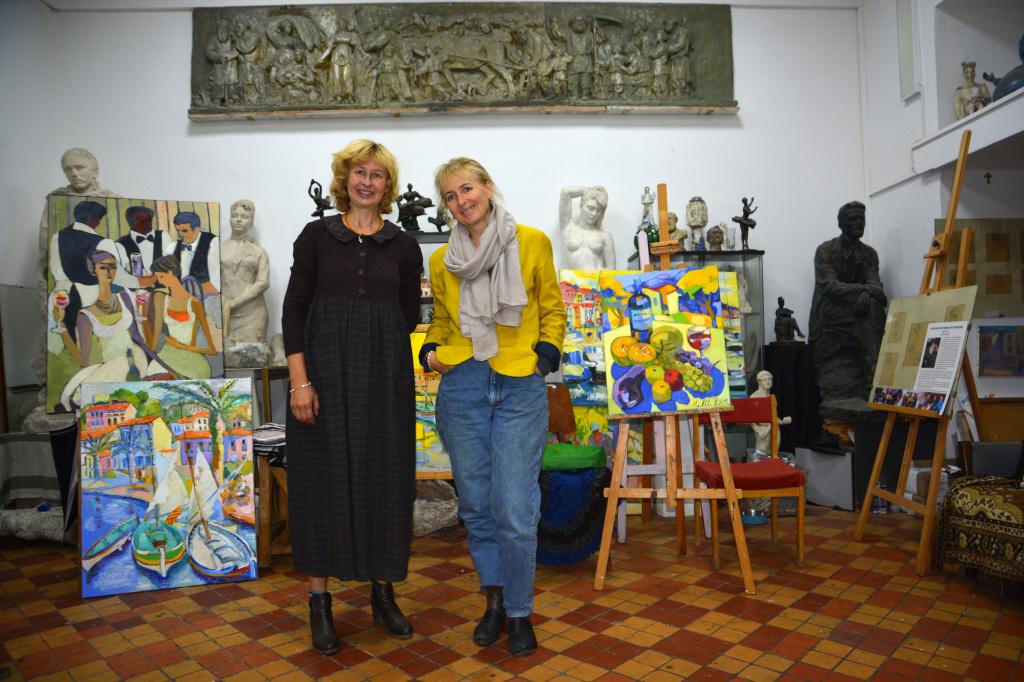
Olga and Anastasia Motovilovs are the granddaughters of the Russian and Soviet sculptor Georgy Ivanovich Motovilov, winner of the Stalin Prize in 1950, author of many monuments and bas-reliefs, who decorated seven stations of the Moscow metro. The sculptor’s descendants took part in creating a miniature copy of one of their grandfather’s works for the company’s anniversary and talked about how the work went. And also shared the story of your family.
Olga, Anastasia, you took part in the creation of a miniature copy of the sculpture “Metrobuilders at the Face”, released for the anniversary of Mosmetrostroy. Tell us about working on it, what difficulties did you encounter?
Anastasia: Yes, we received an order from a company to make a miniature copy of a sculpture by Georgy Motovilov. We took on the project with pleasure, despite the tight deadline and the difficulty of completing a sculpture of such a small size. This work gave us the opportunity to “communicate” with our grandfather and immerse ourselves in his work. We tried not to let the Motovilov family down and to complete the entire print run with high quality.
At first they thought of making a miniature copy, but the deadlines did not allow it. We had to find a master with whom we made a 3D model, which simplified the task. Although even at this stage there was a lot of adjustment. Sketches for the sculpture were lost in 1957 when the studio where Motovilov worked for many years moved from Solyanka to Stroiteley Street. An old photograph was found, taken before the restoration of the sculpture in 1950, and so, together with the master, we worked on all the figures, every fold in the clothes, the anatomy of the bodies, and the composition. It was important to maintain the style, because each sculptor has his own.
We also supervised production. During the work process, we decided to change the initially proposed size from 11 cm to 13. It seems like only two centimeters, but they provide more opportunities for activity. The figurines are made of brass. We were lucky with the company where they cast it. It's hard to find good production now. Experienced masters of the old school immediately see a defect where the plasticity of the body is disturbed. It is also important to properly process the seam after casting, remove sagging, and carefully emboss it. Great professionalism and skill are required. The copy turned out to be 20 times smaller than the original.
The sculpture “Metro Construction Workers at the Face” was created by your grandfather during the Great Patriotic War, at a time when all of Moscow was bombed. Did this somehow affect the sculptor’s work?
Olga: Yes, the work was carried out during the war. Georgy Ivanovich carved the sculpture right next to the Elektrozavodskaya pavilion. We still have letters that he wrote to his son Andrei at the front. In one, he just described the day when he was going to work with his colleagues, and one of them was killed by an explosion right in front of his grandfather.
But the work continued. Three sculptures of metro builders with tools in concrete took their place in a niche in the station’s ground vestibule. And inside the hall is decorated with bas-reliefs of Georgy Ivanovich. He did all the work by hand using marble. At that time there was no modern technology for processing marble: if you chipped it in the wrong place, the sculpture was ruined.
One of the prototypes of the figure of the metro builder on the right was the earlier work “Metallurgist”. And the central figure was modeled from Shakhtar, which is located in the Russian Museum. Georgy Ivanovich had favorite sitters, whom he often invited to pose. He chose people with antique builds, beautiful, muscular, proportional. Motovilov made the sculptures of the Soviet period fly by analogy with the Greek ones, creating the image of a man inspired by work and harmoniously fitting them into the architectural space - both in the exterior and in the interior.
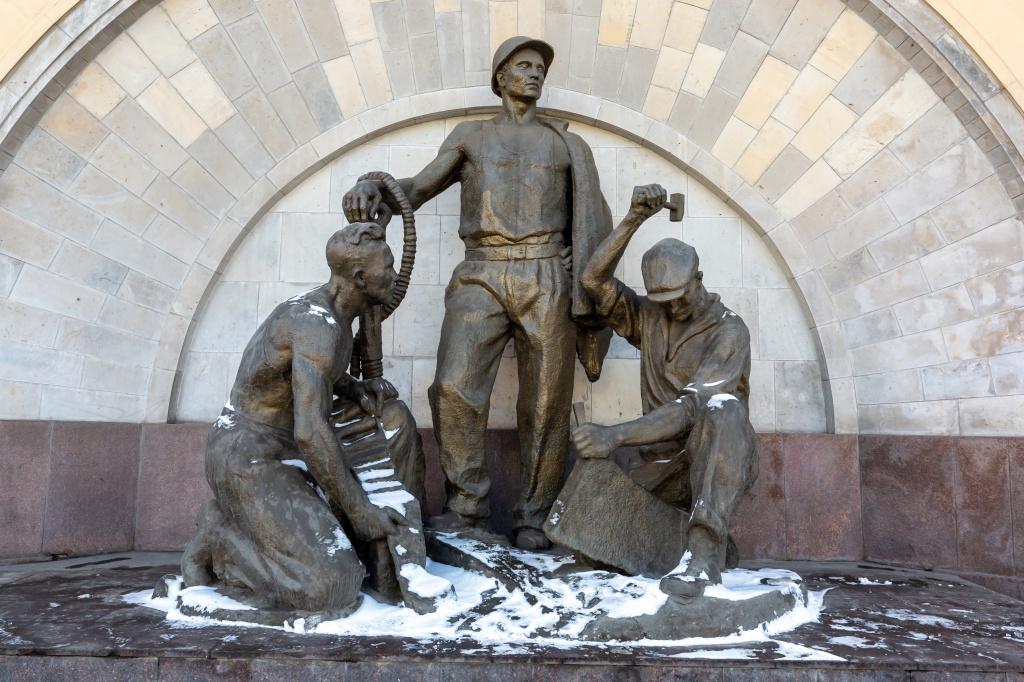
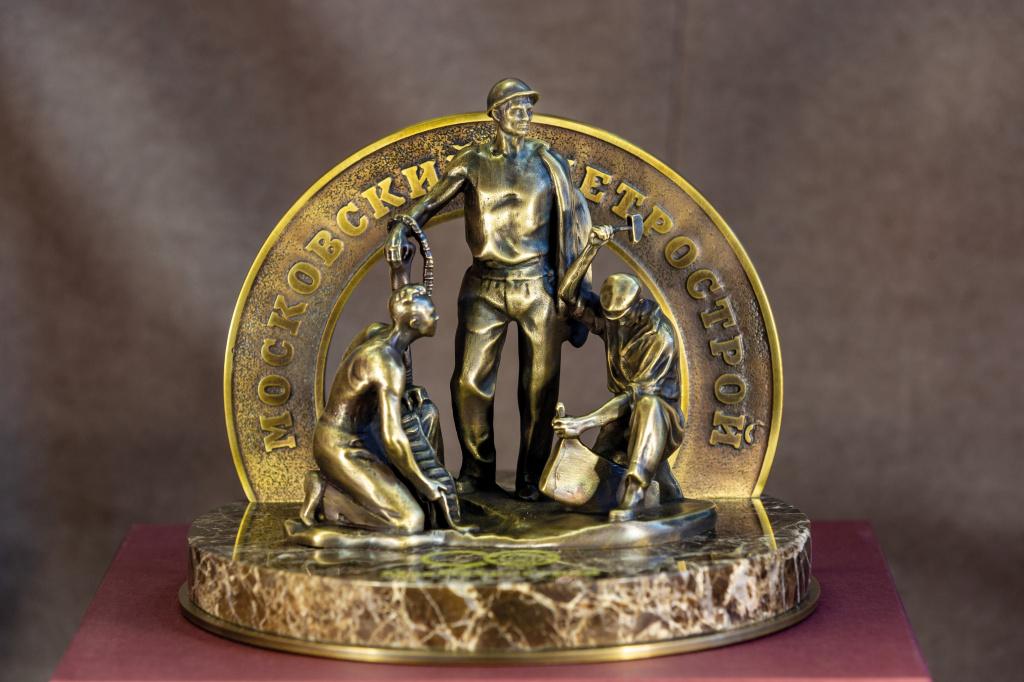
The sculpture “Metro Construction Workers at the Face” in the niche of the lobby at Elektrozavodskaya and a copy of the sculpture released for the company’s anniversary
Georgy Motovilov comes from a family of doctors, and he himself graduated from a medical school. How did it happen that he became a sculptor?
Olga: Georgy Ivanovich was born into a family of Simbirsk nobles. His father was the chief surgeon at the Catherine Hospital on Petrovka in Moscow, and had royal awards for his labor merits. His date of birth is often incorrect on the Internet. The sculptor changed it himself after the revolution, adding age to himself. Original documents were found in the early 90s by a researcher of the Motovilov family, including birth and baptism certificates, which indicate the date 1892. A high school graduation certificate with a silver medal was also discovered, as well as a diploma from the Faculty of Medicine of Moscow State University. The documents were kept in Simbirsk (now Ulyanovsk), where our family had an estate.
Georgy Ivanovich studied sculpture with Sergei Volnukhin (the author of the monument to the pioneer printer Ivan Fedorov), and showed great promise. As a talented student, he was sent to study in Italy. But the father, Ivan Andreevich, was categorically against it, did not let his son go and believed that he should master the profession of a doctor and help people. Both of his sons, Andrei and Georgiy, graduated from the medical faculty of Moscow State University and participated in the First World War as military doctors. By the way, this is why Motovilov knew anatomy perfectly, which is sometimes lacking in modern sculptors.
During the civil war, Georgy Ivanovich worked as a doctor, saving people, as his father wished. He was absolutely apolitical, did not join either the whites or the reds. He wanted to create, art was in his head. He decided to continue his creative activity. He mastered working with wood and stone in the workshop of Sergei Konenkov. Later, Konenkov emigrated to the USA, and as a souvenir he left behind a turning circle on which many works of art of our dynasty were created. The circle is still kept in the studio.
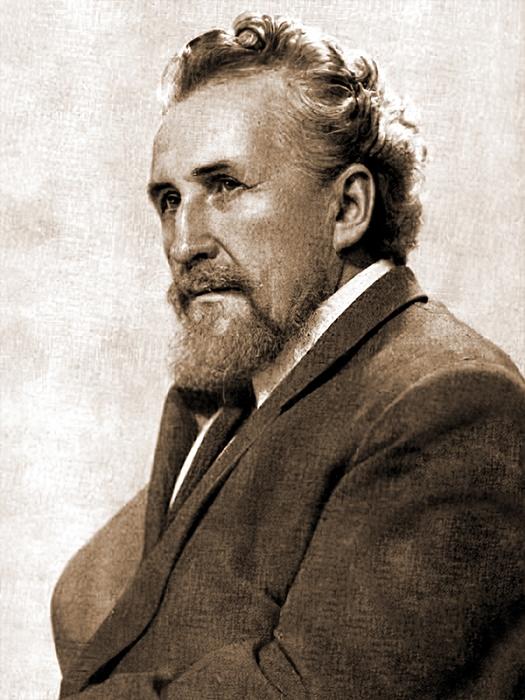
Portrait of Georgy Motovilov
Anastasia: In the 20s, many works were made of wood and stone; they are in museums and private collections in Russia. In the 30s, Georgy Ivanovich worked fruitfully and a lot in terms of monumental decorative art. I did a lot for competitions, for example – Pushkin in St. Petersburg, figures for VDNKh and reliefs, a girl in the “house under a skirt”. Many works are now lost, as they were made in concrete, which at that time was considered a progressive material, but in practice it turned out to be short-lived.
After the war, Motovilov created the department of sculpture at the Stroganov School. He was very educated, knew foreign languages perfectly, including Latin. I read excerpts from Homer’s “Iliad” in the original to my students, quoted poems by Lermontov, Pushkin, and entire chapters from Tolstoy’s “War and Peace.” He introduced them to high art, instilled a love for ancient classics, and created an elevated mood.
They say that the girl with the sickle who decorated the “house under the skirt” on Tverskaya was created by Georgy Motovilov from the image of your grandmother, and some say that this is the ballerina Lepeshinskaya. What's really true?
Olga: This, of course, is one of the urban legends. Both are not true. Ballerinas were among the sculptures. But the girl who decorated the house on Tverskaya is just a girl with a sickle. Our grandmother had a completely different constitution.
Can we say that Georgy Motovilov became the founder of a dynasty of sculptors and artists? Who else in your family has chosen a creative path?
Anastasia: His youngest daughter Natalya Motovilova also became a sculptor. Her works are located all over the country - fountains in the Rossiya Hotel, in Pitsunda, Makhachkala, Cheboksary. The sculpture of cosmonaut Volkov and the portrait of test pilot Anokhin belong to her hand.
Olga Motovilova, the granddaughter of Georgy Ivanovich, is engaged in painting, makes monumental paintings, her daughter Maria Komova also followed in her creative footsteps. She makes beautiful compositions from art glass, works in painting techniques, and creates sculptural works. And I am engaged in a traditional business for our family - sculpture.
We founded the Georgy Motovilov and Oleg Komov Foundation, within the framework of which we try to preserve and popularize the heritage of our dynasty. We are now raising funds to publish a book; it will reflect biographical moments, present archival photographs, sketches and drawings of Georgy Ivanovich, and previously unpublished works. We plan to release it next year, when it marks the 130th anniversary of the birth of Georgy Motovilov.
Georgy Ivanovich left a great legacy. Which of his sculptures are closest to you, admire and inspire?
Anastasia: Of course, “Metallurgist”. Also a bas-relief of Alexander Nevsky, which was installed on the first floor of the Palace of the Soviets and then bulldozed. What remains is a plaster model.
Olga: Relief “Who lives well in Rus'” for the Nekrasov monument, which is located in Yaroslavl. The relief is carved into limestone. Motovilov was a physically strong man and always performed his work in his own way. The horsemen and reliefs in the composition that decorated the locks of the Volga-Don Canal belong to his work. Georgy Ivanovich's horses were masterful. He understood how a person should sit on a horse; his passion for horse riding in his youth affected him. By the way, while working on the composition, his arm was broken, and the riders were high up. He climbed to heights through scaffolding, as the party set strict deadlines.
Have the methods of creating sculptures changed over time? Do you use new technologies in your work?
Olga: Yes, technologies are changing, for example, improved mechanical tools have appeared. They are easier to process bronze, wood, and stone. When creating the miniature sculpture “Metro Construction Workers at the Face,” 3D modeling was used. At the same time, the sculptor must still be able to work with his hands.
You continue to work in your grandfather's workshop. Probably, colossal creative energy has accumulated here over the years? Does it help you in the visual arts?
Olga: Of course, Georgy Ivanovich worked here for six years until 1963, many of his works from different periods of his life are stored here. Unfortunately, we did not find him alive. But the walls and works remember him. People, when they come to us, do not want to leave. A different world opens up here, where you can hide from stress and adversity that remain behind the doors. People exhale.
Georgy Motovilov was an amazing person, a strong personality. His life fell on difficult years in the history of our country. But he did not emigrate, he was a patriot. He treated all people well and had great respect for the work of workers. I didn't like rudeness and plagiarism.
Anastasia: Georgy Ivanovich believed that every morning you need to start with an elevated mood. He didn’t let the children quarrel and the others make comments in order to maintain an elevated mood for the whole day. We still use his advice today.
BTW
“Metallurgist” or “Metalist” was installed inside the famous pavilion designed by Boris Iofan, crowned with “Worker and Collective Farm Woman” by Vera Mukhina, at the World Exhibition in Paris in 1937. The sculpture received the Grand Prix of this exhibition. Now it is in the collection of the State Tretyakov Gallery.
HELP
Georgy Motovilov graduated from VKHUTEMAS. He became widely known as a master of monumental sculpture and decorative reliefs of the “underground palaces” of the Moscow metro. It was he who first proposed and began to create narrative reliefs for the metro, as an alternative to the decorative decoration of stations. Designed Elektrozavodskaya (1942–1944), Novokuznetskaya (1944), Park Kultury-circular (1950), Oktyabrskaya-circular (1950), Komsomolskaya-circular (1951), Prospekt Mira-circular (1952) and Smolenskaya stations on the Arbatsko-Pokrovskaya line (1953).