Modern medical center – record for the entire team
The infectious diseases hospital in the Voronovskoye settlement of New Moscow has been accepting patients with coronavirus infection for more than a month. The builders accomplished a real feat - in five and a half weeks they erected a modern hospital in an open field. A large amount of work was carried out by JSC Mosmetrostroy. In this issue, “MS” talks about the organizations that took part in the creation of the medical center.
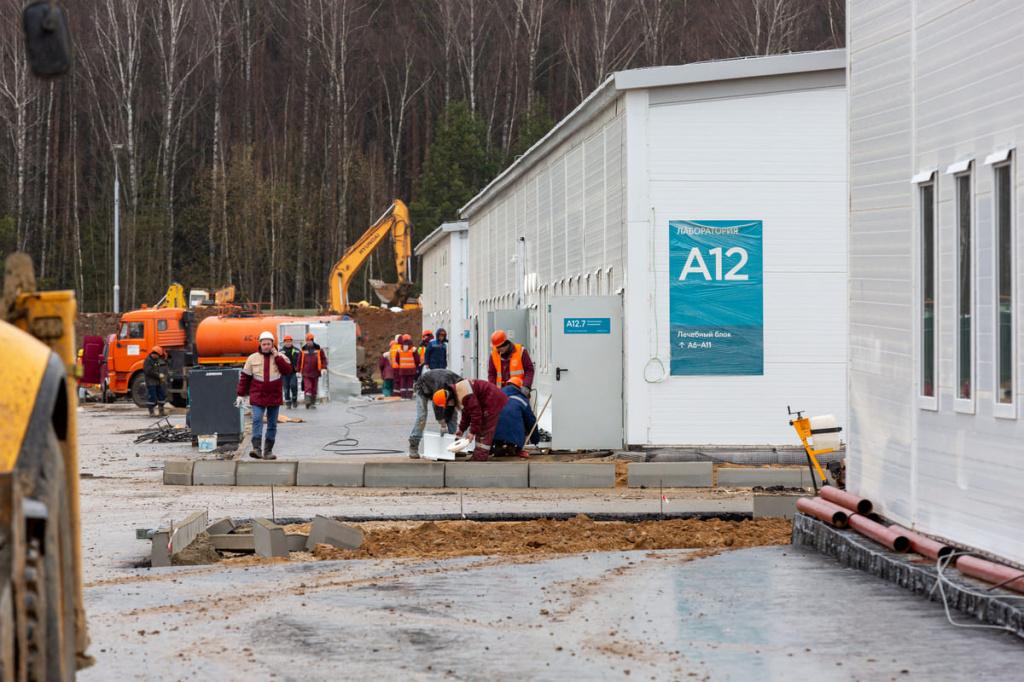
Construction of the medical center was carried out around the clock
HELPED WITH SMALL FORCES
Oleg Litovchenko, General Director of SMU-6
The construction team was assembled after the launch of the Aviamotornaya station of the Big Circle Metro Line. They worked with a small force and were assigned to SMU-24. In total, the builders worked from SMU-6 for about three weeks. After the official opening of the infectious diseases hospital in the Voronovskoye settlement of the Troitsk and Novomoskovsk districts, the team left the site.
FROM A CLEAR FIELD
Evgeniy Satyshev, deputy chief engineer of SMU-12
SMU-12 was the very first to arrive at the beginning of March. There was nothing at the chosen site in New Moscow - an empty field. The tasks assigned to Mosmetrostroy directly related to the arrangement of networks. SMU-12 were engaged in the deployment of a residential camp. They prepared the site for SMU-24, which was entrusted with engineering communications. This work was completed in a week: from developing the site to installing fences and cabins, lighting and building an access road.
But the situation changed, and instead of leaving the construction site, giving way to colleagues from SMU-24, we were appointed responsible for the construction of prefabricated modules A8, A12, B13, B14 and others as part of the medical center. Welders and installers were the first to arrive at the site. Closer to the 20th of March, it became clear that the volume of work was increasing. SMU-12 was also involved in finishing the inside of modular structures. Initially, about 20 workers were mobilized, and at the peak per day the number reached 170 people and up to ten pieces of equipment. This is only from SMU-12.
I arrived in TiNAO immediately after the launch of Aviamotornaya and Lefortovo of the Big Ring. People were removed from work at other metro stations.
SO THAT NO ONE AFFECTS THE VIRUS
Vladimir Chudnetsov, deputy chief engineer of SMU-1
We found ourselves working on the construction of a medical center on Sunday, March 29, almost immediately after the opening of the Aviamotornaya station on the Greater Metro Ring. We were entrusted with the construction of a laboratory. Having arrived there, we took over shifts from colleagues from SMU-12. They were just finishing the roofing at that time. Our main task was to erect partitions and ceilings and bring block A10 to the finishing touches.
At first, organizational issues were resolved: it was necessary to understand how the work was organized, who gets the materials and where from, how they are delivered. Once the logistics were sorted out, the work went faster.
During that working month in New Moscow, I dreamed of one thing - that the coronavirus would not affect anyone. I was worried about my family, like any other person on the construction site. Nobody wanted to be affected by this infection.
COMFORT FOR MEDICS
Denis Varenov, deputy chief engineer of SMU-24
Workers and specialists from SMU-24 installed engineering systems on 12 modules of the medical center in Voronovsky, of which 5 checkpoints were in the area of responsibility of Mosmetrostroy. Very little time was given for mobilization.
On Friday, March 20, we arrived at the construction site, inspected the facility, and already on March 23, SMU-24 began installing engineering systems. During these three days, about 500 installers were brought to the site. We received the projects and began full-time work.
The engineering staff of SMU-24 are not yesterday’s students, but professionals with extensive experience. For them, operating in such field conditions is a familiar task. Engineering is similar at any facility, although, of course, there are some differences between a medical facility and a metro. But for specialists this did not become an obstacle in solving the assigned tasks. We organized shifts and worked around the clock. Most remained in Voronovsky until the official opening of the infectious diseases hospital. After which the core left, but some of the specialists and workers remained for further adjustment of the systems and putting them into operation.
The installation of utility networks was carried out in accordance with the issued projects, but doctors and the operating organization still sometimes ask to move or install additional equipment. For example, taps or sinks. We promptly accept these comments and make the work of doctors as comfortable as possible.
DAYS FOR MOBILIZATION
Alexander Valakh, head of the MMC International section
We arrived at the site on March 29, working on installing internal partitions in prefabricated modules in the laboratory of the infectious diseases hospital. The next task assigned to our employees was the installation of clean Armstrong floors and ceilings in the building. Over 40 people worked for two weeks. Everything was ready in the laboratory on April 10th.
The experience of quickly mobilizing the forces of a contracting organization is useful, and it may be useful in the future. The hasty preparations took only a day. On Sunday morning I received a command from the director to pack up and move to Voronovskoye. In the evening we already inspected the site and calculated the required capacities. People had to be “disturbed” from the reconstruction of the Kakhovskaya station. On Monday, everyone was organized and began building the medical center. Looking at the coordinated actions of my people, I am proud of them! And I see that they can now do the finishing work.
SUCCESS DEPENDS ON OUR ACTIONS
Sergey Golovin, deputy head of the TO-6 section
TO-6 specialists arrived for the construction of the infectious disease center on March 23. Together with SMU-12, they began to erect the load-bearing structures of building A10 - the laboratory, and install the roof, walls and partitions. At the same time, work began on the construction of building A11, a utility block for the repair of ambulances. Work was also carried out on the interior finishing of the building for waste disinfection.
About 120 people worked at the site, work was carried out around the clock. The closer the project was completed, the more and more people participated in the construction process. Work was in full swing, there was no time to think about personal things and matters. We had only one task - to deliver the project on time. The success of the common cause in the fight against one of the most dangerous enemies of our time depended on our coordinated actions. Patriotic songs played at the construction site boosted morale. We went home to rest a little, sleep and then back to Voronovskoye.
WITH IRON DISCIPLINE
Alexander Ivanov-Godunov, deputy chief engineer of SMU-25
We started working on the site on April 4. We immediately organized round-the-clock shifts, more than 30 people worked per day, and about 20-25 at night. We were entrusted with the installation of heating, ventilation, cold and hot water supply input units for the following buildings: A8 - pathology block, A9 - waste disinfection block, A10 - laboratory, A11 - utility block, A12 - vehicle washing and sanitation block, as well as block B15. In addition, we carried out commissioning at the mentioned facilities.
After the official launch they still remained on site. Together with SMU-24 they helped complete the work assigned to them. The last time joint comprehensive tests were carried out was on May 10. I was personally present in Voronovsky that day. All divisions of Mosmetrostroy have iron discipline, developed over decades.
REMAINED UNTIL DISMOUNTING
Abdulla Adziev, mining master Tunnel-2001
The Tunnel-2001 team entered the construction site on March 29. We worked together with the USR. At the initial stage, they helped with loading and unloading construction materials, cleaning blocks B13, B14 and the surrounding area. Organized day and night shifts. About 55 people worked on our behalf. In April, we began installing floors, laying linoleum, installing ceilings, and later sealing the seams of sandwich panels and ceilings.
Then we switched to blocks A8-A12 and B15, helping the SMU-24 brigades. We carried out work on the installation of ventilation systems, installation of ventilation grilles, installation of drains, sewers, priming and painting of water supply and heating pipes, and upon completion of the paint and varnish work, carried out their thermal insulation. In addition, shower trays and faucets were installed. Took part in laying cables to launch ventilation systems. In block A12, work was carried out on installing drain valves and checking and eliminating the heating system for air pockets. After the opening of the infectious diseases hospital, they dismantled the camp and helped load the remaining building materials and send them to Moscow.
WORKING TOGETHER
Roman Baranov, head of section No. 2 of the USR
Our organization carried out the external and internal finishing of blocks B13, B14 and A12 using prefabricated structures. We installed ceilings using the KNAUF system with panel cladding, installed partitions from sandwich panels, and installed floors.
All work was carried out 24/7. We reached the site in the Voronovskoye settlement on March 25. In April, we also worked on cladding walls, ceilings and floors in other blocks - A8, A9, A10, A11 - this is how Mosmetrostroy JSC came to the aid of other organizations.
COMBAT UNITS CHANGES
Sergey Somyanov, Deputy General Director of SMU-8
The team from SMU-8 came to the aid of their colleagues from SMU-24 on April 1st. Until April 24, 35 people worked from our organization. Their main task was the installation of ventilation systems in the laboratory and sanitary inspection room. We didn’t have much experience in this type of work, but nevertheless we had to master everything very quickly. As a result, the entire system was completely laid out, installed, and commissioning was carried out by SMU-24.
The shifts were led by Alexander Startsev and mining foreman Vitaly Priymak. The curator was Deputy Chief Engineer Kamil Mamatkazin, the end-to-end curator was tunneler Igor Bryazgin. The people were selected as real combat units, ready to work on objects of any complexity.
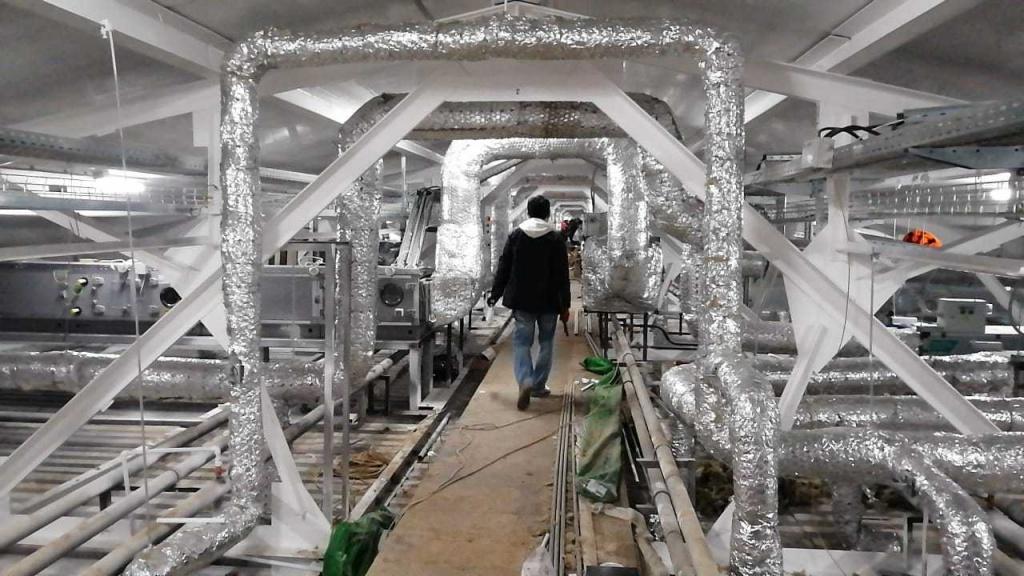
Ventilation system in the laboratory