Three architectural pearls of the Big Circle
One of the most difficult sections of the Big Circle Metro Line was entrusted to us! We are talking about the north-eastern direction of the capital, where since 2017 more than ten construction and installation departments of Mosmetrostroy have worked at the Sokolniki, Rizhskaya and Maryina Roshcha stations. When you first step onto the platforms of the new stations, you seem to find yourself in another reality: first, the “time train” arrives at the Sheremetyev estate, and then you are enveloped in a futuristic atmosphere with Gothic arches. And the journey ends with the heyday of the All-Union shock construction - these are the years of the founding of the legendary Moscow Metro Construction.
Уже в следующем году эти станции примут первых пассажиров, а пока подводим итоги вместе с корреспондентом «Метростроевца».
Впервые вступив на платформы новых станций, вы словно попадаете в другую реальность: сначала «поезд времени» прибывает в усадьбу Шереметьевых, после вас окутывает футуристическая атмосфера с готическими арками. И завершается путешествие эпохой расцвета Всесоюзной ударной стройки — это годы основания легендарного Московского метростроя.
“Maryina Roshcha”, “Rizhskaya” and “Sokolniki” are stations with a deep understanding of artistic images.
SOKOLNIKI: THE MOST METROSTROYEVSKAYA
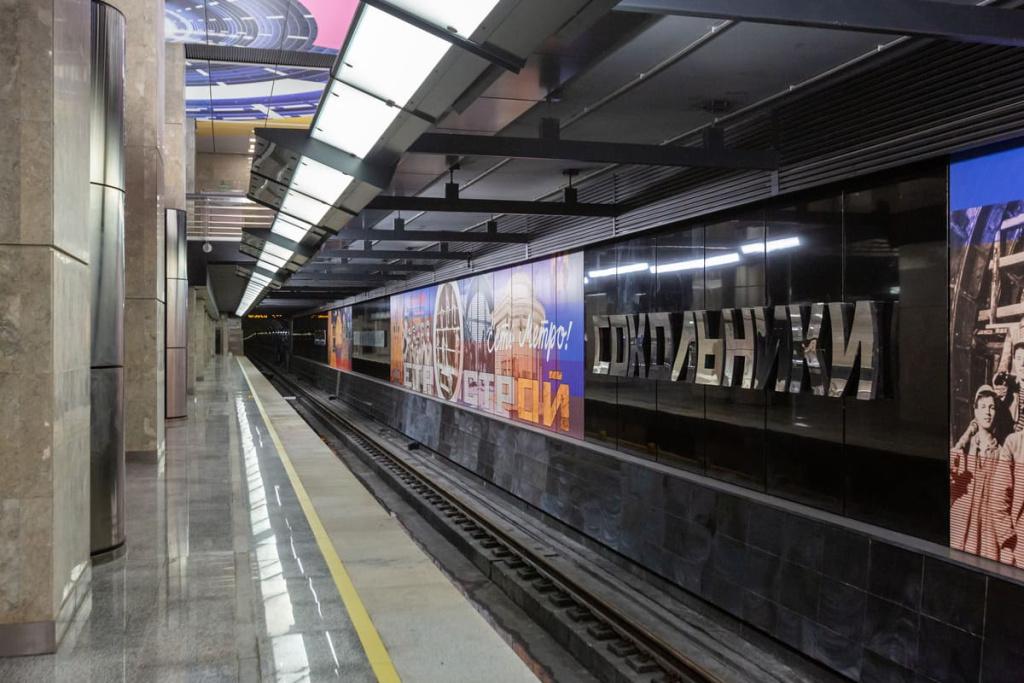
Back in the early 1930s, the first mine was laid on Rusakovskaya Street, and at the same time the first underground palaces of the capital’s subway. Years later, metro builders returned to the same place to continue the story - to build a new station as part of the largest transport project of the century - the Big Circle Line. The events of those years determined the architectural concept of Sokolniki of our time - Metrostroyevskaya.
Its design is dedicated to the formation of domestic metro construction and the people who laid the foundations for the construction of the capital’s subway. On the track walls of the station there are archival photographic materials, including those with famous workers of the Moscow Metro Construction: Tatyana Fedorova - the first and only woman to head the mine; Nikolai Kraevsky - an employee who was awarded the Order of Lenin for high penetration rates at the Okhotny Ryad - Lubyanka section; Ivan Filimonov, one of the first foremen who began to use the “Moscow” method of excavating shallow tunnels. In addition, you can find the organization's logo in one of the lobbies.
“Sokolniki” of the line of the same name became a kind of “alma mater” for thousands of Komsomol volunteers, who honed their professional skills with every meter they walked underground. The hard work that produced 13 beautiful stations of the first stage of the metro in the 1930s served as the basis for creating the architectural appearance of the new station, rightfully worthy of being called a museum of metro construction,” noted Sergei Zhukov, General Director of Mosmetrostroy JSC.
Today, looking at the restored alley paved with clinker bricks and lined with linden trees, it is hard to believe that just recently there was a foundation pit, cabins and endless construction equipment and materials. The new Sokolniki, due to its location, turned out to be the number one object under the close attention of local authorities and residents.
“It was a very difficult period in the life of the district with the closure of traffic on Sokolnicheskaya Square,” says Nasir Mamedov, deputy director for general issues of SMU-12, who in those years held the position of deputy head of the site.
According to him, the old engineering infrastructure added difficulties in developing the site. Before building the station, many underground communications were rebuilt: water supply, city sewerage, MGTS networks, power cables, heating network installation.
The construction work near the existing metro, which is also a cultural heritage site, caused no less trouble for the builders.
— In the area adjacent to the two Sokolniki stations, we were given a non-trivial task - to preserve the finishing in its original form. Considering that the factories of that time are no longer functioning, we considered dozens of materials that would meet the aesthetic and physical characteristics of the 1930s first stage of metro construction. Afterwards, the found marble was confirmed with the Department of Cultural Heritage and, as a result, they found one similar to that used in the 1930s,” Valery Mikhalev, chief engineer of the USR, shared his memories.
RIGA: THE MOST CENTRAL
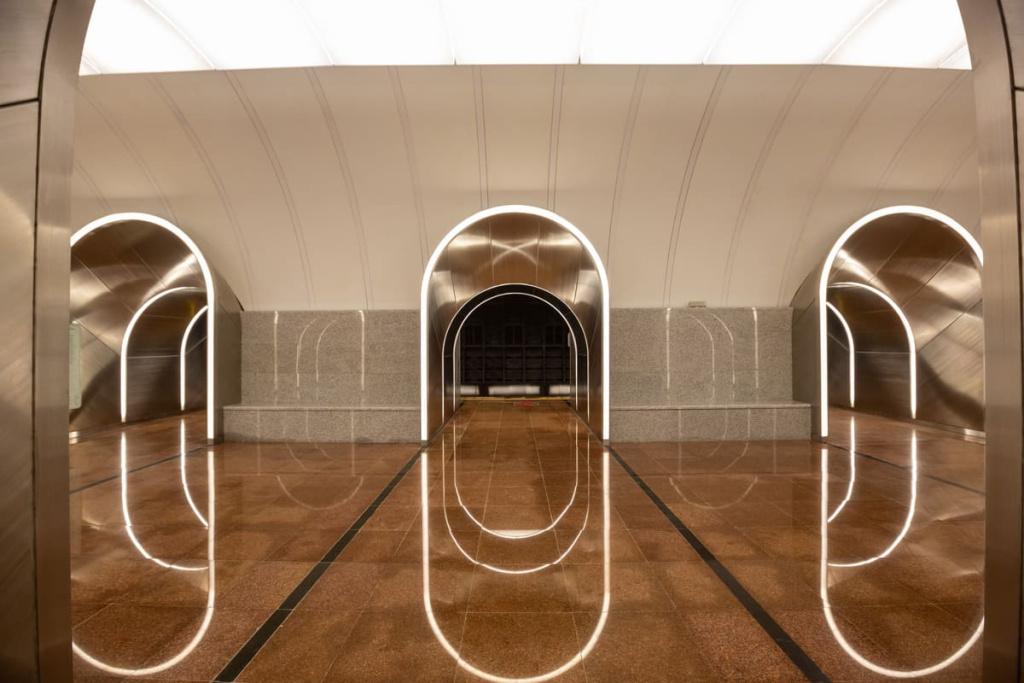
“Rizhskaya” is the closest of the three stations of the northeastern section of the Big Ring to the main square of the city and the only one located in the central administrative district. For its construction, the territory of the former Riga Radio Market was allocated, and the lobby was designed on the square of the Riga Station, which for several centuries had significance as the “gate of the city.” Associations with the location of the new station formed the basis of the project, where the main accents in the central hall are placed through 16 metal arches with built-in lighting, creating the feeling of temporary portals.
To reduce work time, distillation tunnels of the deepest section
from “Rizhskaya” to “Savelovskaya” they were laid using mechanized complexes. They started from a unique round pit on site No. 17 near the Riga overpass of the Third Transport Ring. The route, about 3.5 kilometers long, ran at a depth of 45 to 70 meters under five sections of the Moscow Railway and in the active metro area. The TBMs building the Rizhskaya and Maryina Roshcha stations proceeded in transit, constructing pilot tunnels at the site of the future stations. Subsequently, their diameter was expanded from six to eight and a half meters for the side station tunnels.
The head of the SMU-6 section, Nikolai Panov, has been building metro stations for more than 40 years and immediately notes that he first encountered the bulkhead of tunnels, when he had to break the reinforced concrete rings mounted with shields and install a permanent cast-iron lining instead.
— In the right tunnel there was a special robot destroyer, which broke the concrete into pieces, and then installed the tubes itself. Then we set a personal record - 50 rings in a month! This is a good penetration rate,” Panov says with particular pride. — The left tunnel was built using the traditional drill-and-blast method, but only part of it, because there were restrictions due to the proximity of the station of the same name on the Kaluzhsko-Rizhskaya line.
In addition, geology presented a difficult challenge for his site. During the excavation of the cable and ventilation manifold located above the station, the water inflow reached more than 200 cubic meters per hour.
MARYINA ROSHA: THE MOST RECORD
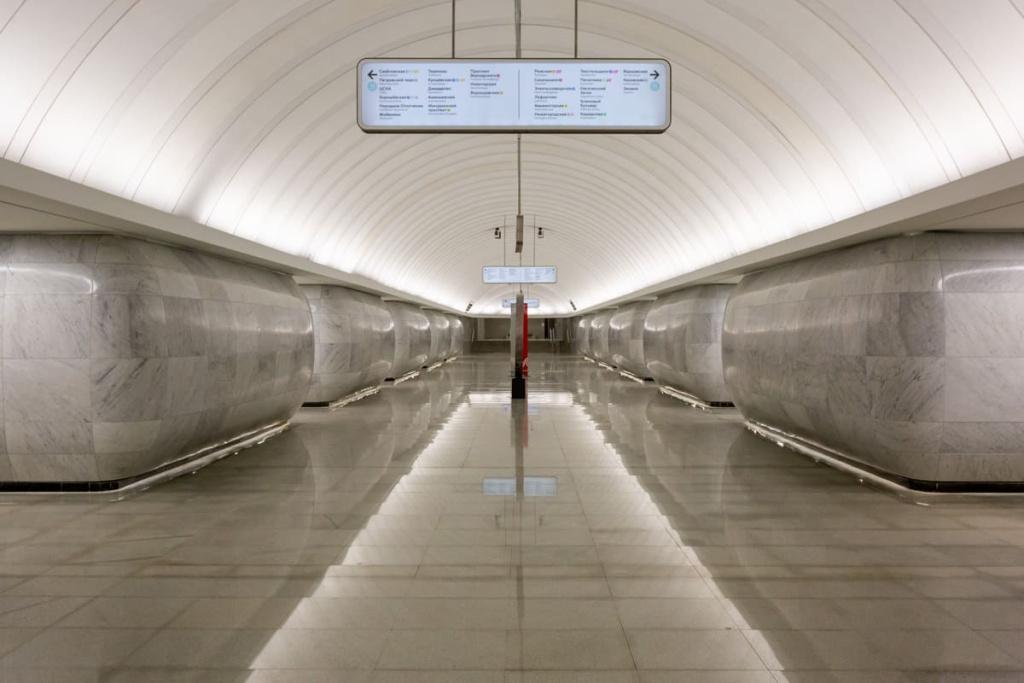
The Maryina Roshcha project was developed in the context of the count's estate and the aesthetics of porcelain. The only entrance pavilion along the perimeter is framed by steel ball-columns, and the convex pylons are a complex metal structure, the decoration of which includes 156 elements of marble products. During production, white marble of the highest grade was coated with “craquelure” - a notch in the form of a spider’s web, giving the effect of small cracks.
The process of their installation was labor-intensive. The weight of one part reached 95 kg, and it was necessary to precisely combine the rotating elements into a single structure, as if assembling a puzzle,” adds Valery Mikhalev, chief engineer of the USR.
The track walls of “Maryina Roshcha” and “Rizhskaya” are designed open, that is, with cast iron tubes left in sight (from English to tube - “to enclose in a pipe”, elements of prefabricated fastening of underground structures made in the form of a ring segment).
The cramped conditions of the ancient Maryina Roshcha district did not allow us to develop properly on the surface, and it was necessary to go even deeper underground, even below the existing station of the Lyublinsko-Dmitrovskaya line. The distance between them is slightly more than six meters. Its features don’t end there.
“For the first time, a traction-step-down substation, which is usually located at the station complex, was placed in the ground vestibule,” noted Dmitry Faizrakhmanov, deputy chief engineer of SMU-8.
And, of course, Maryina Roshcha is a record-breaking station. It owes such a high status primarily to the depth of its location - more than 70 meters, where the longest escalator in Moscow was installed - 130 meters. This is three meters more than the previous leader, Victory Park.
After the launch of Maryina Roshcha, passengers will be able to go to the station of the same name on the Lyublinsko-Dmitrovskaya line, and in the future transfer to MCD-2 and MCD-4. Near the station there will be parking spaces for cars and taxis, as well as recreation areas.