Building underground walls
The builders of “walls in the ground” began work in the new year without “vacations” - on January 3. At the 26th site, two grabs are moving along the perimeter of the future pit of the platform part of the new Aviamotornaya. By January 12, taking into account the December seizures, more than fifty linear meters of the “wall in the ground” were concreted here.
Nikolai Kudryavtsev’s section from SMU-9 is used at five facilities of the Third Interchange Circuit, including Aviamotornaya. Three of them are daily supervised by his deputy Alexey Sukhov. At all sites, the same task is solved - the construction of a “wall in the ground” to enclose one or another construction pit. At Aviamotornaya they will make it impressive: thickness – 80 centimeters, height (depth) – about 30 meters. It is difficult to imagine such a structure on the surface. But underground, the soil itself holds the wall together.
“It’s true that you have to build it “by touch,” says Alexey Sukhov, deputy head of the SMU-9 site. – The grab bucket dives into the thickness of the bentonite. And the result is visible only at the time when the foundation pit is being dug out, but the main structures of the facility have not yet been erected.
At this stage, the dismantling shield chamber No. 2 is located, where the shields coming from Lefortovo will eventually break through. Now SMS machine operators take the soil from there, and the fastening belts below the strapping beam and directly on the “wall in the ground” are installed by specialists from Yuri Smykalov’s site from SMU-1.
But the “wall in the ground” of shield chamber No. 1 was handed over to the concrete workers of SMU-1 for the construction of a strapping beam along its contour, and the wall itself is not yet visible. But what immediately catches your eye are two transverse bridges, on which the bundles of telephone wires that got into the “body” of the future station are temporarily transferred. They remind us of one of the main obstacles to underground construction in the metropolis.
“We encountered the whole range of communications here,” explains Alexey Sukhov. – And telephone wires, and power cables, and water supply, and gas, and sewerage. They are indicated on the drawings, but the problem is that the design position does not always correspond to the real one. So, before starting the main work, you have to do more digging, clarify where and what has been laid, and then look for the “owners” and negotiate.
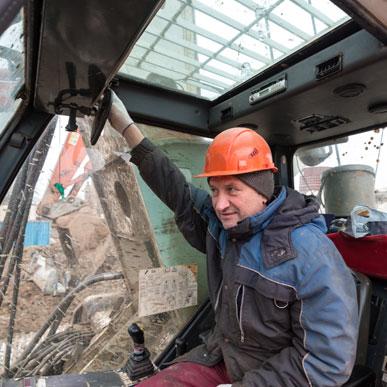
Sukhov adds that the powerful machines are driven by real professionals, experts in their field.
“Everyone understands the task exactly, feels the car, although to varying degrees,” says the deputy head of the site. “But younger people have someone to learn from.” For example, Ivan Novichikhin, Oleg Ivanov, Nikolai Zinenkov. Some people still remember domestic grabs and even how piles were driven into the ground to fence pits.
DIRECT SPEECH
Alexey Balakin
Contract Manager
During the construction of the enclosing structures of the Avia-Motornaya pit, we were faced with a large volume of removal of utility lines, reconstruction of tram lines, highways and demolition of buildings.
Work was completed to construct a “wall in the ground” on two dismantling chambers along the edges of the station. After the demolition of TP-14 and the closure of the road, they began to develop the platform part, vestibule No. 1 and the inclined track.