Man of Steel
The tunneling foreman posed for Vera Mukhina
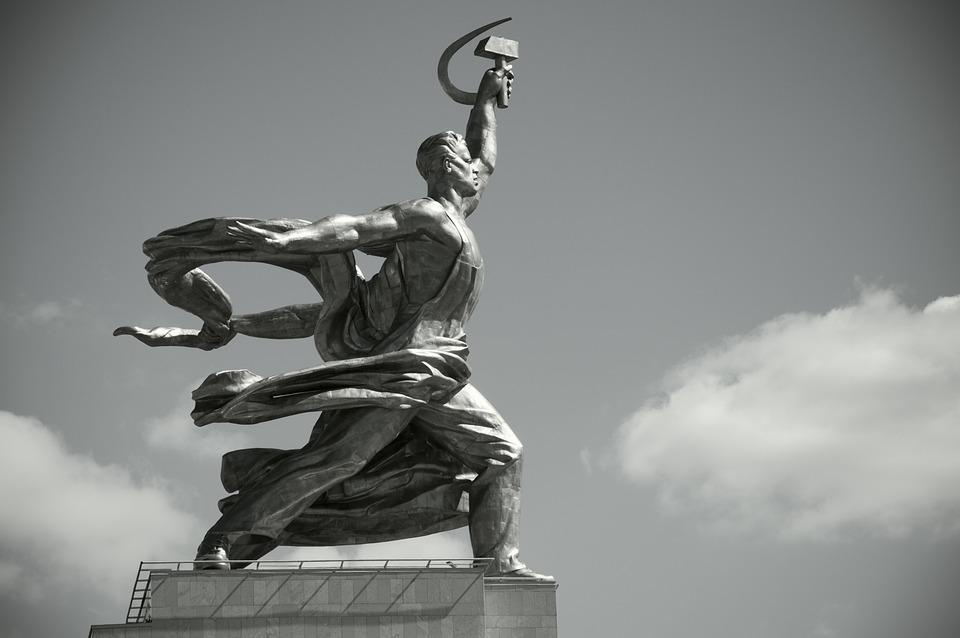
Almost 80 years ago, on November 25, 1937, the World Exhibition in Paris, held under the motto “Art and Technology in Modern Life,” ended. Particular recognition was given to the sculpture “Worker and Collective Farm Woman” by Vera Mukhina, which became the main symbol of the Soviet pavilion. The prototypes of the images of the heroes of the monument were metro builders Sergei Kasner and Zoya Mukhina (the surname coincided by chance).
First, Vera Mukhina invited professional sitters. And, for example, she began to sculpt a worker from the former ballet dancer Igor Basenko. The figure seemed to be quite suitable, but the artist’s face - not at all proletarian - did not correspond to the new role. Mukhina saw the people she needed in Gorky Park at a rehearsal for a physical education parade: a young man and a girl were being transported on a platform mounted on motorcycle wheels. They held in their hands the symbols of the country of the Soviets - a hammer and a sickle. These were metro construction workers - the foreman of the tunnelers, and later the shift engineer Sergei Kasner and the pumper Zoya Mukhina. They have been depicted since then in the famous sculpture.
“Zoya has a highly raised sickle in her right hand, she personifies the peasantry, Sergei has a hammer, but in his left hand,” says historian, Moscow expert Mikhail Fedorov. “It reflects the working class of the country. The monument became a symbol of the achievements of the great Soviet Union.
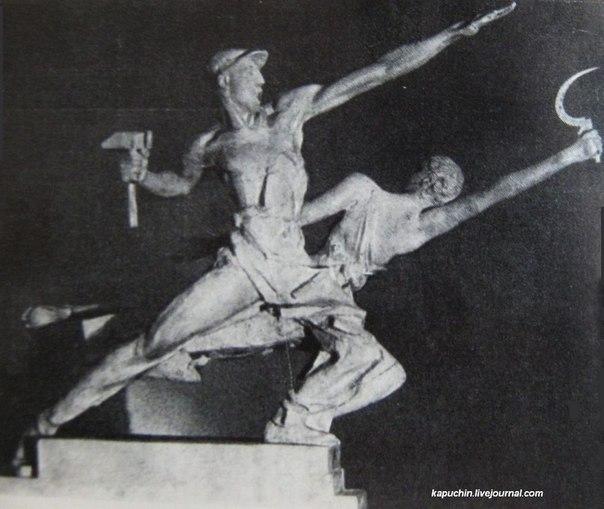
By the way, one of Vera Mukhina’s competitors (a total of four sculptural projects were considered), Ivan Shadr, put a hammer in his worker’s right hand, which was also drawn back. It turned out right from a production point of view, but the idea of readiness to work shoulder to shoulder disappeared.
Zoya Mukhina was very tired from posing motionless, and special supports were invented for her. And Kasner behaved well. He was an excellent athlete, not only did classical wrestling himself, but also organized a section at mine No. 15-16. Sergei Kasner also distinguished himself in production. Arriving at the construction site at the end of 1933 with ten thousand volunteers, he easily mastered new professions and grew as a specialist. He was awarded the "Jackhammer Master" badge. In 1936, Sergei became a shift supervisor, but did not give up his sports activities.
In November 1941, Kasner was sent to Siberia at the disposal of the Kuzbassshakhtstroy trust. What the metro builder did between the ages of 36 and 41 is more difficult to trace. According to one source, Kasner participated in the creation of defensive structures around the village of Borodino, and according to another, he worked at special facility No. 16. There is a third option regarding the mysterious Metro-2. If Kasner really worked at a secret facility, then it becomes clear why he was never allowed to go to the front. But in the deep rear - please.
Alexey Veselovsky, great-grandson of Vera Mukhina:
The monument “Worker and Collective Farm Woman” is the most famous creation of Vera Mukhina. It has been reproduced many times in different forms - from movie screensavers to postage stamps. But I believe that Mukhina’s creative legacy as a whole is great and cannot be reduced to one monument.
HELP
Vera Mukhina was born in 1889 in Riga. She spent her childhood and youth in Feodosia, where her father took her, fearing for his daughter’s health. Here the future artist received her first lessons in drawing and painting. Having moved to Moscow, I decided to study art professionally. Then she began working as a fashion designer, creating theatrical costumes. During the First World War she became a nurse in a hospital. In 1916, she nursed a young surgeon-officer, Alexei Zamkov, who was sick with typhus. And in 1918 she married him.