A quarter of a century in color
The employees of the Mosmetrostroy Administration celebrated the New Year 1995 with a housewarming party. The long-awaited move to spacious, bright offices on Tsvetnoy Boulevard had been awaited for seven years.
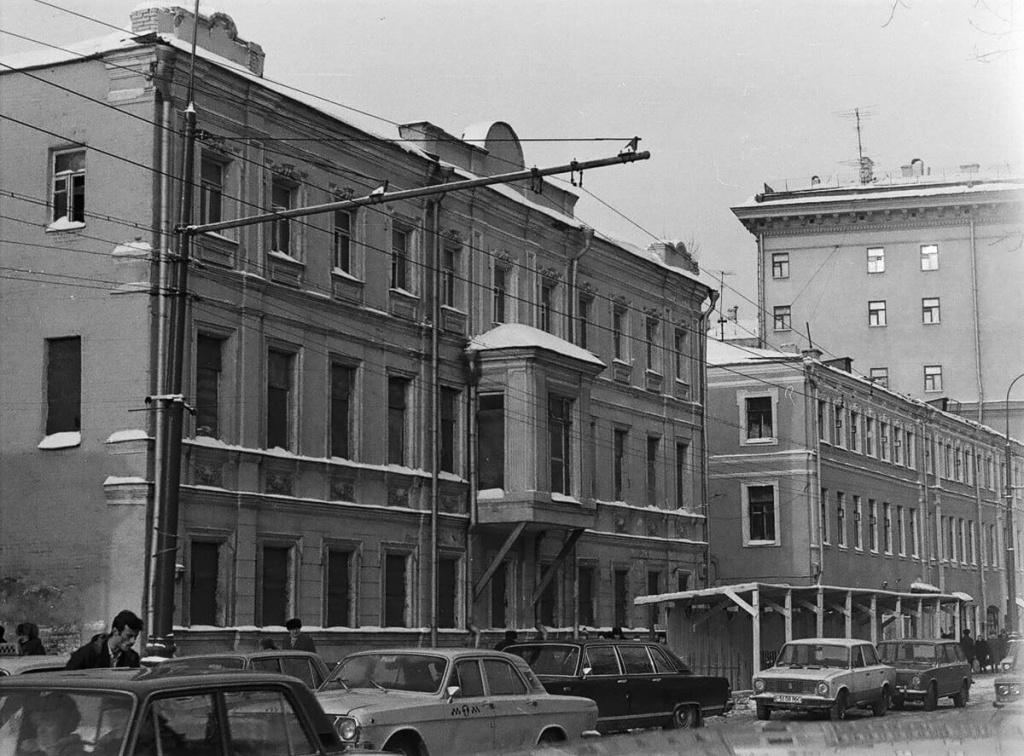
House of Fyodor Malyushin, 1986
FROM ILYINKA TO MALYUSHENKA
Since the founding of Metrostroy in 1931, the Department occupied a complex of buildings in the very heart of the capital, on Kuibysheva Street, 3 (now Ilyinka Street). During the lunch break, metro construction workers walked along Red Square, went to GUM to see fashionable new items and enjoy the legendary creamy ice cream.
The old three-story mansion housed all the employees of the Department, Mosmetrotranskomplekt, a canteen and a library. Until the 70s, the editorial office of Metrostroevets and the Komsomol committee were based here. Later they moved to the chambers of the Ilyinsky Metochion, their offices were occupied by the transport department and the control room. Employees of the party committee and dorprofsozh worked in a separate building. Over time, the premises required global reconstruction, and the move was a matter of time.
The metro builders found a new building in an equally historical area. Once upon a time they called her Little One. “They are rich from Malyushenka, there are armor removed, there are crumpled chervonets, there the Tick stabbed me...” - these lines were written by Vladimir Vysotsky, whose youth was spent next door on Bolshoi Karetny.
Fyodor Malyushin, after whose last name the neighborhood was nicknamed, was a famous merchant, owner of the tea trade and furnished rooms in the 19th century. His house at number 19 was demolished in the late 1980s. It was located right at the exit from the Tsvetnoy Boulevard metro station.
The Tsvetnoy shopping center located next door was built only in 2010. For a long time, from the windows, Department employees observed the dilapidated building of the Central Market, which was closed in the mid-1990s. Trading stalls with flowers, seedlings and seeds have existed here since the 19th century. The oldest circus on Tsvetnoy Boulevard is also located here.
Metro builders joked that they built the metro station at the personal request of Honorary Metro Builder Yuri Nikulin, providing the shortest route to the circus.
HOW THE BUILDING WAS BUILT ON Tsvetnoy
Tsvetnoy Boulevard station opened on December 31, 1988. The building above it, which has an atypical design, was built in parallel, but the housewarming took place only seven years later. The main work was carried out by SMU-13 under the leadership of Alexander Suslov, they were assisted by SMU-4 and USR. The construction of the building on Tsvetnoy was supervised by Ivan Petrosyan, deputy head of Metrostroy. They built it during breaks between work on other sites - houses on Astrakhansky Lane, the lobby at Petrovsko-Razumovskaya, the Pechatniki depot, the early launch of the Altufevskaya station.
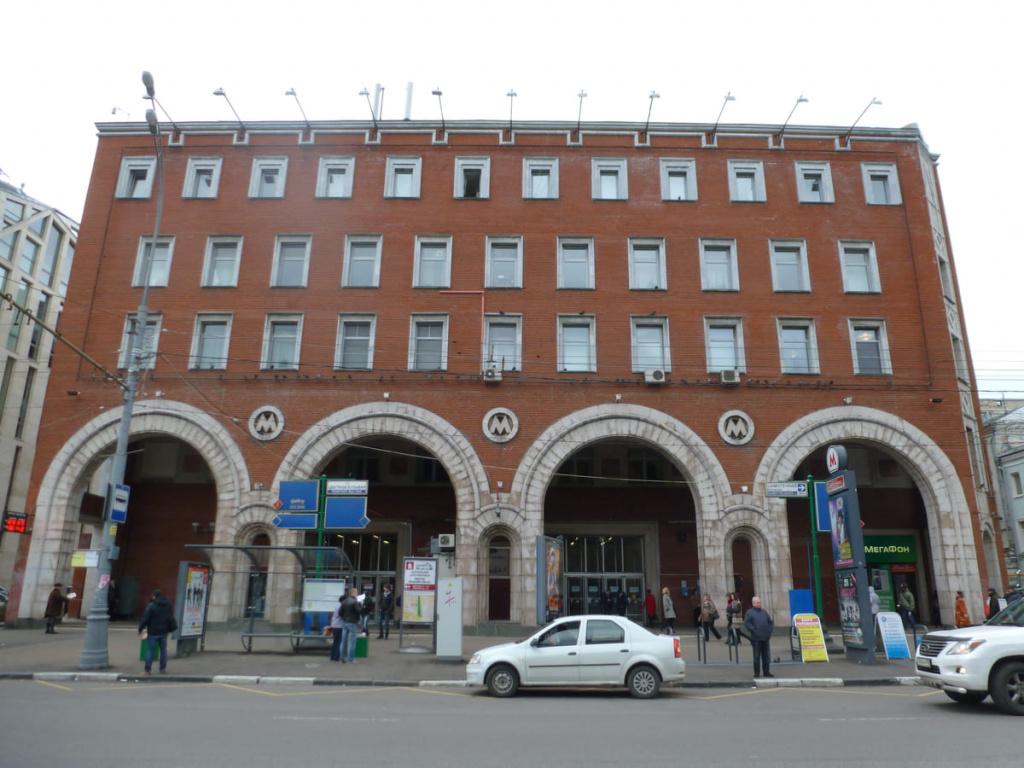
Mosmetrostroy Administration Building
The authors of the project for the new building for the Department were specialists from workshop No. 14 of Mosproekt-2 named after. M.V.Posokhin. The chief architect is Mark Feldman, the chief designer is Victor Parnes. The building and the entrance to the metro formed a single structure. The main façade of the building “lies” on the station lobby, as if “growing” out of it. The junctions with the vestibule and the inclined track were strengthened with bored piles and isolated from vibration and noise of passing trains.
The bright red and white color scheme at that time matched the houses in the neighborhood and was familiar to ancient Moscow buildings. The arched loggia entrance to Tsvetnoy Boulevard is reminiscent of the first metro stations. Belorusskaya, Paveletskaya, and Park Kultury have similar entrances. The finishing of the building began only in 1993. Inside, the architects used motifs from the 1940s and 50s: plaster stucco ceilings, massive chandeliers, walls in colored marble. Decorating the walls of the conference room with a wave-like shape has become one of the most labor-intensive. USR employees were also often diverted to basic work to prepare metro stations for launch.
Over the course of 25 years, reconstructions took place inside the building. Partitions in offices appeared or were demolished, windows were blocked up. More recently, the dining room has been turned into cozy offices for UMC employees.
PRESERVED TRADITIONS
– We ordered vans from Metrostroev car depots. The move was long and difficult. The whole department had to be moved. We started in December and finished after the new year. The rooms were assigned in advance. Some of the furniture was taken from Ilyinka, the rest was purchased new,” recalls Alexander Pukhov, chief specialist of the administrative and economic department of Mosmetrostroy JSC. – But the New Year was already celebrated on Tsvetnoy. Decorated the Christmas tree.
“It was more crowded at Ilyinka, which is why the employees were maximally immersed in production issues. All departments were involved in the common cause, visited each other, lived as if in a communal apartment. We moved to Tsvetnaya as if it were a new spacious apartment. Previously, there were eight people, now there are four,” recalls Vyacheslav Nosaev, a veteran of Mosmetrostroykomplekt OJSC. “The metro builders brought not only furniture, but also good traditions to the new building. Like any holiday, the New Year was celebrated with feasts, fun, and soulfully. In each office, departments gathered, held dances, and dressed up in carnival costumes. The leadership of Metrostroy, represented by the chief, with deputies and representatives of public organizations, entered each department and congratulated the metro builders.
INTERESTING
Metro builders have always had many New Year traditions. We held events at the House of Culture on Kostomarovsky Lane (Christmas trees for children of metro construction workers, concerts, carnivals and dances), festive evenings in dormitories, and decorated construction sites with New Year's paraphernalia. Have a nice New Year's tradition was the opening of new metro stations for Moscow residents. Over its almost 90-year history, the Moscow Metrostroy presented the capital with 69 stations on 11 metro lines for the New Year (from December 25 to January 5). "Elektrozavodskaya" of the Big Ring will be in its seventieth anniversary.