Inventor of the first shield
The first tunneling shield was not round. He laid rectangular tunnels, which were immediately lined with brick. The mechanism was invented by the English engineer Mark Brunel; he called his son Isambard his main assistant. It is to him that the book of the prose writer Andrei Volos, “The Life of Isambard Brunel, as if he had told it himself,” is dedicated to him. At that time, Brunel the Younger was not yet twenty, and sometimes he did not leave the construction site for several days.
Проходку первого тоннеля под Темзой начали в 1825 году – из шахтного ствола глубиной 20 метров, сооруженного в 45 метрах от реки. Тогда Брюнелю младшему еще и двадцати не исполнилось, а он иногда по несколько суток не покидал строительную площадку.
The shield was not solid - it consisted of 12 three-tiered sections. This created 36 cells, jobs for miners. The cells were separated from the rock by horizontal sections of boards supported by jacks. The workers developed the layers, one by one removing boards from them. At the same time, the builders remained under the protection of the metal structure. The sections moved independently of each other, but the excavation leaders tried to maintain the common front, that is, a single line.
The Thames made itself felt several times during construction. There were also breakthroughs of huge masses of water. The most powerful one occurred on the night of January 13, 1828. One builder did not have time to dodge the flow. The workings were completely flooded. The hole was repaired from the Thames side using a diving bell. The water was pumped out for several months. The excavation was resumed only seven years later, when the construction company received a government loan.
The long-awaited finish took place in 1843 - the public began to walk through the tunnel. It remained pedestrian until 1869, when it was included in the metro line. And, most importantly, the brick-lined first-born is still in working order. For almost a century and a half, trains with passengers have been running along it.
“The heroes - Brunel's son and father - have become for me the embodiment of the idea of technical progress,” Andrei Volos told the Metrostroevets correspondent. – My engineering education helped me work on the book. Actually, this topic made me re-evaluate something. Now I clearly understand that the industrial revolution in England was a great era. And, most likely, it seemed simply terrible to contemporaries. “The more interesting a century is for a historian, the sadder it is for a contemporary.” From a young age I have been riding the Moscow metro and love it very much. It only gets better over time, despite the overload. Probably, the first builders did not imagine what Moscow would become almost a hundred years after the start of their work. I wish modern builders good luck and ingenuity, which would allow them to find a way out of bottlenecks - literally and figuratively.
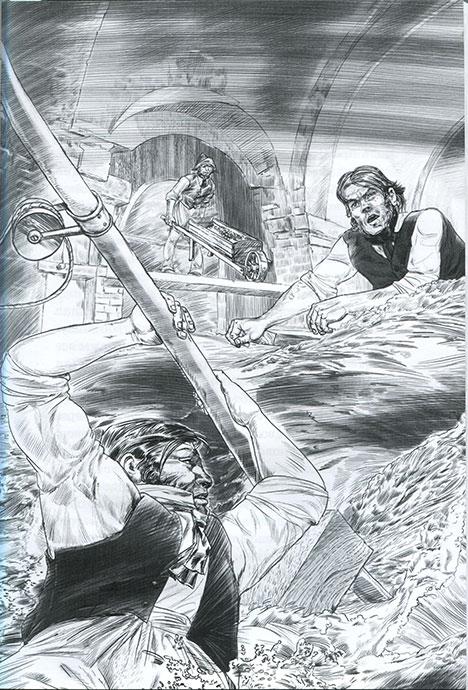
Illustration by Vasily Khramov for the book “The Life of Isambard Brunel, as if he had told it himself,” Moscow: Publishing House “E”, 2016