Always ready for Victory Day
2025 is a special year for Russia: 80 years ago, the USSR defeated the most terrible beast - Hitler's Germany, which enslaved all of Europe. At the cost of incredible sacrifices and efforts of our grandfathers and grandmothers, fathers and mothers, sisters and brothers, representing 15 union republics, the Fatherland freed itself from the brown plague and hoisted the Victory Banner over the Reichstag.
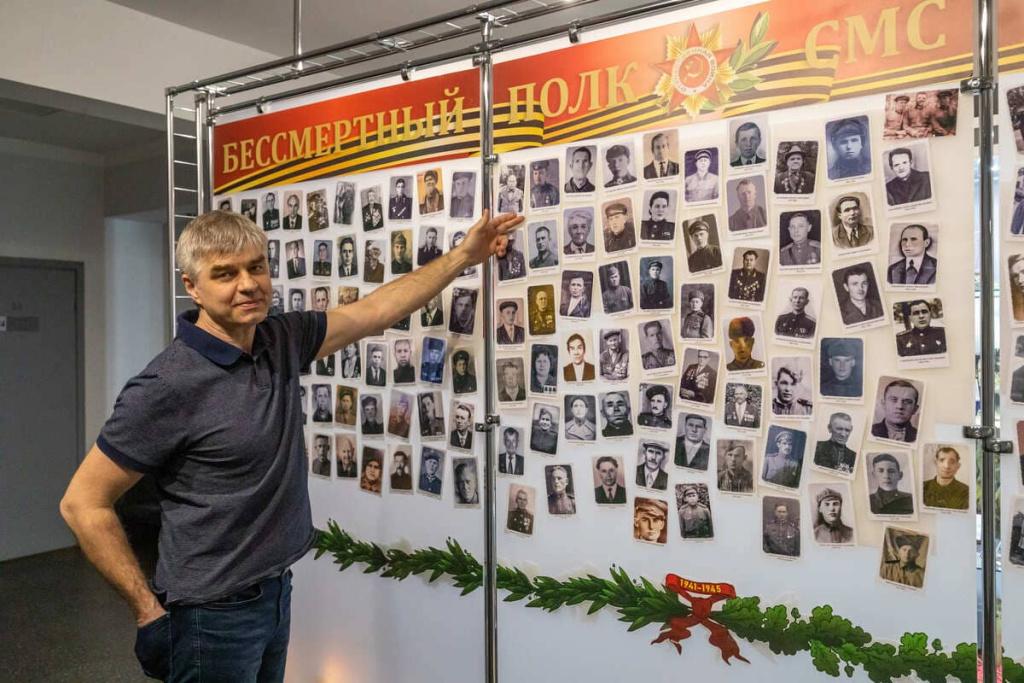
The descendants of the winners remember and honor the memory of their loved ones and every year on the eve of May 9 they remember their feat. The All-Russian “Immortal Regiment” is the clearest proof of this. Stroymekhservice Metrostroy also has its own “regiment”. Director Anatoly Syomushkin, deputy directors Oleg Alabushev and Andrey Dortsev spoke about the attention with which people prepared for the anniversary of the Victory, about the participants of the Great Patriotic War, whose photographs are presented at the stand, introduced them to the exhibits displayed in the window, and remembered those who supported the idea and helped with artifacts.
Behind each photo there is a story
The Immortal Regiment stand features more than 150 photographs. I looked with interest at the faces in the photo - calm, with anxiety in their eyes or confidence and hope for a bright future. There are also photographs taken before June 22, 1941. So different, but united by one destiny - to become defenders of the Fatherland.
Behind every photograph is a life-long story, a story in which the war has left an indelible mark.
Andrey Dortsev says: “Each of us has something to tell about our loved ones, whose photos are posted here. My example is two brothers who went to the front as young boys.
Mozheiko Robert Semenovich, drafted on June 23, 1941 at the age of 20, and Mozheiko Leonid Semenovich, who went to the front in October 1941 at the age of 18. Two brothers - two sides of the same coin. Robert Semenovich, my grandfather, told me that he had to get his first machine gun in hand-to-hand combat with the enemy and his assistant was a rifle with an attached bayonet. I learned more about Leonid Semenovich from the Internet, although both brothers, fortunately, returned from the war alive. In the Berlin operation, over the course of a few days in April 1945, a howitzer division commanded by Leonid Semenovich destroyed over 800 enemy soldiers and officers. During these battles, about 300 enemy soldiers and officers also surrendered.
When the enemy came to them in 1941, young guys, yesterday's schoolchildren, went to the front, and returned after the end of the war as officers. Real lieutenants of Victory, heroes who became officers not after college, but in the trenches and in positions, having completed short-term courses. Leonid Semenovich is a holder of two Orders of the Red Banner, the Order of the Red Star, two Orders of Alexander Nevsky and the Order of the Patriotic War, 1st degree.”
“Of course, career officers and military leaders are among our heroes,” says Oleg Alabushev. – My relative, Lazko Grigory Semenovich, met the beginning of the war with the rank of major in the position of chief of the operational department of the 45th Rifle Corps of the Kharkov Military District. In 1943, already with the rank of major general, he was appointed commander of the 30th Rifle Corps, which took part in the Battle of Kursk and the Battle of the Dnieper, Zhitomir-Berdichev and Rivne-Lutsk offensive operations. For its distinction during the liberation of the cities of Stanislav and Budapest, the corps was given the honorary name “Stanislavsky” and “Budapest”.
Despite his high ranks, according to the recollections of his fellow soldiers, this large and heavyset man, distinguished by his fearlessness, personally repeatedly led soldiers into attacks, and, being surrounded by the division, he himself went on reconnaissance. For the exemplary performance of command tasks and the courage shown at the same time, Grigory Semenovich was awarded the Orders of the Red Banner, Red Star, Kutuzov 2nd degree, Suvorov 2nd degree (twice).”
“War is not only the front line and hospitals,” Andrey Dortsev continued the dialogue. – These are also human destinies. My grandfathers were lucky to return from the war alive. Both Stepan Stepanovich Dortsev and Robert Semenovich Mozheiko returned. In the family archive there is a photograph with a dedication “In memory of my best friend and comrade Robert Mozheiko” from two young girls... “Together we are going to the front with you. June 23, 1941. Tomsk". After the war, Robert Semenovich could not find these girls. It’s interesting that now, while preparing materials for the stand, I accidentally found on the Internet exactly the same photo, but with a dedication to my mother and father. This photo was posted on the blog by one of the grandchildren and in his post he told how honorably these girls fought. That’s how I learned their history, including the post-war one.”
“We learned a lot of interesting things while preparing,” Oleg Alabushev supported the dialogue. – On the website “Memory of the People” I found an award document for Red Army soldier Sofya Efimovna Lazko with a presentation from the commander of the 307th Infantry Division, Colonel Grigory Semenovich Lazko. This also happens. Husband and wife fought side by side. And they were awarded, apparently, because in November 1941, when leaving the encirclement of the 307th Infantry Division, it was this fragile girl who carried the division’s banner on her body.”
Another photo and story from the stand - here is the cover of the Ogonyok magazine No. 14-15 for 1944: “Collective farmer Grigory Ivanovich Pompik performed a glorious feat. He led our advancing soldiers bypassing the German minefield secretly behind enemy lines through a ford on the Ingulets River, which the Germans did not know about, which made it possible to deliver an unexpected blow to the enemy and complete the combat mission.” Grigory Ivanovich looks at us from the center of Ogonyok. His great-grandson, chief engineer Pompik Alexey Sergeevich, is in the office nearby.
Oleg Vladimirovich also told the story of the father of the retired Irina Aleksandrovna Gavrilenko, who worked at Stroymekhservis for more than 20 years. “At the Immortal Regiment stand there is a photograph of her father, a participant in the French resistance. Irina Alexandrovna’s grandfather was a tsarist officer who served under Wrangel, with whom he went to the Balkans. Irina Alexandrovna's father was born there. Then his family moved to France, where Alexander grew up, received his education, and fought in the French resistance during World War II. At the end of the 50s, the family was allowed to return to their homeland.”
Unfortunately, not everyone knows about the fate of their relatives. For example, Deputy Director for Operations Yuri Shleev found out where his grandfather Nikolai Vladimirovich was buried by chance: during the preparation of the stand, he found information about his heroic death in Belarus.
Driver director Alexei Kachkov's two grandfathers went missing: Vasily Prokhorovich Kachkov and Pavel Azarovich Komarov. “My parents,” he says with pain, “lived without fathers, and we without grandfathers. There is no information about Pavel Komarov: he disappeared in 1943. He was called up from the village of Lgovka, Oryol region. Vasily Kachkov fought in the 3rd Infantry Division and disappeared near Leningrad.”
Parallels of the Second World War and Northern Military District
In addition to the “Immortal Regiment” stand, Stroymekhservice has a showcase dedicated to the defenders of the Fatherland from 1941 to 1945. and SVO. “We wanted to draw parallels between the heroes of the Great Patriotic War and the Special Military Operation,” explained Anatoly Syomushkin.
Behind the glass display case are the finds of the “Memory of Metrostroy” detachment, original documents and authentic awards of WWII participants - relatives of our workers, and soldiers of the Northern Military District - personal belongings, letters. A rusted helmet from the fields of the Great Patriotic War and a bayonet stand side by side with fragments of ammunition from the battle site in 2014 in the village of Novosvetlovka, Lugansk region. The leather field bag of an Afghan warrior is located next to the unloading of the deceased soldier - Pavel Chernyaev. Nearby are touching letters from his younger sister and parents. A young, smiling, cheerful guy from the Moscow metro... There is always room for heroism in life. The trouble is that heroes often become posthumous.
Pavel’s parents came to Metrostroy’s Stroymekhservice to see the exhibition. Together with grandmother and daughter. We chatted over a cup of coffee. They are simple teachers, my grandmother remembered in a conversation that the history of their family can be traced in Moscow even before the period when Moscow was burning, burned by Napoleon. Pavel's sister is 15 years old. Of course, she will retain the love for her brother, with which her letters to him and drawings are imbued, for the rest of her life. And, probably, like his parents, he will become a teacher. Because this family knows first-hand what it means to love the Motherland and what values to instill in young people.”
Next to the display case there is a large colorful printing with the names of the heroes of the metro builders and objects built by the metro builders during the war. The Moscow Metrostroy has trained 52 Heroes of the Soviet Union and one Hero of Russia.
One of the heroes is Alexander Sergeevich Morukhov. He worked in the Moscow Metrostroy for two years before the Great Patriotic War and 42 years after. And during the war he was the commander of the bilge department on a submarine. He received the Hero Star for saving the M-35 submarine. “At the beginning of my career, it was Alexander Sergeevich who became my mentor at SMU-4 of Metrostroy,” recalls Anatoly Syomushkin.
Reserve officer Ruslan Bublii put a lot of work and soul into preparing models of Soviet military equipment for the 80th anniversary of the Victory. The models are posted here, in Stroymekhservice, for public viewing. Exact copies made in compliance with proportions and scale. It's hard to believe that this is handmade, and the base material is multi-layer paper!
A special place is also occupied by a copy of the Victory Banner, made by Ruslan Nikolaevich in the proportions of the original. Before the capture of Berlin in 1945, several such banners were made for 8 assault groups, so that one of them could be hoisted over the Reichstag. The artists made them in one night. Ruslan Nikolaevich made the same banner: the same proportions, the text is written in oil paint, and the image of a hammer and sickle is applied in silver.
Under the Banner - photo of the first Victory Parade in 1965, where the Victory Banner is carried by metro builder Konstantin Samsonov - colonel, participant in the storming of the Reichstag, Hero of the Soviet Union. He is assisted by two fellow soldiers, Mikhail Egorov and Meliton Kantaria, participants in the storming of the Reichstag, who together hoisted the Banner in 1945.
“The memorable exhibition turned out to be visual, at the same time solemn and touching,” continues Anatoly Vasilyevich. – We are grateful to everyone who took an active part. I would like to say a special thank you to Pavel Yuryevich Kalinin, Deputy Director of KSUM JSC; Ruslan Nikolaevich Bubley, a talented decorator and author of models; to the parents of Pavel Andreevich Chernyaev, I want to thank the search team “Memory”, the volunteer groups “Mobilization” and “Zaryanka” and all caring colleagues.”
Natalya Dolgushina