How the roundabout changed in archival projects
Next fall our company turns 90 years old. This is how long our team has been building the best metro in the world. Starting with this issue of Metrostroevets, we are publishing a series of articles about our history, based on documents from state and departmental archives, as well as our newspaper files. Most of the materials will concern the first five stages as a tribute to the memory of veteran metro workers. Let's start with the Circle Line, which celebrated its anniversary this year. 80 years ago, on January 1, 1950, its first section from the Kurskaya station opened.
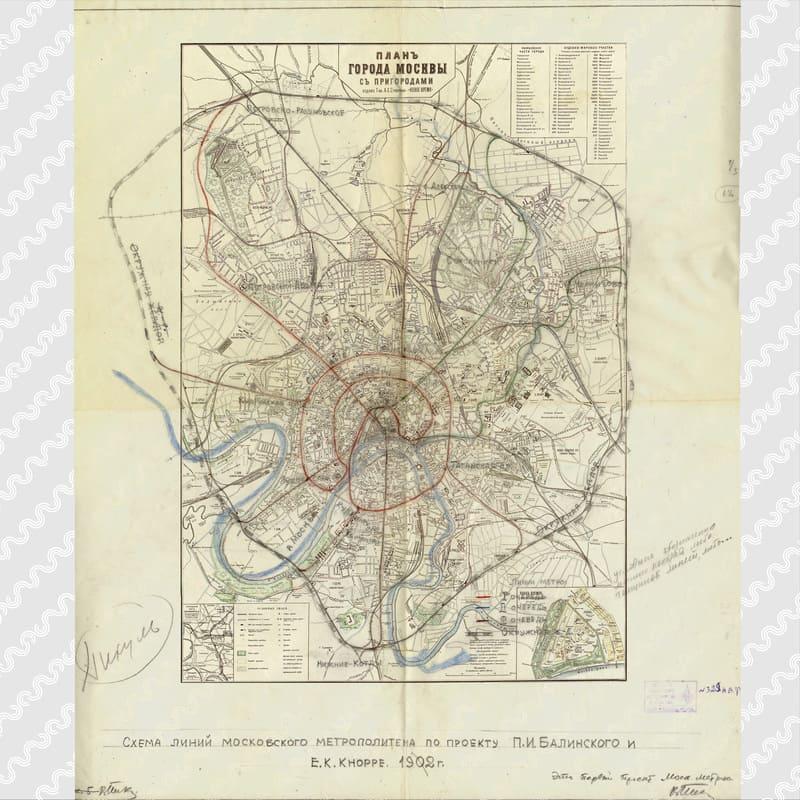
Diagram of Moscow Metro lines designed by P.I. Balinsky and E.K. Knorre. 1902 Drawn by engineer Vadim Pikul in 1931
The history of the Circle Line began more than 100 years ago. In 1902, engineers Pyotr Balinsky and Evgeny Knorre presented a project for the Moscow Metro, where there were two Circle lines connected to each other. One of them passed under the Boulevard Ring, and the second – under the Garden Ring. Radial lines diverged from the central station on Red Square to different parts of Moscow - to the dacha area of Petrovsko-Razumovskoye, Sokolniki, Cherkizovo, to the Novodevichy Convent and to the Paveletsky Station. The structure of Moscow streets dictated the radial-ring metro system, therefore, in all the various presented metro projects, the Circle Line was present in one way or another.
The First World War, revolution and intervention greatly delayed the very need to build an underground railway. The capital's transport infrastructure has fallen into disrepair. In 1920, tram traffic virtually ceased in conditions of economic devastation. Only in the mid-20s, as passenger traffic in Moscow grew, did they return to the idea of building a metro.
FIRST METROPOLITAN PROJECTS
In September 1923, by order of the Moscow City Council, a subdepartment for subway design was created under the Tram Administration (since 1927 - the Administration of Moscow City Railways (MGZD)). Initially, it consisted of a single employee - engineer Konstantin Myshenkov. At the same time, negotiations were underway on the design of the subway with the Siemens-Banunion company. German engineers had experience in such construction, which we did not have. The end result was two different projects. They were united by the presence of the Circle Line. The first pre-revolutionary projects were not implemented. We can say that Moscow was lucky in this sense. We would end up with a primitive metro system, without any architecture, convenience or planning.
In the scheme of the Moscow Metro lines, approved by the Council of People's Commissars of the USSR on March 21, 1933, the Circle Line was not included. It soon became clear that this was a wrong decision. At the beginning of 1937, our newspaper published two materials about the third stage of construction, which already included the Ring Road. Moreover, in the first article (Drummer of Metrostroy, No. 4 of January 8, 1937) it is presented in full, but with ten stations. Its route passes under the Garden Ring. The second note (Udarnik Metrostroy, No. 8 dated January 10, 1937) talks about the launch section from the Kurskaya station to the Park of Culture and Leisure.
It is interesting that in the resolution of the Council of People's Commissars No. 1316-31ss of December 14, 1938, according to which the construction of the third stage began, the Circle Line is again missing. Its construction was postponed to the fourth stage due to the completion of the reconstruction of the Garden Ring, which at that time was coping with the transportation of passengers by ground transport.
Here it is worth clarifying that there were two rings in Moscow: A and B. A is the Boulevard Ring, B is the Garden Ring. And usually two Circle lines were designed. In memory of this, at the Kurskaya station of the current Ring Road it is written: “Kurskaya Station of the Big Ring”. The little one never showed up. Transfers between radii turned out to be quite enough.
The completion of the third stage was prevented by the war. But even without this, by June 1941, all the deadlines set by two government decrees had already been missed by a year. And after June 22, 1941, the construction of the metro stopped. Our metro builders went to the front to build special facilities, railways, and defense lines.
When the Germans were driven back from the capital, construction of the metro resumed. First, on January 1, 1943, the Zamoskvoretsky radius was launched, and then on January 18, 1944, the Pokrovsky radius. They surrendered under simplified technical conditions, but everyone saw that despite the most difficult war and trials, the heroic construction of the metro continued in Moscow.
GRAND CONSTRUCTION OF THE VICTORY SOVIET COUNTRY
Even before the launch of the Pokrovsky radius, on November 21, 1943, GKO decree No. 4629 “On the construction of the IV stage of the Moscow Metro” was issued. According to it, already in January 1944, Metrostroy was supposed to begin construction of the Big Ring route, 20 kilometers long with 12 stations. Six of them with transitions to radial lines. In fact, there were only five transfer stations. There was no transfer to the Paveletskaya station; it still had to be built, as well as the radial station had to be reconstructed according to the original design.
The deadlines were tight and not entirely realistic. So the first section from the Kurskaya station to the Park of Culture and Rest station, 7.1 km long, was to be launched by Metrostroy by May 1, 1945. During 1944, the sites were developed and the shafts were drilled, so by Decree of the State Defense Committee No. 6247 of July 23, 1944, the deadlines were shifted by a year. But this did not save the situation, since by this time the technical design of the Circle Line had only been finally approved. As a result, the first section opened its doors to passengers on January 1, 1950.
WHAT RING STATIONS COULD BE
The Russian State Archive of Economics stores the conclusion on the technical project. Unfortunately, there are no drawings, but the text part of the document gives an idea of what was planned and what ended up happening. For example, the option of building a thirteenth station - on Commune Square - was discussed. The groundwork for it was left and now there is also talk about its construction under the name “Suvorovskaya”. Due to the possible construction of a thirteenth station, the Novoslobodskaya station has been rotated 180 degrees to make the distance between them more optimal. The inclined passage and the lobby of Novoslobodskaya remained the same, and the platform became closer to Belorusskaya.
“Kurskaya” was immediately planned as a column, and “Oktyabrskaya” was similar to “Semyonovskaya” of the Arbatsko-Pokrovskaya line. True, replacing the pylons with columns in the corners did not bring benefits in operation, and such a project was eventually abandoned. Also, the column was to be “Kyiv”, similar to “Mayakovskaya” and “Paveletskaya”. In 1949, a decree was issued on the construction of the “deep Arbat”. They planned to build a two-story station with a cross-platform transfer for the Kyiv transfer hub. But grandiose plans were prevented by a detailed study of geology. As a result, two Kievsky pylons were built for the Arbatsko-Pokrovskaya and Circle lines.
The Komsomolskaya station, which is considered the pearl of the Circle Line, had three options on the final list of technical design. Two of them are five-vaulted structures with a combination of cast iron and monolithic lining, as well as an incredibly wide space between the tracks. The third option is the one that was eventually implemented.
By launching the entire Circle Line, we once again confirmed that the Moscow Metro is the best in the world, and the Moscow Metrostroy can implement any project, despite the most difficult hydrogeological conditions. Even if the water inflow into the mine reaches 2500 cubic meters of water per hour.
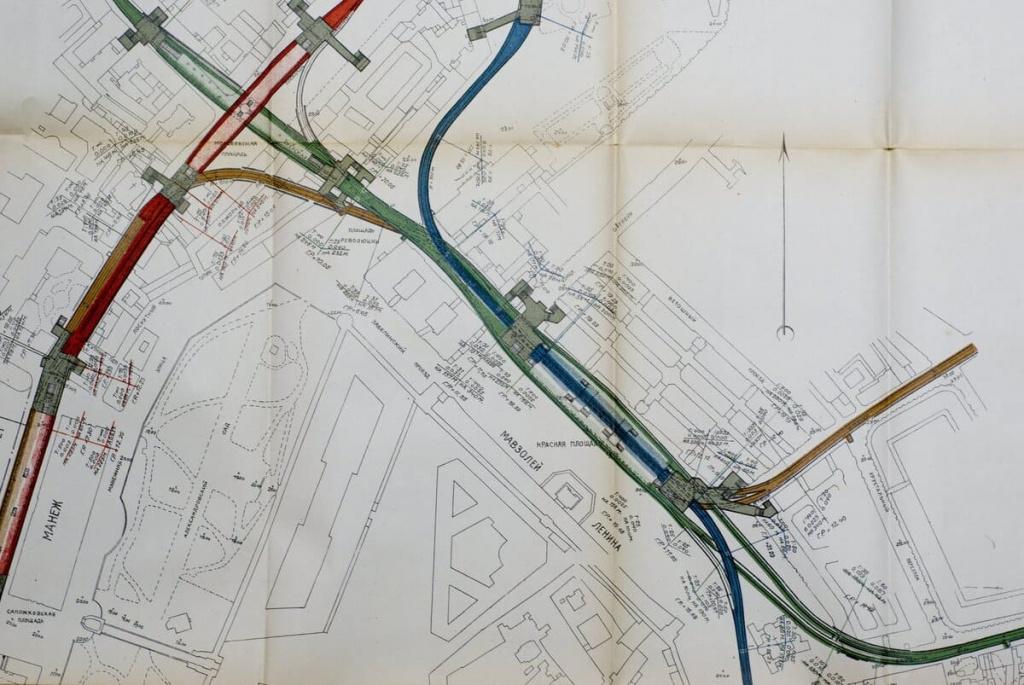
Central transfer station designed by Siemens-Banunion