How we greeted the builder's first day
Builder's Day appeared in the calendar of residents of the Soviet Union on September 6, 1955 by Decree of the Presidium of the Supreme Soviet of the USSR.
The initiator of its establishment was the first secretary of the CPSU Central Committee, Nikita Khrushchev, who was impressed by the scale of construction of the Zhigulevskaya hydroelectric power station.
The first celebration took place the following year, 1956. Since then, every second Sunday in August, builders celebrate their professional holiday. Since 2011 it has become federal. This year it was celebrated for the 65th anniversary.
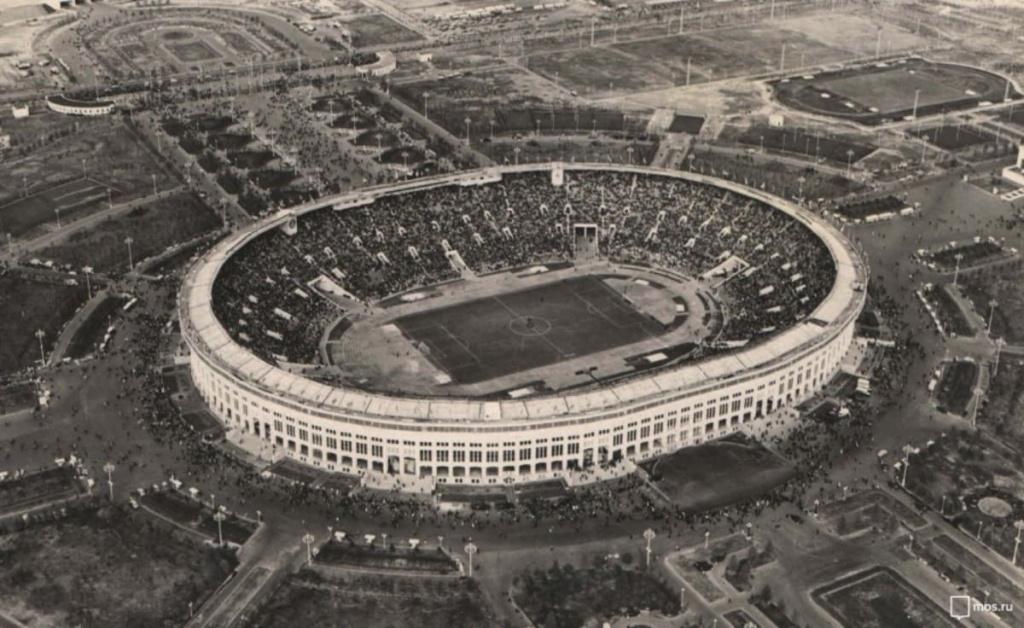
Central Stadium named after. V.I. Lenin in Luzhniki. Closing of the 1st Summer Spartakiad of the Peoples of the USSR
HOLD THE BANNER OF THE FIRST
By the first Builder's Day - August 12, 1956 - metro builders approached with considerable achievements. Based on the results of all-Union competitions for the 2nd quarter, the team was awarded the challenge Red Banner of the Council of Ministers of the USSR and the All-Union Central Council of Trade Unions. The Ministry and the Central Committee of the trade union noted the good work of the teams of SMU-5, SMU-7, SMU-8 and plant No. 1.
The construction and installation work plan for the first quarter of the first year of the sixth five-year plan was completed by the Moscow Metrostroy by 122.7 percent. The metro builders have held this banner for the last three quarters.
In honor of the holiday, mass festivities were organized in the towns of Losi and Cherkizovsky, in the Central Park of Culture and Leisure named after Gorky. Reporting meetings were held at which results were summed up and plans were outlined. Artists performed for metro construction workers in cultural centers and on summer stages.
ON CONSTRUCTION SITES
During these days, the Frunzensky radius stations “Frunzenskaya” and “Usachevskaya” (now “Sportivnaya”) were being built at an accelerated pace, and construction was also underway from Alekseevskaya to the future VDNKh station, which at that time was called the “All-Union Agricultural Exhibition” (“VSKhV”).
The construction of residential buildings on Malenkovskaya Street, a club and a hospital in Losi was actively underway. In total, by the end of the year it was planned to commission twenty thousand square meters of living space.
At the same time, the construction of the Usachevskaya traction substation was completed. The construction of the Detsky Mir department store was nearing completion, where the team of the Metrostroy finishing works office tiled about four thousand square meters of walls and ceilings with marble, laid 3.5 thousand granite floors, installed granite arches with a height of 17 each and over 8 thousand linear meters of stucco cornice.
CONTRIBUTION TO SPORTING LIFE
On the Frunzensky radius, by August 1956, station and escalator tunnels were completed. Builders began building the vestibules. Not only residents of the area, but also all Muscovites were waiting for the launch of these stations.
On the eve of the first Builder's Day, the Central Stadium named after V.I. opened next to Usachevskaya. Lenin (Luzhniki Olympic Complex).
Metro construction workers took a direct part in its construction, performing all the waterproofing work. They were tasked with protecting the roof from leaks so that not a single drop would penetrate into the stands of the Big and Small arenas, the swimming pool from the upper canopies and galleries. I had to master a new type of waterproofing - laying asbestos-cement sheets.
Within two and a half months, 150 thousand square meters of waterproofing were laid, 70 of them with asbestos cement. The pioneers of the new business were the builders from SMU-8. They were helped by teams from SMU-5 and SMU-7.
Specialists from SMU-3, having successfully completed the waterproofing of the Small Arena, began building a Sports Palace for 15 thousand seats.
At the same time, the first summer Spartakiad of the peoples of the USSR took place in the new arena. Metro construction workers also took part in it. Sport has always been one of the important aspects of the life of our builders.