Numbered construction sites of Mosmetrostroy
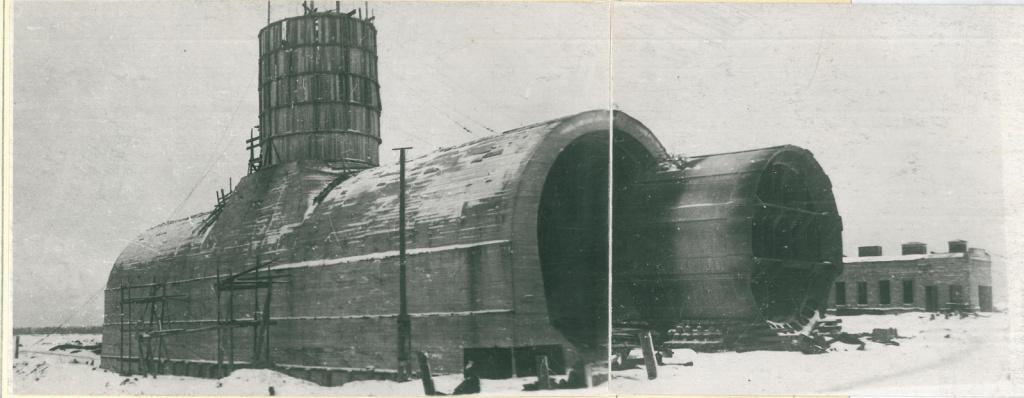
In the newspaper “Udarnik Metrostroy” No. 26 dated February 2, 1939, a note was published entitled “Metrostroy has been transferred to the NKPS system”:
“In view of the fact that Metrostroy is building several large railway tunnels and that the construction of railway tunnels will develop, and also given that the construction of the metro is closer in nature to railway construction, by a resolution of the Council of People's Commissars of the USSR and the Central Committee of the All-Union Communist Party of Bolsheviks, Metrostroy was transferred to the NKPS system with its subordination directly to the People's Commissar of Railways. Head of Metrostroy T.I.D. Gotsiridze was introduced to the Board of the NKPS.”
After our organization was transferred to the jurisdiction of the People's Commissariat of Railways, a new, including secret, history of various construction projects throughout the territory of the Soviet Union began. The commissariat was headed by Lazar Kaganovich, who was involved in the construction of the metro from the first days. So such a unification under the roof of one department was logical.
TRANSFORMER No. 20
However, the construction of secret facilities began much earlier. The first of these was Transformer No. 20, or T-20. This is the Moscow air defense command post. Discussion of its configuration began in 1933. Only nine people were allowed into the secret of its location: three from Metrostroy, five from the Red Army Air Defense Department and one person from the Mossovet. And the object itself received the code name “Transformer No. 20”. Its construction began almost simultaneously with the completion of the first stage of construction. By the first quarter of 1936, the main structures of the facility were already ready.
In November 1937, a government decree was issued on the official acceptance of the first deep-lying special facility in Moscow. Since then, the Moscow Metrostroy has built many different special structures, most of which are still in operation. Due to the fact that a huge number of documents have been declassified in the state archives of our country over the past twenty years, it is now possible to create a more complete picture of construction projects with the participation of metro construction workers. And studying the United Archive of our company allows us to find out some small details and the fate of the people who built not only the civilian metro.
TUNNELS UNDER THE DNIEPR
Numbered construction projects begin with the first number - Construction No. 1 of the NKPS. These are railway tunnels under the Dnieper in Kyiv. Their construction began in 1938 in case of the destruction of two railway bridges. Which would cut off the connection between the two banks and greatly complicate the defense of Kyiv. Metro construction workers were invited to lower the caissons and shield penetration. Naturally, other organizations of that time worked here, including engineering units of the Red Army, but there was no one else to do deep digging in the quicksand except us.
By the beginning of the war, they managed to go through 430 meters of deep tunnels on the Southern Transition - this is 14% of the total length. On the Northern passage (the construction consisted, respectively, of two tunnels in the north and south of the city), they managed to concrete one caisson and began to make a second one. Construction was difficult. At some point there was a strong breakthrough of quicksand. This led to a stop in mining work on one of the titles. But the attack of Nazi Germany suspended all work altogether. The tunnels were flooded with all the equipment, and, unfortunately, almost nothing was evacuated from the above-ground sites.
In November 1943, the Metrostroy commission for Construction No. 1 of the NKPS in the city of Kyiv began work to assess the extent of the damage and the prospects for restoring construction. The report of this commission is kept in our archives.
Despite the fact that in August 1944 the State Defense Committee issued a decree to continue construction, it was soon recognized as inappropriate. At that time, the protective properties of the tunnels no longer satisfied the increased means of destruction. Construction was completely stopped. There is still debate about what remained in the flooded tunnels and whether they were drained in order to dismantle various equipment. As a monument to this construction in the Obolon region there is a caisson of title No. 14 of the Northern passage.
AMUR TUNNEL
The editors do not yet have documents about construction sites No. 2 and No. 3, although scattered materials on them are found in the archives. This work is still awaiting its researchers.
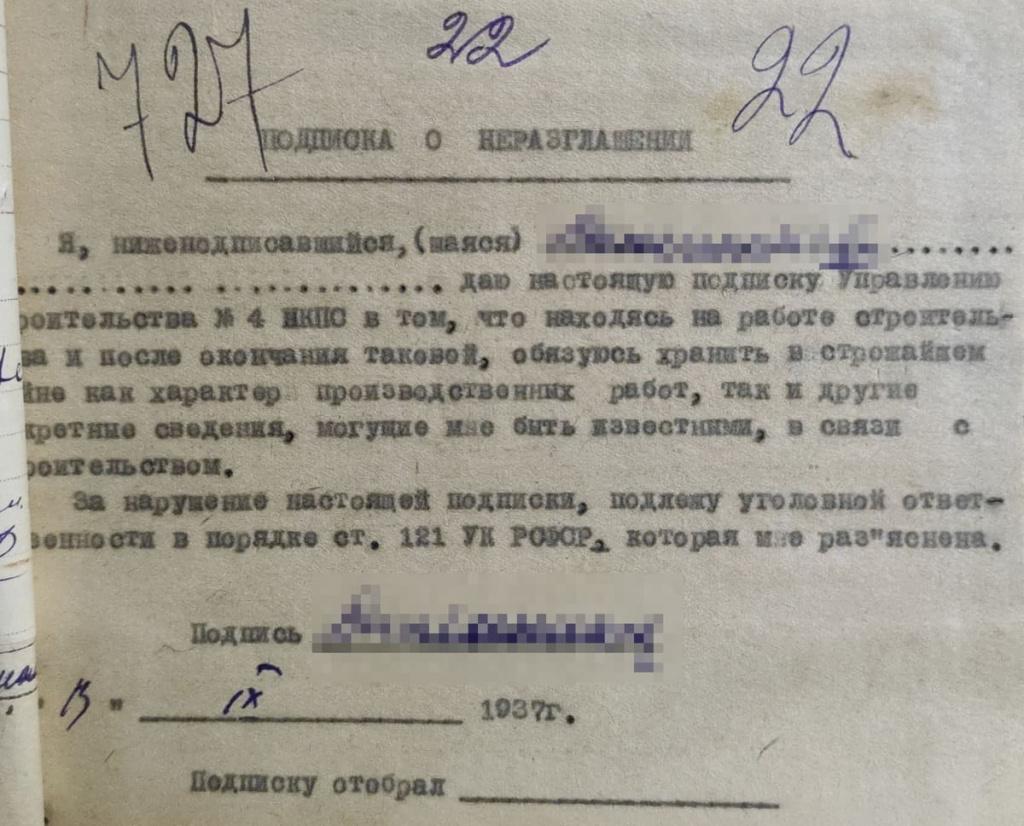
But we are well aware of Construction No. 4 of the NKPS - this is the Amur Tunnel. Metrostroy's traveling specialists traditionally carried out panel tunneling of this complex facility. By the beginning of the war, the tunnel was almost ready, but it was completed during wartime. It was put into permanent operation on October 25, 1942. Now our company’s specialists are working on the reconstruction of this tunnel.
LENINGRAD METROPOLITAN
Just before the war, on January 21, 1941, Construction No. 5 of the NKPS was formed - this is the construction of the Leningrad Metro. It was headed by a hereditary builder, one of the pioneers of the Moscow metro, Ivan Georgievich Zubkov. Unlike Moscow, construction in the northern capital was secret. The fact is that the Leningrad Metro was immediately considered as a huge bomb shelter, and they wanted to make one of the transport tunnels under the Neva in a railway gauge - an emergency route in case of bridge destruction.
Further numbered construction projects of the NKPS take place in large quantities and reach three-digit figures. The capital's metro construction workers also worked for many of them, since our company was still part of the NKPS.
BIG DISTRICT
Thus, during the war, metro builders took part in the completion of the large circular railway in the Moscow region. This is Construction No. 7 of the NKPS, organized on March 5, 1942. In wartime, emergency measures were taken to prepare the roadbed and lay tracks, which made it possible to relieve congestion at the Moscow railway junction and to build routes for military trains more flexibly.
Also known is Construction No. 165/T - the construction of tunnels on the railway line to the Tkvarcheli coal deposits. This is the territory of modern Abkhazia. And Construction No. 175 was located in the city of Stalinogorsk - now it is Novomoskovsk in the Tula region. Metro workers built a gypsum mine there in the 40s.
At that time, railway tunnels were traditionally the domain of Metrostroy. We restored the Black Sea tunnels after the war. They built tunnels in the Slyudyanka area - Construction No. 12.
MILITARY OBJECTS
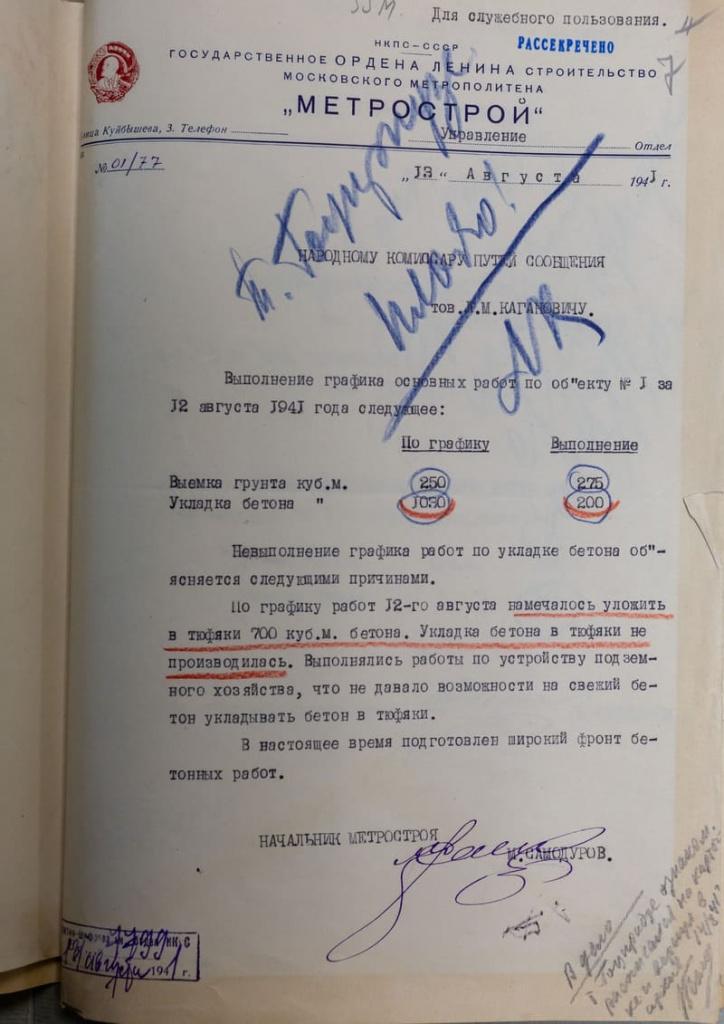
A separate line includes various special facilities that Metrostroy built before the war and during the war. A document was found in the Russian State Archive of Economics (RGAE. F. 1884. Op. 49. D. 1311. L. 7.) dated August 13, 1941 - a report from the head of Metrostroy Mikhail Samodurov to the People's Commissar of Railways, Comrade Kaganovich, on the implementation of the schedule of main work on object No. 1. Lazar Moiseevich’s resolution remained on the document - “BAD!” And there was something to be upset about. After all, instead of 1030 cubic meters of concrete, only 200 were laid... Then it was a very secret construction project, but now from declassified documents we can conclude that this is a special shelter for the highest officials of the country in the Kremlin.
Of course, only a small part of the numbered construction projects is listed. After many decades, these numbers mean almost nothing. There is still a lot of archival work ahead to identify them. And our task is to preserve this history.