Underground on “Marxist” one one and a half thousand people worked at the same time
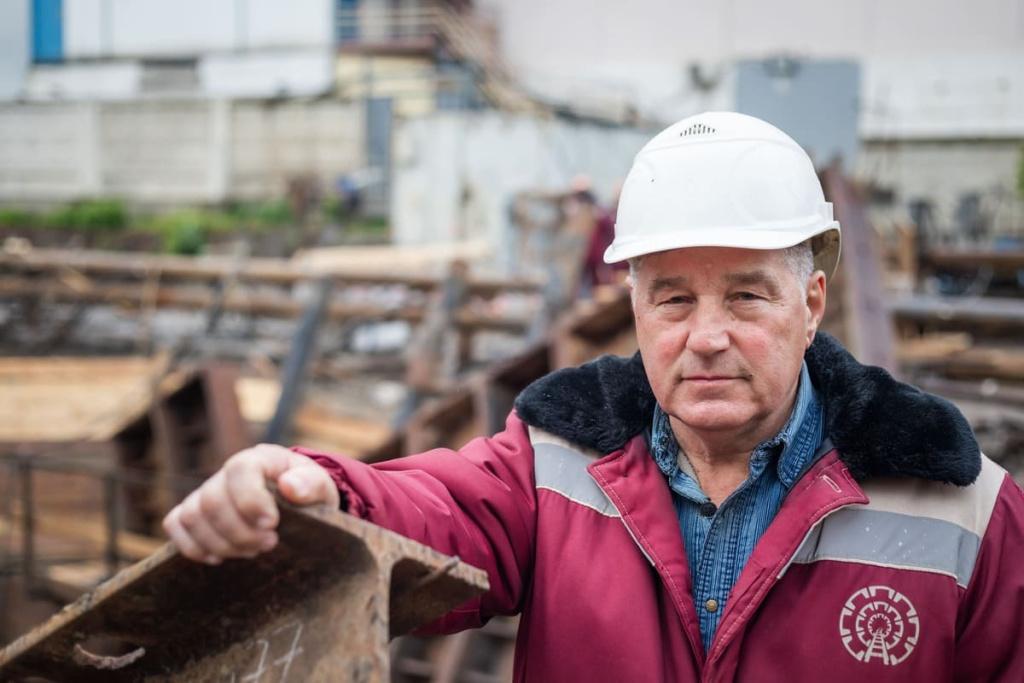
Deputy head of the SMU-6 section Alexander Nevin came to Metrostroy in 1974. This year is his work anniversary - 50 years in one organization. The Metrostroevets correspondent met with Alexander Filippovich and asked how he began his career in the profession.
– When I, having served in the army, came to work at Metrostroy, I was sent to SMU-6, which at that time was headed by Nariman Aleksandrovich Prostov. I started at the Kuznetsky Most station, then we were transferred to the Marksistskaya station to deepen the ventilation shaft. There, serious and, in my opinion, the most dangerous work began - vertical excavation: everything that could fall from a height of 40-50 meters flies onto the heads of the miners.
It took me almost five years to build the Marksistskaya station. We worked for seven hours, with a 45-minute break for lunch. We didn’t go upstairs: the dining room was in the mine. The first, second and compote were served. Lunch cost one ruble. I didn’t smoke, so I had twenty kopecks left from the ruble for half a glass of sour cream. Before lunch, we changed into dry clothes: the dryer was also in the mine.
We finished our shift, handed over the jackhammers to the shift workers, and went through the first aid station. If the nurse notices the slightest scratch, she will definitely apply brilliant green: the health of the metro construction workers was strictly monitored.
I was lucky: I started working with front-line soldiers - serious people who taught us wisely: how to mount, how to edit rings and keep them in normal parameters, what cuts to make. The quality of work was controlled by the foreman.
The Marksistskaya station was built by one SMU-6. 4-5 faces were working underground at the same time. During the shift, the miners produced 300 wagons of rock. There were just as many empty ones. There was a special haulage section where they only did ascent and descent. The shift manager knew which face had which cycle of work, what to lower, what to lift, what to take and deliver where. This is a whole science on which the rate of penetration depends. If there are trains in the metro, then the same kind of work is going on underground! The whole mine is buzzing!
At Marxistskaya, SMU-6 built: two interchange hubs, an STP, where all the electrical equipment servicing the station, on-duty metro electricians and alarm systems are located; an inclined entrance, dead ends behind the station, a new radius towards the Tretyakov Gallery, two exit chambers where trains turn around, stages, a middle hall, a connecting branch from Kurskaya to Marxistskaya. A huge amount of work! It’s hard to even imagine how many breeds were given out. One and a half thousand metro construction workers were working at the same time. There are three tunneling crews per day at each face. And what specialists! And everything was controlled by Nariman Prostov.
His role in the development of SMU-6 is enormous. Firstly, he was competent in his field, and a lot depended on this; secondly, he worked well with personnel - he assembled a strong team of like-minded people, trained and developed experienced site managers and foremen capable of properly organizing and conducting work. SMU-6 became a real talent forge for Mosmetrostroy.
The SMU-6 team was able to handle work of any complexity. I remember how Nariman Aleksandrovich in a short time solved the most difficult problem that arose at Marxistskaya during the construction of an interchange hub to the Taganskaya-radial station.
While climbing up while drilling the shaft vertically, we came across a layer of water - an underground river, and a waterfall of clear, like a tear, icy water fell on our heads. In six hours, everything that we managed to pass through was flooded - the transfer hub, dead ends, half of the trunk: from bottom to top - 25-30 meters. The carriages were floating. People were running away. All this happened before my eyes.
Nariman Aleksandrovich quickly got his bearings and organized the pumping of water: we installed four pumps: a discharge of 600 cubic meters per hour, and two deep pumps with a discharge of 300 cubic meters per hour. They turned them on at the same time. Without interruption, the pumps pumped water into the street: Taganskaya Square was flooded.
They placed a specially made metal trough under the breakthrough, let incoming water flow into it, and from the trough it went into the pipe and into the pump. To close the breakthrough, they built formwork, and cement mortar with additives was pumped into it under pressure so that it would set and harden faster. When they sealed the break and pumped out the water, they replaced everything that was flooded - the electrics, hydraulics, mechanisms, engines on electric locomotives, cables, did waterproofing, re-bolted: all the bolts were replaced and isolated from external influences, the seams were cleaned, hammered with lead wire, and insulated. The transfer hub was completely rebuilt. And they started the mine again. We completed it in a month: Nariman Aleksandrovich thought through everything down to the smallest detail.
I have been working at Mosmetrostroy for 50 years, eight of them at SMU-6. When SMU-15 spun off from it, I was appointed there as a comprehensive foreman of the youth brigade. There were about 90 people in it. He worked mainly in the morning shift, but if some link was slipping, he went out both at night and in the evening. At the same time I studied. The next day after defending my diploma, I was appointed head of the section. I grabbed my head, didn’t sleep that night, worried. All responsibility rests with the site manager and foreman. But they reassured me: don’t worry, they said, we’ll help. And, of course, they helped. I worked as a foreman and a section chief for almost twenty years.