Purpose - to serve the country
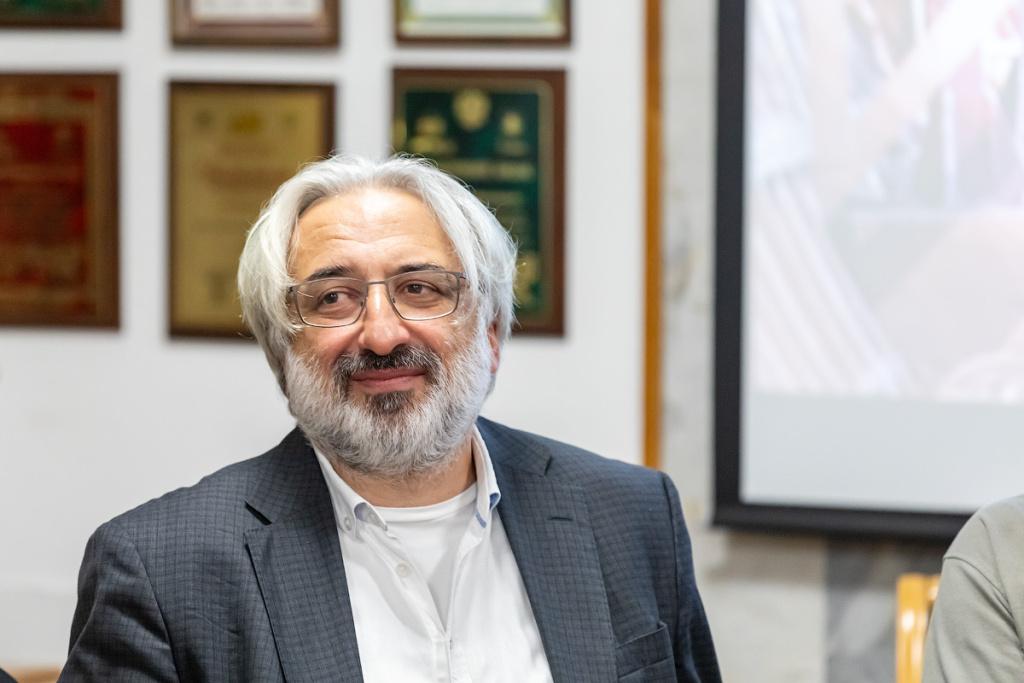
Georgy Kekelidze, chairman of the board of the non-profit partnership for the development of renewable energy "Eurosolar Russia", shared with the correspondent of the newspaper "Metrostroyevets" his memories of his great-uncle - the third head of Mosmetrostroy Ilya Gotsiridze.
–Georgiy Nodarovich, the legendary Ilya Gotsiridze is a dear person for you. Please tell us about him.
– I have known Ilya Davidovich since childhood. He is the older brother of my grandfather Viktor Davidovich Gotsiridze. In his homeland he was the first Komsomol member and the first to “descend from the mountains.” Without hesitation, he left to study in Moscow. He graduated from MIIT and became a railway engineer. At the call of my heart I went to work for Metrostroy. A few years later, younger brothers followed him: the middle one, Mikhail and the youngest, Victor.
Ilya Davidovich had fantastic hard work and endurance. His usual working day began at 12 noon because it ended... at 7 am.
He was distinguished by his kind and attentive attitude towards people and their needs. He knew what was going on in their families, and they knew that they could count on him. Ilya Davidovich was always surrounded by many people - friends, associates, those who needed help. He helped everyone. He avoided conflict situations and tried to resolve any issue peacefully. Workers and employees treated him with respect, rather, with care: they were afraid to upset him and tried to work conscientiously.
Ilya Davidovich observed the fate of former metro construction workers; if life was difficult for someone, he offered to return - not to the mine, but to a job that they could do, for example, as drivers. I kept in touch with them even after retiring. He was simple, open in communication, and was friends with the St. Petersburg Metrostroy team. The famous metro construction worker Tatyana Viktorovna Fedorova wrote that when she got off at the Mayakovskaya station, she always touched the stone that Ilya Davidovich ordered, one might say, from his village.
The main driver for it was bold technical solutions. He introduced many innovations, for example, he was responsible for the construction of pontoon bridges when Stalin went to Tehran, where in 1943 the situation on the fronts of World War II was discussed with Roosevelt and Churchill; when digging a tunnel under the Amur.
Ilya Davidovich had an emergency suitcase ready, which contained clean linen, crackers and something else. There was a telephone set near the door, next to it lay a piece of paper on which the telephone numbers of Stalin, Khrushchev, and the objects where he could be located were written in large handwriting, so that he could be contacted at any moment.
The main thing is that he left a special mark on the souls of the people with whom he interacted. They all understood that their only purpose was to serve the country. This was also his main message. At that time, everyone lived like this and were truly happy. The life position of these steely people is one of my main memories.
Towards the end of his life, Ilya Davidovich’s legs hurt – a consequence of many hours spent underground in water.
It took me a while to realize that the metro builders spent almost their entire lives voluntarily underground. The biggest school in my life was Metrostroy and the Metrostroy workers. I learned from them how to do big projects and resolve conflict situations. Workaholism, I believe, is inherited: our family’s generation grew up this way.
–Ilya Davidovich found love in Moscow or at home?
– At home: Nina Antonovna Chikhladze comes from the same remote Georgian village as Ilya Davidovich. She also “came down from the mountains.” She came to Moscow as the wife of Ilya Davidovich. At first she worked under Nadezhda Konstantinovna Krupskaya as a teacher, then accompanied her husband on business trips. Our family archive contains their memories of working on Turksib: how Komsomolsk-on-Amur was laid, about the first passage along the BAM highway and many others: they had an interesting, eventful life.
Nina Antonovna graduated from medical school. During the war she was a military field surgeon. She worked with academician Sergei Sergeevich Yudin, the chief surgeon of the Institute. N.V. Sklifosovsky (1928-1948).
My grandparents, one might say, got married thanks to Ilya Davidovich and Nina Antonovna. First, Ilya Davidovich invited my grandfather Victor to Moscow, and later Nina Antonovna invited her sister. They met and fell in love. Two siblings married two siblings.
Mikhail Davidovich, married to Evdokia Gotsiridze, had four children: Galina Novikova, Yuri Gotsiridze, Nina Gotsiridze, Margarita Magaril. There were no children in the older brother's family. Ilya Davidovich even asked to give them one child, but Mikhail did not agree. My younger brother, my grandfather Victor, had a daughter, Irina, my mother. You could say that my mother was raised by two brothers and two sisters.
–How did Ilya Davidovich spend his free time?
– He was practically absent. When I did have a free minute, I loved to read - thoughtfully, with a red pencil. Ilya Davidovich not only collected books, but edited them - even Stalin and Karl Marx - everything was outlined. Ilya Davidovich had a ton of books - fiction and technical literature. Now it’s not clear what to do with them: Nina Antonovna distributed fiction, but there was no one to read the special literature.
My mother Irina Viktorovna told me that Ilya Davidovich gathered around him a galaxy of talented Georgian engineers, most of them worked in the metro. Much attention was paid to international contacts. We met with Hungarian colleagues, metro builders from Czechoslovakia, Azerbaijan, Georgia, Armenia, and the Ukrainian SSR. Everyone was a frequent guest with us.
Over time, they became the backbone of the Tbilisi metro construction. Without the metro construction engineering core, it would have been impossible to retain personnel and build the metro in Georgia, Azerbaijan, and Armenia.
–The most famous of them is a metro builder– engineer Nikolai Danelia is the father of the famous director Georgy Danelia.
– Yes, Nikolai Dmitrievich worked at Mosmetrostroy from 1932 to 1954, rising from foreman to chief engineer. Under his leadership, Vecherka wrote, the Paveletskaya stations - ring and radial, and Kyiv stations of the Circle and Arbatsko-Pokrovskaya lines were built. During the war, he built underground command posts for the high command. Returning from evacuation in the summer of 1943, his son Georgy and his mother expected the head of the family to meet them on the platform with orders on his tunic. And he appeared unshaven, in pajamas - he ran away from the hospital. His tuberculosis worsened from overload. He did not return to the hospital, worked sixteen hours underground, smoked two packs a day, and by Victory Day the tuberculosis went away on its own.
In January 1954, Nikolai Danelia had to leave Mosmetrostroy. While excavating under the Red Rose factory, workers came across karst - fragile rock with voids. The buildings could go underground. Nikolai Dmitrievich led the rescue efforts. Chairman of the Council of Ministers Alexey Kosygin arrived at the scene and also began giving commands. Danelia yelled at him. The authorities remembered this. At the first opportunity, Nikolai Dmitrievich was accused of having poor safety standards in his department and was sent into retirement.
Georgy Danelia’s film “I Walk Through Moscow” with Nikita Mikhalkov in the title role is dedicated to the metro builders - in this way the son paid tribute to his father.
–Viktor Davidovich Gotsiridze largely repeated the path of his older brother.
- You're right. When my grandfather graduated from school, his parents sent him to his older brother in Moscow - to the Rabfak, where workers and peasants were prepared to enter universities. Victor, who did not know Russian, found it difficult to study, but soon he mastered it so much that he began to help lagging students. In 1930, he easily entered the Moscow Automobile and Road Institute, Faculty of Road Construction. In his fifth year he came to mine No. 21. As a certified specialist, he worked with Ilya Davidovich in 1934-1937. During the construction of the Krasnye Vorota station he was a shift engineer.
In 1937, his family returned to Tbilisi. Grandfather was the chief engineer in the education department of the Tbilisi City Executive Committee, and was involved in the construction, improvement and expansion of schools. During the Great Patriotic War, he was senior assistant to the head of the military information department of the Transcaucasian Railway - he ensured reliable transportation of military equipment, manpower, weapons, evacuees, food, and fuel. In 1941-1946 he served at the headquarters of the Transcaucasian Front, after the war - in the railway administration of Transcaucasia.
For quality work done, he was awarded the medal “For Military Merit.”
In 1952, Viktor Davidovich became the first deputy of the construction of the Tbilisi metro, in 1957 - the head of the Tbiltonnelstroy (hereinafter Tbilmetrostroy) department. Under him, 21 metro stations were opened in Tbilisi and 27 km of lines were laid. Today there are 19 stations, all built in Soviet times.
–Metro construction, judging by his track record, is not the only thing he did.
– Under his leadership, highways, railway and automobile tunnels, hydraulic structures, underground storage complexes for wine, vegetables and fruits, the Metekhi tunnels in Tbilisi, a significant part of the Kura embankment, the building of the Institute of Physics, the underground seismic laboratory of the Institute of Geophysics, the administrative building of the metro and the railway post office, and the first underground passages were built. Grandfather supervised the creation of the New Athos cave complex, including the New Athos cave railway, a sanatorium in Likani, residential buildings in Borjomi, Bakuriani, Sukhumi, Batumi, Tskhinvali...
By decree of the Presidium of the Supreme Soviet of the USSR of January 28, 1980, he was awarded the title of Hero of Socialist Labor with the Order of Lenin and the Hammer and Sickle gold medal. His merits were appreciated by the USSR State Prize and many orders.
–I heard that in order to build the Tbilisi metro, the Georgian leadership resorted to forgery.
– In those years, metro could be built in cities with a population of one million, and 600 thousand people lived in Tbilisi. But this is the capital of Stalin’s homeland. The first secretary of the Central Committee of the Communist Party of Georgia, Kandid Charkviani, went to remind him of this. And in 1952, by decision of the CPSU Central Committee, the Political Directorate of the Tbilisi Metro was created. Viktor Gotsiridze was appointed first deputy head of construction.
Unfortunately, the joy of Tbilisi residents was short-lived: after Stalin’s death, the USSR Council of Ministers in September 1953 decided to liquidate the construction of the metro in Tbilisi; in Kyiv and Baku - mothball.
To save the situation, Viktor Gotsiridze goes to Moscow and tries to ensure that the construction is not liquidated, but mothballed. The Georgian government convinces the USSR Council of Ministers that underground mines in Tbilisi will be used for civil defense (CD) needs. According to the approved civil defense shelter projects, Tbilisi metro builders actually manage to build the metro.
In Moscow they are trying to open a case of illegal spending of funds. The head of the Council of Ministers of Georgia Givi Javakhishvili and Viktor Gotsiridze manage to “put the brakes” on everything - largely due to the fact that Tbiltonnelstroy, headed by Viktor Davidovich, erected such objects as the building of the Institute of Physics, the underground seismic laboratory of the Institute of Geophysics in the tunnel passage to the Botanical Garden, the Digomi residential area, storm sewers, sections of the embankment Kura, the Tskhra Tskaro geophysical laboratory in Bakuriani, the Ordubad railway tunnel in Azerbaijan...
And yet, when in the 1960s it became clear that Tbilisi was still far from reaching 1 million residents, they decided to forge it: a certificate was sent to Moscow stating that the million mark had been crossed. Thanks to the authority and connections of Viktor Davidovich Gotsiridze, issues of financing, timing, allocation of limits on equipment and materials are resolved positively. Officially - for the needs of civil defense. Only after Khrushchev was removed from power in 1963 did the USSR Council of Ministers give the go-ahead to continue construction of the metro. The station of the first stage of the Tbilisi metro opened its doors in 1966.
–Victor Gotsiridze is remembered in Tbilisi?
“Unfortunately, few people remember him today. After the collapse of the USSR, the Tbilisi metro stations were not repaired, although they had exhausted their service life. Now the city is doing something, but a huge shortage of personnel has emerged. The only ones who are helping to restore the Tbilisi metro are the first generation metro builders - associates of Ilya Davidovich and Viktor Davidovich Gotsiridze. They want to revive the Tbilisi metro and name one of the stations “Gotsiridze”.
Grandfather died in 1968 and was buried, like his older brother, at the Novodevichy cemetery.
–The middle brother – Mikhail Gotsiridze was not a metro builder, but he also left a noticeable mark on the history of the USSR. What was he doing?
– Mikhail Davidovich Gotsiridze graduated from the Tiflis Chemical-Technological College in 1926, worked at chemical plants in the Ryazan region and Moscow. In 1930 he came to Dzerzhinsk, Gorky region and got a job in the 7th workshop of plant No. 80 named after Ya.M. Sverdlov. He worked his way up from shift engineer to deputy shop manager. In 1939 he became the head of workshop No. 3 and worked in this position until 1944.
During the war years, the plant produced 148 million artillery shells and mines, 5.5 million aerial bombs, 5 million anti-tank mines, 2.8 million rockets for Katyusha guard mortars.
By decree of the Presidium of the Supreme Soviet of the USSR dated 04/06/1945, the plant of the People's Commissariat of Ammunition No. 80 was awarded the Order of the Red Banner for the successful completion of the tasks of the State Defense Committee (GKO) to provide ammunition to the Red Army.
In 1944, Mikhail Davidovich became the chief engineer of the plant, and in 1953– director In 1956, with his direct participation, a new workshop for the assembly of Oka washing machines was organized on the basis of workshop No. 3, which, thanks to the simplicity and reliability of its design, quickly won a strong place in the market of domestic consumer goods.
In 1960, Mikhail Davidovich Gotsiridze was appointed head of the Chemistry Department of the Volga-Vyatka Economic Council. After its liquidation in 1965, he retired. He was an honorary citizen of the city.
He died at the age of 89 on September 28, 1993, and was buried in the Dzerzhinsk city cemetery.