Trace the evolution of form
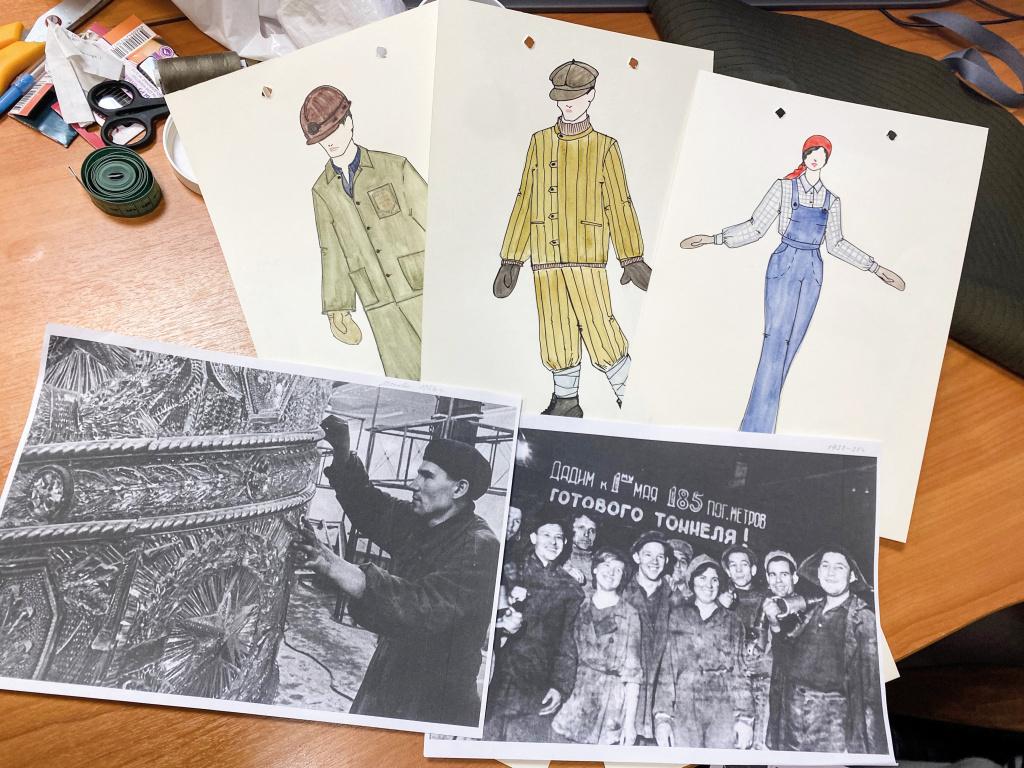
At the Vorobyovy Gory metro station on November 2, an exhibition dedicated to an entire era of the capital's Metrostroy will open. Clothing is designed to reflect the changes, namely the uniform of metro construction workers from different years. It was decided to coincide with the company’s anniversary. The MS correspondent found out how the clothing models were selected and which samples were the most difficult to find.
For a whole month - from November to December - mannequins dressed in Metrostroy uniforms from different years will be displayed in glass columns at the Vorobyovy Gory station. And although the workers’ clothing, of course, was not unique, it still had a number of distinctive features by which one can judge each decade of development of both the city subway and our country as a whole. After all, people came to the Moscow construction site from all over the Soviet Union.
Including for this reason – the all-Union nature of the construction – finding individual copies became a difficult task. Exhibition curator Alena Puchkova and costume designer Natalya Osnovskaya say: they decided to start by studying various sources - photographs from newspaper files, documentaries, forums. They approached filmmakers, costume designers, and dealers of Soviet antiques, so consultant-reenactor Ivan Yalychev joined the team. Difficulties in collecting information from archives were added by the fact that all sources - old photographs and newsreels - were black and white. Only after the 1990s can color cards and documentary stories be found.
– Having studied the photo archives, carefully examining every detail, we have identified several striking images that can be presented at the exhibition. Each decade has its own form, and we tried to highlight the most striking image,” says Natalya Osnovskaya, laying out the sketches on the table. – The next stage was the search for surviving products and the development of patterns for sewing ten suits, one of which was typical for women, all the rest for men.
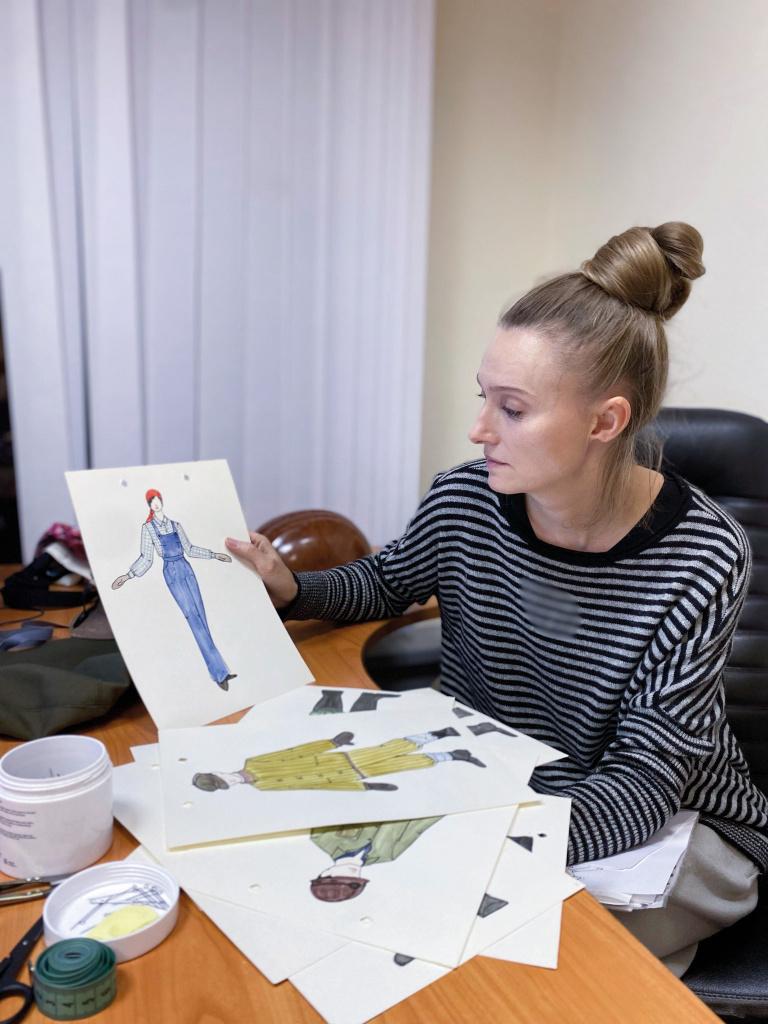
Natalia Osnovskaya talks about preparations for the exhibition
Preparations began in July and are still ongoing. Ideas are still coming in to this day, although almost all the samples have already been collected and will soon take their place on the Sparrow Hills.
“The details turned out to be the most important,” Alena Puchkova picks up the story. “They had to be examined from different angles, and we couldn’t rely only on photographs. It is important to look at the texture in order to select everything as close as possible to the original, so we used archival video footage - from it you can understand the properties of the material. We bought something, sewed something, 90% of the exhibition is original clothing from different decades, preserved or restored from old fabrics or similar.
According to documents from the chronicle, people in double-breasted dark blue suits, white shirts and black ties began to appear on Moscow streets in 1931. "Who is this?" - Muscovites asked. "Metro builders!" - answered those in the know. This is how the blue suit became recognizable, although at first the metro workers did not have a standard uniform that all workers would wear.
– Clothes in the distant 30s and now depend on the specifics of the work. Thus, in the caisson mines they worked naked to the waist. The temperature here reached 40 degrees, the caisson workers had to work in sports underwear,” notes Natalya Osnovskaya. “At the same time, on the surface at the same time, people were freezing in cold weather in padded jackets and cotton pants; these clothes were the most common and affordable. Nevertheless, the worker in the dark blue overalls and beret became a recognizable symbol of the large construction site.
“It was almost impossible to find such a jumpsuit, but we found fabric whose properties corresponded to the samples of that time, and we sewed it from it, copying the original,” shares Alena Puchkova.
They sewed it, and then decided to artificially age it, adding the desired texture. Brushes and paints, ash and bleach, as well as brushes of various sizes were used. Thanks to this simple set, the seams are whitened, abrasions are added, individual areas are darkened or highlighted, and thus create the feeling that the suit was worn by some very hardworking builder. A little later, a girl painter in a blue jumpsuit with straps and a red headscarf will be in his company. It will already be the 40s and 50s, when the fair half of humanity began to actively join the construction of the metro. Women were predominantly involved in finishing and finishing work.
“It turned out that a women’s checkered shirt from the 40s cannot be found in the original,” Natalya Osnovskaya shares her observations. “They were dragged to the holes, and that’s why finding a calico shirt turned out to be such a challenge.” Later they began to look for pieces of chintz at flea markets, through private advertisements, at flea markets and in specialized stores selling Soviet household items - literally a couple of meters of fabric - in order to restore similar clothes of the 40s for women. We excluded proposals to replace them with flannel or fleece shirts - they would not correspond to the spirit of the time and historical reality.
By the way, wartime samples also turned out to be difficult to find for the upcoming exhibition. For many years in the post-war period, tank overalls were used due to shortages.
In the 40s, with the beginning of the large-scale use of tunneling shields, the question arose of what to wear for the tunnellers. They took this seriously. Instead of the usual canvas suits, they were given overalls with all kinds of slits, pockets and buttons, as well as rubber miner's helmets with dashingly curved brims. The outfit turned out to be uncomfortable. Buttons quickly flew off, pockets filled with rock. The brim of the hat touched everything around, and the ribbon with which it was fastened under the chin quickly tore. The walkers returned to canvas suits consisting of pants and a jacket. And the head was covered with ordinary berets made of felt or wool, if there were no canvas panama hats. On my feet, of course, I only wore rubber boots, which protected me from electric shock.
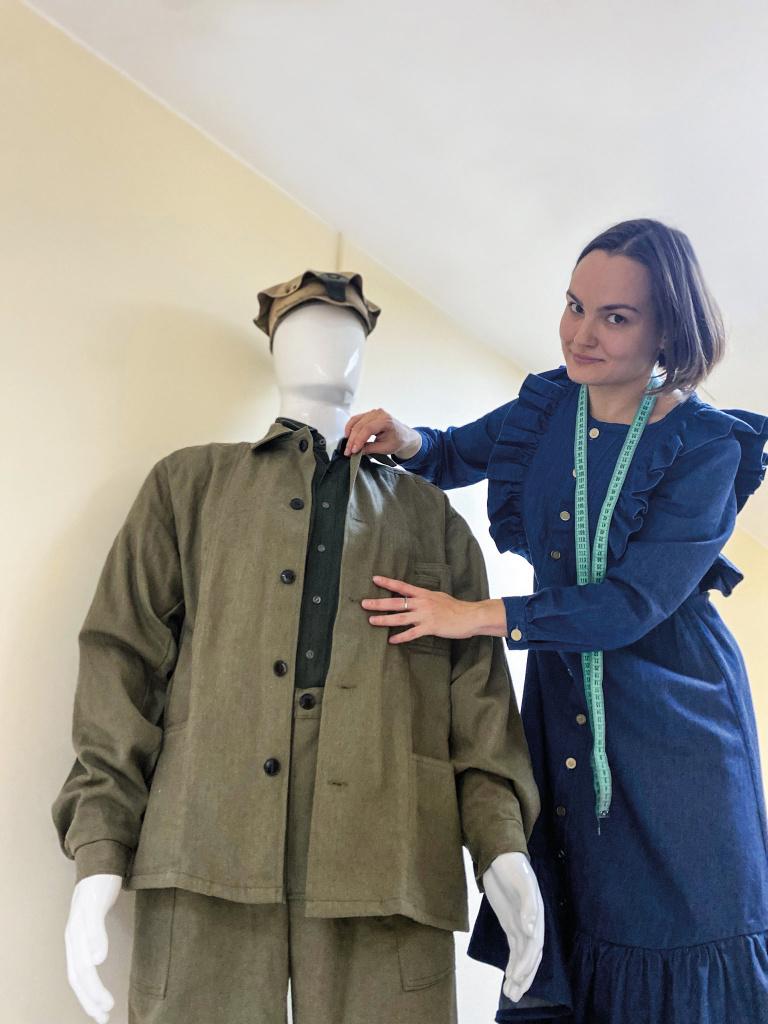
Alena Puchkova straightens her suit on a mannequin
Before the war, rubber overalls for tunnel workers: trousers, jackets, raincoats were purchased in Leningrad and Yaroslavl. By 1944, the production of rubber overalls was mastered by the Metrosnab sewing plant. Overalls, mittens, padded suits and rubberized safety shoes were produced.
By the way, in search of the necessary things, Alena, Natalya and Ivan turned to people not only in Moscow. The geography turned out to be very wide - from the west to the south of Russia. Bryansk, Saratov, Krasnodar, Yaroslavl, St. Petersburg became “suppliers” of the necessary things.
Alena Puchkova notes that the boots have been the best preserved over the years. Rubber ones, even those produced later, wore out faster, but leather shoes: cowhide or tarpaulin boots were found by the exhibition organizers in very good condition. The heels, lined with small wooden nails, and the stitched tops were polished almost to a shine.
“Then the boots were passed from shift to shift. The shoes did not have time to dry. Those who lacked shoes worked barefoot. Many construction site managers, on their own initiative, purchased overshoes for workers,” says Natalya Osnovskaya. — Workshops for repairing clothes and shoes were organized in other areas.
However, finding boots turned out to be easier than many other things. For example, hats. Each decade they were very diverse: caps, scarves, miner's helmets with brims and a stiffener on the dome. In some old photographs from those years you can see workers wearing aluminum helmets. They were thin, not very comfortable, but, most unpleasantly, they conducted electricity well.
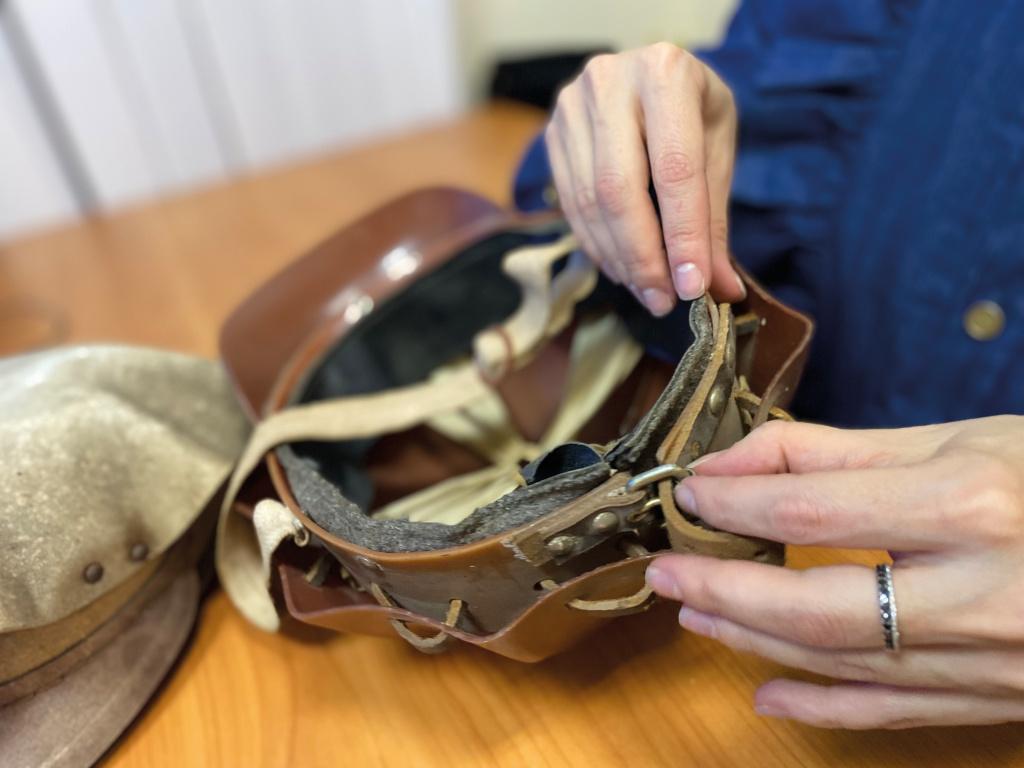
The main range of construction hats will be presented at the exhibition
At the exhibition you can see the original helmets. So, Metrostroy invented its own helmet in the 50s. The authors of the development were Metrosnab employees Lisitsin and Izyumnikov together with Glavkhimplastkraski specialists Zolotarovsky and Kogan. A new sample of a miner's helmet was made from vinyl plastic, it was durable, had low moisture permeability, had low thermal conductivity, and retained its shape.
Fiber helmets were replaced by textolite miner's helmets in the 1960s. Textolite is a lightweight and durable material - fabric pressed into epoxy resin. Each helmet had its own unique design. Another decade later, helmets began to be made from polyethylene plastic.
“We were lucky: after the construction of the metro, many helmets wandered to other construction sites, and finding them turned out to be difficult, but interesting,” admits Natalya Osnovskaya.
The revolution in clothing comes later. The uniform of most Metrostroy workers in the 80s has no visual differences from the 70s - standard overalls and helmets. Some workers have visible patches on their sleeves. Starting from the 1980s, we can talk about the appearance of uniforms, clothing became convenient for builders, they began to actively engage in it, including hats, shoes, but the uniform became truly thoughtful in the last 10–20 years.
In the 2000s, Mosmetrostroy acquired its own signature, specially designed style. Since then, metro builders have been distinguished by the color scheme of their workwear and the use of the logo and company inscriptions on it.
– While preparing the exhibition, we were able to trace the era and a kind of evolution of the special uniforms of builders. We hope that passengers, walking through the gallery, will take the time to look at all the samples and notice the differences in overalls,” summarizes Alena Puchkova. – And to appreciate that at first the construction of the Moscow Metro was a real heroism, which rested on the incredible enthusiasm of the people. People worked with simple tools, knee-deep in the ground, in snow or rain. Muscovites and guests of the capital still enjoy the results of their work.