Co-authors of "Novokuznetskaya"
Almost 75 years ago, in November 1943, the Novokuznetskaya station opened on the existing section "Sverdlov Square" ("Teatralnaya") - "Plant im. Stalin" ("Avtozavodskaya"). Construction was entrusted to the team of mine No. 15-16 (current SMU-8). The architectural project of Novokuznetskaya was developed by a married couple - Ivan Taranov and Nadezhda Bykova. The son of the architects, Andrei Taranov, spoke about the process of creating one of the most beautiful metro stations in the capital.
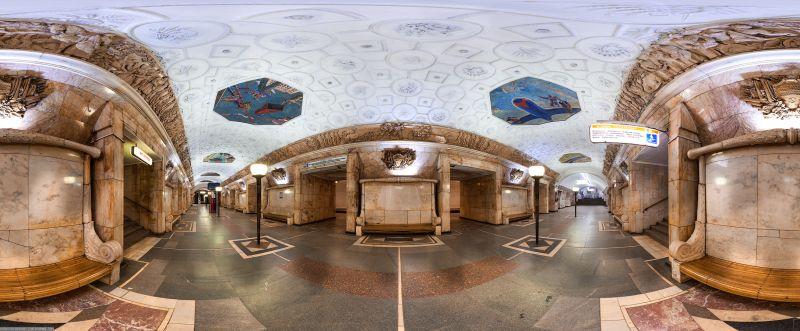
By the time the project was developed, Ivan Taranov and Nadezhda Bykova had already distinguished themselves in the first stage, having won a creative competition among architects for the design of the Sokolniki station.
– In the fall of 1941, when the construction of the metro was suspended, our family, and I was not even a year old, was evacuated to Barnaul,” explained Andrey Taranov. “And in winter, a message came from Moscow about the resumption of work. My father urgently flew to the capital, and two months later both my mother and my sister Alena and I returned. The authors of the architectural design of Novokuznetskaya had to urgently make adjustments to it related to the course of the Great Patriotic War. First of all, they concerned the multi-figure frieze. A group of sculptors worked to switch it to a military theme. It was also necessary to place mosaics brought from besieged Leningrad on the vault.
Initially, the authors focused on classical examples dating back to the times of Ancient Rome. This trend was supported by the consultant of young masters, academician of architecture Ivan Zholtovsky. But the war against the fascist invaders made its own adjustments and additions to the project. For example, the plaster sculptural frieze in the middle hall represents an alternation of various front-line episodes, separated by stucco images of a military order. Another important design element of the station was the mosaic panels on the vault, depicting the peaceful labor of the Soviet people. The sketches for them were made by Alexander Deineka, collected by Vladimir Frolov. He did this in besieged Leningrad and was able to send boxes with mosaics to the mainland in January 1942, and a few days later he died of exhaustion. According to the plan, they were intended for Paveletskaya, but because of the war they have not yet begun to build a middle hall there. And Ivan Taranov offered to take them to Novokuznetskaya. Now in its middle hall, passengers also see a memorial plaque dedicated to the professional feat of Leningrader Frolov.
The most voluminous and multi-figure mosaic of Novokuznetskaya, symbolizing the unity of the front and rear, was located at the end of the station. In 1970, when its middle hall was extended due to the construction of the transfer station, this mosaic was moved to the wall of the transfer area. In a group of representatives of peaceful professions, the architect Ivan Taranov is depicted there, with a drawing and a compass in his hands. Now, as if from the future, he looks at his completed project together with his wife. And Novokuznetskaya, recognized as an object of cultural heritage, is already reliably serving people in the new century. The events of the Great Patriotic War are reminiscent of the shields placed above the benches of the middle hall of the station. They are framed by banners and bear the inscriptions: “Glory to the heroic defenders of the city of Leningrad”, “Glory to the heroic defenders of the city of Sevastopol”, “Glory to the heroic defenders of the city of Odessa”, “Glory to the heroic defenders of the city of Stalingrad”. At the same time, from the moment the Novokuznetskaya was launched, about a year and a half remained until the Victory, and Sevastopol and Odessa were still in the occupation zone. Nevertheless, glory was given to their former defenders.
REFERENCE
The mosaics on the vault of the middle hall of the station are united by the theme - “Peaceful working life of the Soviet people.” Among the heroes you can see gardeners, steelworkers, machine builders, and aviators. The sixth story is called “Skiers and the Triumph of Industrialization” and it actually depicts athletes. And in front of them is a bridge along which a train is rushing, and above is a wide-winged airplane. And all this is not accidental. The railway bridge across the Moscow-Volga Canal at the 8th lock was built in 1936 according to the design of engineer A.D. Bachelis. At that time it was one of the longest reinforced concrete bridges in the world. The train is also difficult. He is carried away by the 2-3-2B steam locomotive, made according to the design of D.V. Lvov, who was aiming for a speed record. And on the ANT-25 plane, pilot Mikhail Gromov set a flight range record in 1937, covering more than 10 thousand kilometers without an intermediate landing.
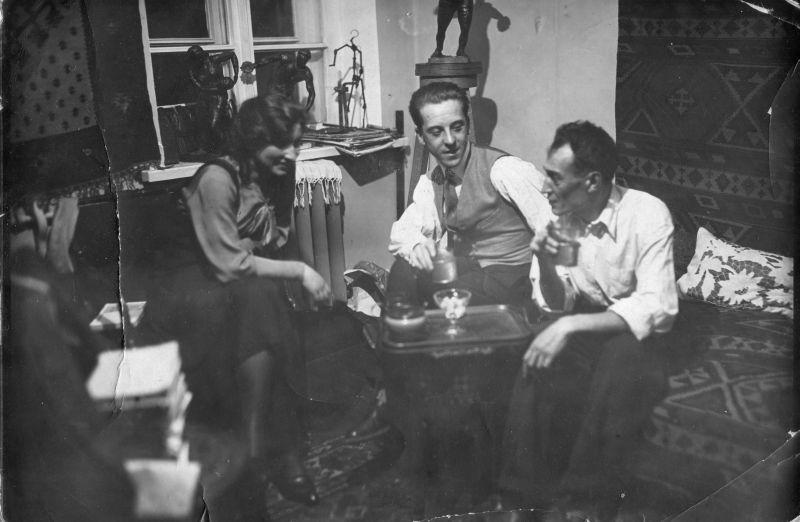 Nadezhda Bykova, Ivan Taranov (in the center) and their colleague in the architects’ apartment