Tatyana Chubarova: “our father and I had a spiritual connection”
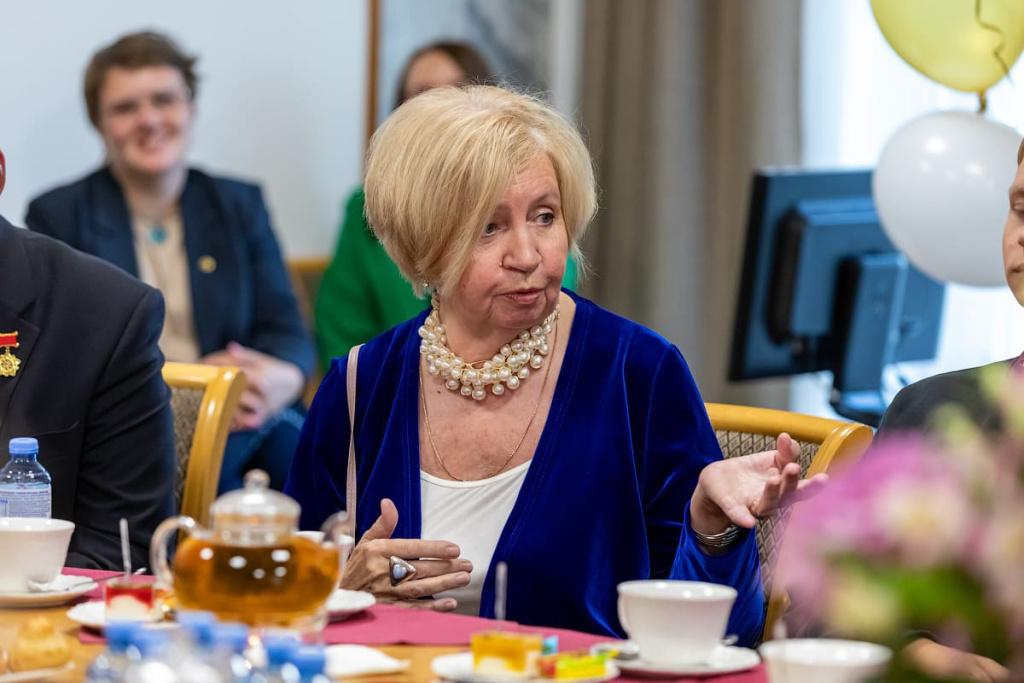
Tatyana Chubarova, the daughter of the famous head of Mosmetrostroy Yuri Koshelev, in an interview with the newspaper “Metrostroyevets” spoke about her famous father.
- Tatyana Yuryevna, your father is almost He spent 40 years in Metrostroy and headed it for 17 years. He left and came back. Couldn't part with him?
- Dad lived by Metrostroy and its tasks. We can say that the organization he headed was also his family. Even during a walk, and we often walked in Lefortovo Park, he talked about his work, about how Metrostroy lives, about interesting technical solutions to complex problems, about how it all began, and always with a kind word he remembered his first teacher - Alexey Leontyevich Yaremchuk. For his father, he was a model not only of an engineer of the highest standard, but also of a leader.
In 1946, after graduating from the Ryazan Railway College with honors, my father entered MIIT at the Faculty of Bridges and Tunnels, a decision he never regretted. After graduating from high school, almost the only one from the group went to Cape Lazarev to build a secret tunnel under the Tatar Strait that would connect the mainland and Sakhalin Island. About 6 thousand former prisoners worked there. Strict discipline reigned at the construction site. It was all the more surprising, my dad said, that when the tunneling was completed, a table was set for the miners, at the head of which sat Alexey Leontievich. Then he gave dad a warrant for a room, and mom and I went to him across the country. I was almost five years old. After Stalin's death, this construction site was liquidated. At Yaremchuk’s request, my father was enrolled in the production department of the Metrostroy Administration.
When he became the boss, he said: being a chief engineer is interesting: I like to solve technical problems, but the boss has more opportunities to help people. Therefore, when he headed Mosmetrostroy, one of his main tasks was to provide housing, high salaries, and modern equipment for metro construction workers, and he did everything in his power to reduce the use of manual labor in the mines. I became interested in the tunneling shield of the Canadian company Lavat. When its president came to Moscow, dad charmed him so much that the Canadians actually sold us the shield on credit.
- I read that thanks to the intervention of Yuri Anatolyevich, several people avoided prison.
- In 1972, when my father was the head of the main department, an accident occurred in Georgia: four people died while driving through a road pass. The head of the Tbilisi metro construction was supposed to go to prison. Dad rushed there on the next flight. The first secretary of the Central Committee of the Communist Party of Georgia at that time was Eduard Shevardnadze. Dad went to a meeting of the Georgian Central Committee and convinced him not to punish anyone rashly, but to find the true cause of the tragedy. It turned out that it was not the miners who were to blame, but the earthquake. With his ability to persuade, he saved two people: the boss and the chief engineer of the Tbilisi metro construction. When dad had his 55th birthday, grateful Tbilisi residents carried him around the city in their arms.
A similar incident occurred in Moscow. A fire broke out at the Ploshchad Revolyutsii station. Due to its proximity to the Kremlin, it could be perceived as sabotage. The head of the station was Yuri Pavlovich Rakhmaninov, who could have been sent to prison, which dad could not allow. Despite the fact that he himself could have suffered, he went to the first secretary of the Moscow City Committee of the CPSU, Viktor Grishin, and proved that the cause of the fire was a faulty welding machine. I remember that we, students, were taken to the station, and we scrubbed off all the soot with our hands.
- Yuri Anatolyevich loved work and Metrostroy. How did he treat people?
- With respect. He valued friendship and was faithful to it from his student days. Dad had wonderful friends. One of them headed a sector in the State Planning Committee, the other, his brother, was involved in container transportation, his wife worked in the city party committee. They loved to go out into nature. As a rule, one of the brothers called dad on Friday and said the code phrase: “let's go get some lilies of the valley.” After these words, the friends took off, took a tent and rushed to the Moscow region for the weekend.
One day we went to pick mushrooms - in a Volga and a Moskvich. The wife of one of the brothers suspected her husband of cheating and nagged him all the way. In the end, he got nervous, drove off the side of the road and fell into a ditch with water. The car overturned and the woman fell into the mud. When the travelers were convinced that everyone was alive, they began to wait for the traffic police. We decided to spend the night there.
Mom was not at a loss, took out a basket of food, started peeling vegetables, strawberries, taking the opportunity to make a strawberry mask, and put a few slices of cucumber on her forehead.
The traffic cops arrived and saw her and decided that she was wounded. When they explained that it was not blood, but a mask for wrinkles, they laughed.
Unexpectedly, journalists with cameras arrived at the scene of the accident. We were glad that we had found such a colorful company for filming: a representative of the State Planning Committee, the Central Committee and dad, the chief engineer of Metrostroy, settled down on the side of the road, preparing to spend the night. It turns out that the journalists needed to film mushroom pickers for the Sunday issue of “Evenings”. The next day, the newspaper published a photo report on how high-ranking Muscovites were relaxing. Next to them, to the surprise of the heroes themselves, stood a full basket of mushrooms, which they never started collecting.
- What attracted people to Yuri Anatolyevich?
- His incredible sincerity. We had a cozy, hospitable house, delicious dinners: my mother was reputed to be an excellent cook. The guests became dad's friends for many years. At the table we sang songs with pleasure; as a rule, dad started. I still remember his words: “How the prophetic Oleg is now planning to take revenge on the unreasonable Khazars” or “Victory March”: “We won, and the enemy is running, running, running.” Mom also sang beautifully, and I actually wanted to become a singer. When my husband and I came to visit our parents and sang, the neighbor told my dad: “Yuri Anatolyevich, when your children come to see you, I turn off the radio and TV and listen to your songs.”
My father was very homely. I loved cooking borscht. When he started cooking, he warned them not to come up to him and advise him on anything: he knew everything himself. Mom was strict, and dad never raised his voice to anyone. I was his favorite, I studied well, went to music school, and sang well. I tried not to cause any trouble.
I had an incredible relationship with my father, spiritual closeness. When I gave birth to my daughter Irishka, he was 43 years old. My husband, a sailor, was at sea as always. Therefore, without a doubt, I gave my daughter to my dad. He adored his granddaughter. Mom and Dad were happy to take her on weekends and visit with her. Irishka still remembers how her grandfather told her a fairy tale about a brother rabbit and cooked “baby porridge.”
- Where did the parents find each other?
- At school. Dad fell in love with mom in the third grade. He told how he wrote her name on pieces of paper: Klavochka, Klavusya, Klavusenka... They were a harmonious couple. Dad was an extraordinary person. Leadership qualities, honesty, nobility, talent, broad outlook were inherent in him from the very beginning. He was interested in history and studied Hegel. When they met, dad told mom about philosophy and was surprised at her patience: “how did Klavusya endure all this?”
Despite his humanitarian inclinations, after school, my father went to the railway technical school, then, however, he planned to enter the Faculty of Philosophy at Moscow State University. There was a constant internal struggle between philosophy and technology. Technology won: he graduated from the Moscow Institute of Transport Engineers.
They were 19 years old when I was born. I never heard Mom and Dad quarreling or arguing. I built my family life in the same vein. There can be no other relationship. If something unpleasant happened to my brother and I, mom and dad would hug and kiss, and everything would go away. Our house has absorbed this atmosphere.
- What did Yuri Anatolyevich do in his free time?
- Dad loved the dacha very much. It took six years to build it. Mom worked on flowers, dad dreamed of growing his own carrots, beets, horseradish - for his favorite borscht. There was a place for carrots and beets, but not for horseradish. Then, secretly from his mother, he planted it between the roses. Mom had to look for a new place for her favorite flowers.
My parents also introduced me to gardening and asked me to thin out carrots. I didn’t like it: it was boring to sit and tug at the tender tops. But the whole family was happy when the carrots he grew went into dad’s borscht! His parents had a private house with a vegetable garden. Therefore, he believed that beets, carrots, onions, and tomatoes should be his own.
- You also graduated from MIIT. Where did you work after graduation?
- At first I got into Metrotrans, but I really wanted to go to Metrostroy. When I shared my dream with my dad, he said: “This is sacred, go,” and I ended up in SMU-6 in the labor and wages department. I immediately noticed a luxurious elderly woman - slender, with a beautiful hairstyle. It turned out that this was the famous Olga Aleksandrovna Frolova-Debolskaya, one of the first thousand Komsomol members who came to Metrostroy upon conscription. The same Lelka by Elina Bystritskaya from the film directed by Yuri Egorov based on the novel of the same name in verse by the poet Evgeny Dolmatovsky “Volunteers”. True, the modest Olga Alexandrovna said that Lelka was not her, that she was a collective image of women metro workers who participated in the construction of the first stage of the Moscow metro. But it was Elina Bystritskaya’s long conversation with her that helped the actress create an amazing image of a pioneering metro construction worker. Women trailblazers are amazing people - selfless, brave, hardworking. After all, in those years women were not accepted into the mines. Olga Alexandrovna and several other girls went to Kalinin and persuaded him to allow them to work underground.
She told how Evgeny Dolmatovsky, who planned to write a book about pioneers, was temporarily enrolled in a brigade of haulage workers: he wanted to plunge into the real atmosphere of work underground. Dolmatovsky, along with the girls, pushed cars loaded with rock and wielded a shovel.
One day, tired of hard work, he fell asleep in an abandoned section of the mine. When the hauliers found him, they gave him a good thrashing. The girls carried the trolleys the entire work shift, but the man couldn’t stand it. Dolmatovsky was not offended by them, and gladly handed Olga Alexandrovna a copy of his book “Volunteers.”
She immediately treated me well, saying: “You’re definitely a dad.” I was very pleased to hear these words from her.