Hollywood star Mosmetrostroy
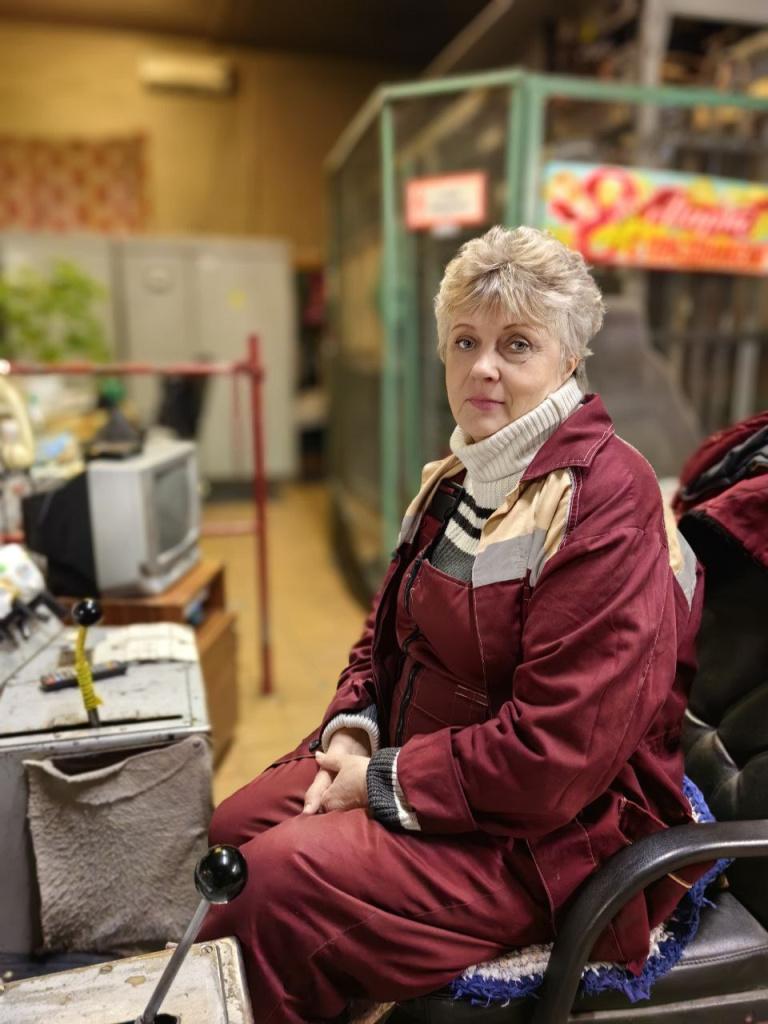
“Hollywood star” Zavadskaya, a labor veteran, was nicknamed by her colleagues, who over the years became real friends. True, Lyubov Vasilievna herself does not agree with this, especially after Los Angeles burned like a match. If it weren’t for this circumstance, I would have supported her colleagues: Lyubov Vasilievna’s smile with which she greeted me truly resembled a Hollywood one. But the goodwill was Russian: without pretense or affectation. Over a cup of tea and cake, we talked about work, personal life, and how a Bryansk girl became a metro construction worker more than forty years ago.
Legendary Mosmetrostroy won
Lyubov Vasilievna was born on January 10, 1965 in the village of Alekseevka, Bryansk region, into a large family of home front workers. Her parents Vasily Fomich and Maria Mikhailovna lived in love and harmony for 65 years and gifted their homeland with four children.
After graduating from school in 1972, Lyuba entered the Bryansk Construction College at the Faculty of Industrial and Civil Engineering and had no intention of leaving her native place. But it was impossible to live life without unexpected introductions. Puzanov’s father’s cousin, Ivan Lukich, came to their village on vacation.
“My uncle,” said Lyubov Zavadskaya, “worked in Mosmetrostroy in SMU-7 as a shift engineer. He suggested that I study and work in the capital. My parents knew that my uncle would not give bad advice, and they let me go. They were worried, of course, about how I, a girl, would live alone in Moscow, but the thought that my daughter had a chance to get into the legendary Metrostroy won out.”
The prospect of working with technology did not frighten me: the girl had no problems with mathematics and physics. And Lyuba went to the capital.
She lived in a departmental hostel: first in Losi, then on 5th Parkovaya. She studied at the Mosmetrostroyevsk School No. 72 as a painter and at the same time at the Construction College at the Faculty of Tunnels and Bridges. After graduating from vocational school, she was assigned to SMU-7 as a mine hoisting machine operator. And she sat down at her desk again.
It was a wonderful time: studying was easy, the hostel was fun: there were many young and perky girls and boys like herself. In the evenings, the guys held dances, attended concerts, and if they wanted silence, they went to the library. And in the morning they sat down at their desks and learned the basics of the profession. I firmly remembered the words of the teachers: do not be distracted by foreign objects in the workplace.
Soon Lyuba received a diploma as a master builder with the right to supervise drilling and blasting operations. She worked at SMU-7 until 2000. With respect he remembers the head of the site, Nakip Galievich Faizrakhmanov, a strong, competent leader. When SMU-7 was disbanded, she transferred to SMU-8.
From Nagatinskaya to Maryina Roshcha–distance of 40 years
I started at the Nagatinskaya station, then there were Savelovskaya, Tretyakovskaya, and Dubrovka.
“After the successful commissioning of the Dubrovka station,” says Lyubov Vasilyevna, “we were redirected to the Maryina Roshcha station.” So for more than ten years we have been working under the leadership of the site manager, Roman Ustrizhitsky. A very attentive leader. He always listens and gives advice. Mechanics Alexander Goncharov and Andrey Saprunov are the same. Over the decades of work, there were different situations, but thanks to strong, understanding leaders, all issues were resolved. We treat our bosses with respect and, I’m sure, they treat us too.
The team in the engine room is very friendly. The girls and I have been working together for more than 30 years, during which time we have become one big family. We always meet each other halfway - after all, situations are different - but there are no disagreements.”
Main–attention
“We work,” explains Lyubov Zavadskaya, “for 8-12 hours, we go out both at night and in the morning. When I sit down in a chair, I forget about everything – both the good and the bad. I only think about what I have to do. The main thing is attention. I heard a signal from the mine - and off we went: two signals - cargo, four - people. On the overpass they also receive signals from the mine. There are two reels: one goes up, the other goes down. We take the breed from below, we lower the people from above. Sometimes you do 200-220 ascents and descents during a shift.”
Before the driver’s eyes is a board on which the necessary information is displayed, a lot of different instruments, movement handles and brakes, and a microphone for communication. Like in the cabin of an airliner. Maybe a little simpler, but an outsider can’t figure it out right away.
Behind the machine, as Lyubov Vasilievna calls the unit it controls, there are huge reels with a wound cable. With a slight movement of the hand they begin to move, and in one or two minutes the cabin with the miners rises from a depth of 67 meters. Or it goes down. The depth of the rise depends, of course, on the metro station being built.
The noise is incredible. Zavadskaya has gotten used to it for more than 40 years. She believes that her profession is not the least important in the construction of tunnels and subways. With the help of her machine, more than one metro station was built, but without a hoisting operator you can’t build a single mine: “If you’re healthy,” Lyubov Vasilyevna says cheerfully, “I’ll work some more, because my anniversary is so modest.”
As a schoolgirl, Lyubov fell in love with drawing: she was excellent at it, so Lyubov Vasilievna was more than once offered to change her workplace: go to the planning department or take up drawings. But the young girl was attracted by the opportunity to drive her favorite car, and she did not exchange her workshop for a warm, comfortable office. As I grew older, of course, I thought more than once that it would be more convenient to sit at the drawing board, but what’s done is done.
You can’t build a metro without responsible personnel
Suddenly, mechanic Andrei Saprunov entered the engine room. Taking this opportunity, I ask him what he thinks about Zavadskaya’s work: “Lyubov Vasilievna,” answered Andrei Alexandrovich, “showed herself on the good side. She always made concessions and did not give up during difficult times for us and Metrostroy. We are very grateful to her for her services, conscientious work and attitude towards work. Without people like her, you can’t build a metro: after all, miners, rock, equipment, and little else must be lowered and lifted into the mine! The work is necessary, responsible, requiring attention and the ability to gather yourself and discard the unnecessary.”
Today, the profession of a mine descent machine operator is especially valued: there is a problem with personnel, young people do not go to them. With warmth, Lyubov Vasilievna recalled the time when students came to them for internships and learned to work on a small lifting machine. Mosmetrostroy has its own Technical School; previously, throughout the country there were vocational schools and industrial technical schools in which the working class was raised. Today there are only a few of them, it’s good that at least there is an awareness that such specialists as Gosha from the beloved film “Moscow Doesn’t Believe in Tears” are needed more than lawyers and economists, that without them there will be no technological breakthrough in Russia. Conditions are being created for training the necessary personnel. It's time to think about how you can attract them to the workplace? Zavadskaya believes that this is not an idle question.
Time does not heal
With sadness, Lyubov Vasilievna spoke about her personal life. She got married in the 90s to a fellow countryman: “In Bryansk, where her husband Alexander Vasilyevich Zavadsky was from,” said Lyubov Vasilievna, “they didn’t meet, but in Moscow they found each other. In 1992, our daughter Julia was born. They lived together for 35 years. We had a very good, friendly family. Two years ago my husband passed away. It was hard to deal with this grief. But the warm attitude of colleagues, daughter and her family helps to overcome the loss of a loved one. The feeling of loss does not leave, it is present everywhere, but the attention and care of family and friends makes it less tangible.”
In her free time from work, Lyubov Zavadskaya lives outside the city, in a house that she and her husband built. There is a garden and a vegetable garden, tomatoes and cucumbers, however, Lyubov Vasilievna does not do much with this. Her main hobby is roses, which she loves, grows and cherishes. She is glad when her daughter’s family comes to her to breathe fresh air and admire the flowers. The most beautiful flowers, of course, go to our beloved granddaughter Dashenka.
Zavadskaya has a large library, all family members used to read a lot, today everything you are interested in can be found on the Internet. Lyubov Vasilyevna closely monitors the situation in the world and wants a peaceful sky above her head.
In the evenings, he often remembers how it used to be: metro construction evenings, meetings with interesting people, trips. Zavadskaya, with the help of the trade union committee, traveled to Czechoslovakia, traveled along the Golden Ring, enjoyed visiting various museums, and herself participated in trade union activities.
No, no, and my memory will come back to how I survived during perestroika: “It was hard, my daughter had just been born, they gave me food with coupons. Well, my mother sent meat and lard from the village. Despite the difficulties, we survived everything, raised our daughter and gave her a good education: she graduated from the RANEPA Institute under the President of the Russian Federation.”
Our heroine’s parents are from the Bryansk region: “Dad,” Lyubov Vasilievna says with pain, “died at 84, five years ago; Mom survived dad by four years and passed away at 92. My sister and I took her to Bryansk and buried her next to my dad.” Today I live with my daughter’s family and memories. Of course, a passion for flowers helps. They put your nerves in order and give you the opportunity to enjoy beauty.”
Stars of Mosmetrostroy
By the way, about beauty: if you remember about Hollywood stars, then I’m sure there are no less of them in Mosmetrostroy. Remember the movie "Volunteers"? The main character of the film, Lelka - the prototype of the metro construction worker Olga Debolskaya from SMU-6 - was played by Elina Bystritskaya, who rightfully won the title "Miss Universe". Olga Debolskaya was a beauty, so was the famous Tatyana Viktorovna Fedorova - a pioneer builder, deputy head of the Moscow Metrostroy, Hero of Socialist Labor, Honored Builder of the RSFSR. Elena Seslavinskaya, a leading engineer of the production department of the Mosmetrostroy Administration, a mentor of young specialists, an honorary builder of Moscow, an honorary transport builder, an honorary employee of Mosmetrostroy, was not inferior to them. Lopatkina Galina Aleksandrovna - head of the planning department of Mosmetrostroy, Elizarova Galina Anatolyevna, member of the Council of War and Labor Veterans of Mosmetrostroy, one of the best managers of a kindergarten in Bibirevo, headed the association of kindergartens "World of Childhood". And the magnificent Lidiya Gurgenovna Arushanova - a hereditary metro builder, an honorary metro builder, a labor veteran? Her sharp mind, charisma and elegance invariably inspire respect and admiration.
Once you start listing the names of beauties from the metro, you won’t stop. I am glad that our women are not only beautiful, but also smart.
Natalya Dolgushina