Fragile pages
The almost century-old history of Mosmetrostroy is full of memories of persistent, selfless work. There are truly heroic pages. Evidence of the exploits of individuals and entire teams, grandiose construction projects and important events in the life of the organization - all these treasures are kept by its United Archive, created in 1934.
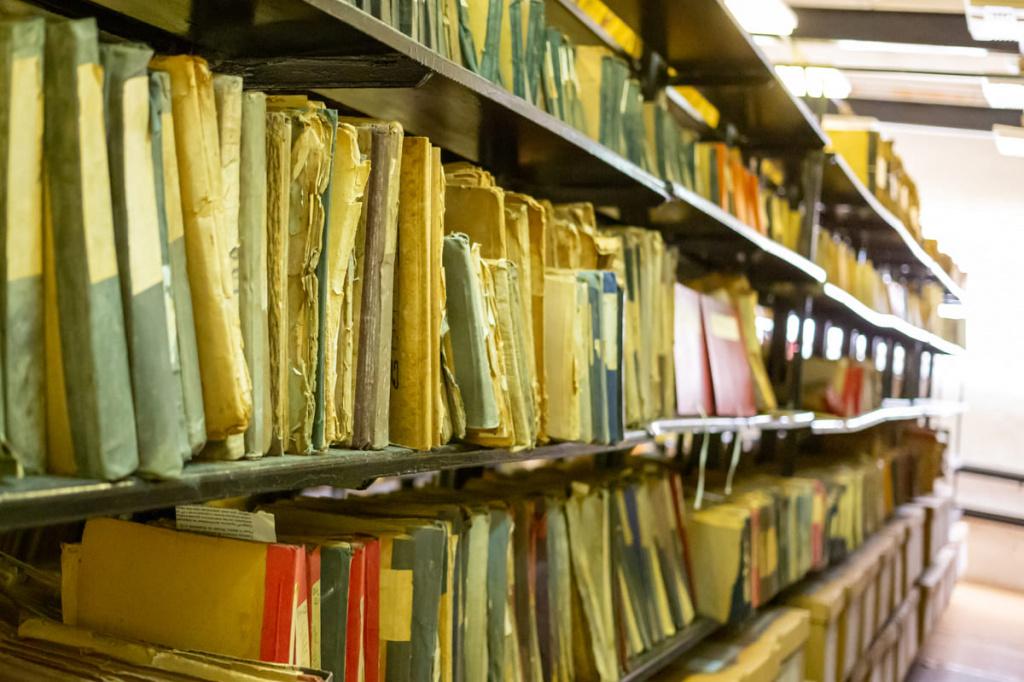
Today the archive has more than 110 thousand storage units, each containing 300–400 pages. For the last 20 years, it has been located in a building on Otkrytoye Shosse; since 2016, it has been headed by Svetlana Turuntseva. She often recalls her early days at the archives. Once Svetlana opened a folder with the personal files of metro construction workers from the 1930s and saw a yellowed photograph from which a fragile, pretty woman in a boa and with painted lips was looking at her. The documents said that this woman worked as a digger at Metrostroy. And many such unexpected finds can be made in the United Archive. Some facts from the history of our country have been preserved only here.
Since its inception, the archive has accepted for storage all documents relating to Mosmetrostroy employees: personal files, cards, personal accounts, orders for employment, transfers and dismissals. According to the rules, each paper is stored for 75 years, after which a special commission decides whether the documents are valuable. If not, they are destroyed. Before doing this, the United Archives staff must scan and organize the papers. This is what they did in 2019 with personal accounts issued before 1944.
“Representatives of the State Archive visited us,” says Svetlana Turuntseva. “They were delighted and amazed that we saved documents that had already been destroyed in other storage facilities due to expiration of deadlines. For example, personal accounts of the war years, which can be used to recreate the social and living conditions of that period. Among the boring economic papers, there are unique ones: payments for evacuation or containing information about repaid loans.
There are real treasures in the Mosmetrostroy archive. They got there because initially the organization did not divide orders into personal and production. As a result, the first orders of the leaders, their unique signatures and data on what objects, in addition to the capital’s subway, were erected and repaired by metro builders have survived to this day.
A place of honor in the archive is occupied by Pavel Rotert’s order dated December 23, 1931 on the selection of a site for the construction of the Metrostroy administration building; Abram Tankilevich’s order dated June 21, 1944, that the organization’s employees undergo a ten-day chemical reconnaissance course; order of Mikhail Samodurov dated May 16, 1944 on the reconstruction of the music school at the Tchaikovsky Conservatory. Each document is an original piece in the historical puzzle of the Moscow Metro Construction.
Among the personal files are handwritten biographies of famous figures of the organization: Tatyana Fedorova, Ivan Zubkov, Zinovy Gerdt and many others. Cards of ordinary employees are no less valuable and interesting for their relatives.
The archive is often visited by people looking for information about their relatives who were metro workers. Recently a woman called from the Chelyabinsk region. She wanted to know more about her grandfather; she only said his name and place of birth. They helped the woman: they found the right one in the scanned personal cards, with the exact date of birth of the man and an indication that he was a navvy.
According to Svetlana Turuntseva, people are proud that their ancestors built the metro. They often cannot hold back their tears when they receive at least a little new information about their grandparents. And photographs from the personal cards of metro builders often turn out to be their only photographs during their lifetime. Archive employees help search for such data on their own initiative. Their main responsibilities include processing requests for pension matters. Stored information about the work experience of employees, including former ones, allows them to process the payments due.
Through the archive, kinship with the metro builders is confirmed by both their descendants and ritual services. If there is no information, it will not be possible to bury the newly deceased together with those who left before, and this, as a rule, is the last will of the deceased. Up to a thousand different requests are received per year.
The staff of the United Archive is constantly working to make it easier to find the necessary data. Svetlana Turuntseva, together with archivist Pavel Faleev and human resources specialist Nadezhda Reznichenko, in their free time from responding to requests, put personal files in order and scan papers that must be removed from storage due to the expiration of the statute of limitations. This process is slow. As of today, the documents of the old SMU-2, Distances No. 1, 2, 3, 4, Mine No. 20-21, Lumber Plant, FZU school have been digitized - in total about 16,000 personal cards and 2,500 personal files. The numbers are impressive, but a lot remains. The files of the first Mines and Distances are not systematized; documents in folders are often not in alphabetical order. It is extremely difficult to find a specific card there, and if you do not know the year the person was fired and the department where he worked, it is almost impossible. All hope lies in electronic versions of old papers.
Documents from the first half of the 20th century must be handled with particular care. Fragile and rather “capricious”, they should be stored in a properly ventilated area, at a constant temperature of 20˚C and a humidity of 50–55%, out of reach of direct sunlight. Violation of any of these conditions risks the documents turning into dust. Then the memory of the significant deeds of the metro builders for the country, and of them themselves, will sink into oblivion. So archivists try to preserve this value, outwitting time.
The archive is currently in the process of moving and is not accepting requests.
INTERESTING
An archive for storing and systematizing documents of Mosmetrostroy, mainly its employees, was created on December 1, 1934 on the initiative of the first head of the organization, Pavel Rotert. Ironically, order No. 1087 has not survived.
At different times the archive was headed by:
1. Kryzhanovsky V.N. (1934–1935)
2. Semenov A.E. (1935–1950)
3. Nazarov Yu.P. (1950–1971)
4. Larionova N.V. (1971–1986)
5. Gerasimenko E.N. (1986–2006)
6. Poryvkina T.A. (2006–2014)
7. Arkhipova V.A. (2014–2016)
8. Turuntseva S.P. (2016 – present)