Making a way in the dark
We continue the “Keyhole” section. In it, an MS correspondent spends one day with a builder, “spying” on his work. This time the hero of the column was the operator of the tunnel boring shield from TO-6, Dmitry Aldokhin. He told how to operate the Lovat-242SE TBM and how it differs from the German Herrenknecht.
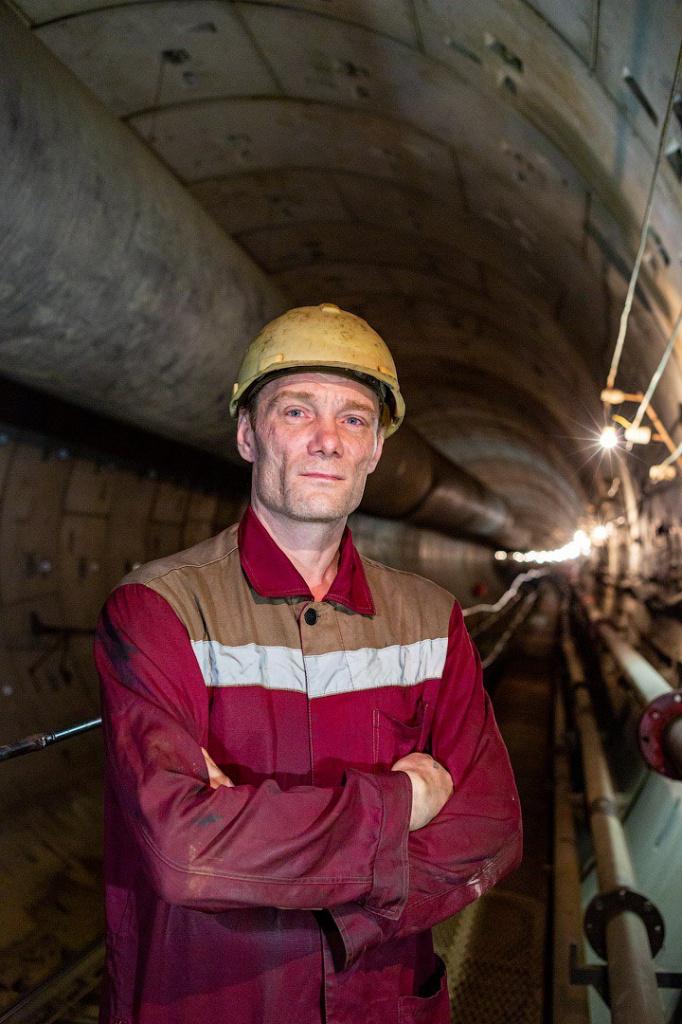
Dmitry Aldokhin in the tunnel under construction between the dead ends behind Seligerskaya and the future Lianozovo station
Dmitry Aldokhin is one of the four pilots of the multi-ton Claudia. His shift takes place in the distillation tunnel under construction from site No. 30 behind Seligerskaya towards Lianozovo. Every day you have to walk a little more by 10-15 meters to your destination (8-10 rings, each of which is 1.2 meters). Now this distance exceeds two kilometers.
– We start with the report of the shift worker: how the shield behaved, are there any minor breakdowns that are worth paying attention to. Then comes the inspection of "Claudia". At this time, the miners are just installing the lining ring,” says Dmitry. – First of all, we check the lubrication level to see if there are any oil leaks.
“Claudia”, by the way, is a rather voracious metal lady - a barrel of lubricant of 200 kilograms is consumed per shift.
– The value is approximate. “It all depends on the operating time of the machine,” he continues.
Downtime is rare. For example, when replacing rollers, bearings, hydraulic hoses or other parts that most quickly fail. Only European spare parts are used. By the way, despite its age, “Claudia” has retained many original details.
SUBTLETS OF DRIVING
“It needs to be driven carefully, gently, unlike the Herrenknecht TBM,” explains Aldokhin, who had experience working on a German shield. – The main difference between Lovat is the presence of articulating parts. The German shield in its system has jacks that need to be pressed to the right, left, up or down. In Lovat you can raise or lower the rotor, turn it left or right. The car turns out to be more maneuverable and at the same time responsive to control, there are fewer buttons, and there are more levers in the control panel.
Under the pilot’s hands is a large control panel, which displays the operating diagram of the jacks, pressure, TBM speed, rotor operating speed and other parameters of the mechanisms. Dmitry compares “Claudia” to a large machine - you need to feel its dimensions, with the operators’ prompts to make your way in the dark underground.
At the same time, operators on the surface, using computer data, suggest the route, adjust the direction of the shield, changing the force of individual jacks. They also say that when the shield needs to rotate, the pilot must prepare for such a moment in advance. Modern navigation tools help - gyroscopes and laser theodolites allow the shield to accurately maintain the design values of the route.
“At first, being at depth was oppressive, but then I got used to it,” the driver shared. – You have to work while standing. Short breaks for warming up occur when diesel trucks are transporting soil through the tunnel and the miners are busy lining the tunnel. Then you can have a snack.
“Claudia” doesn’t let you relax. After the next shift change, you need to walk kilometers underground and look into the headquarters, communicate with colleagues, and hand over the shift. By the way, communication between teams is continuous using the drivers’ chat. If a problem arises, it is promptly discussed and a solution is found.
FROM THE DYNASTY OF METRO BUILDERS
Dmitry Aldokhin is a Muscovite. After school, he graduated from college and received a specialty as a rolling line operator. He came to Mosmetrostroy at the age of 17 as a tunneler. Without interrupting his work, he mastered the profession of a TBM operator.
The first ones Dmitry managed were Russian-made shields. I have experience working on German machines from Herrenknecht. It is interesting that the first sinking of the Klavdia TBM on the Butovskaya line was carried out with the participation of Aldokhin after completing courses on the Lovat technique. Today Dmitry is leading the fifth passage and again on the legendary “Claudia”.
The Aldokhin family continues the dynasty of metro builders. His wife, brother and brother-in-law also work at Mosmetrostroy.
HELP
The Lovat TBM appeared at TO-6 in 2002. The name “Clavdia” was given in honor of the wife of the former head of Mosmetrostroy, Yuri Koshelev.
Over its 18 years, the car has passed through about 13 kilometers of tunnels. The key to her longevity is constant work. The technology lasts a long time as long as a person uses it.
Maintenance of the switchboard requires different specialists. Among them are a team of tunnelers, hydraulics, electricians, mechanics and welders. Now “Klavdiya” is moving along Dmitrovskoe Highway towards the future “Lianozovo” station.
The head of section No. 2 of TO-6, Evgeny Bachurin, is supervising the excavation. He notes that now on the way “Claudia” and the builders are faced with water-saturated soils and a large number of boulders. Beautiful stones, but very strong, add complexity to the passage.
Lovat TBMs have special elements called “bear paws”, they are responsible for sorting the rock, preventing large boulders from entering the rotor chamber and jamming the auger. The boulders are removed manually while inspecting the cutting tool. Otherwise, the stones will damage the sash jacks.
In June, we will have to part with “Klavochka”, as it is affectionately called in TO-6, for a while. The TBM will be dismantled at site No. 36. After refurbishment, the shield will be transported to site No. 30, and it will begin laying the 11th tunnel in its technical age.
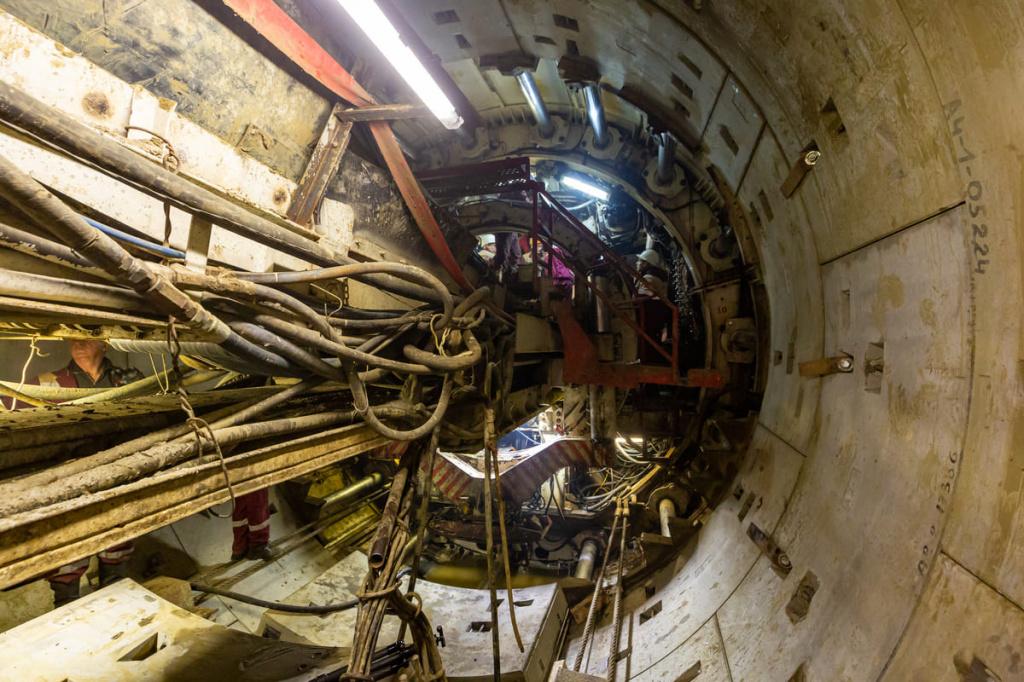
Head of TPMK "Clavdia"