Vira and Natalia Ivanovna's tower crane lane
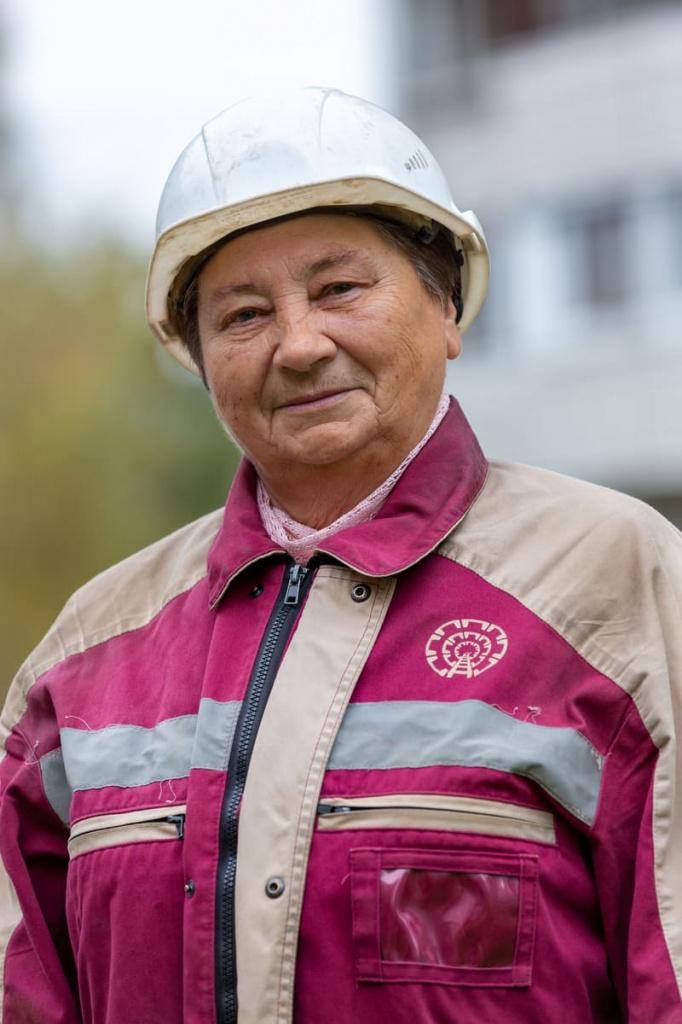
Natalia Starodvortseva has been working at a construction site for almost half a century. In 1971, on a Komsomol voucher, she left Ukraine for Moscow to build a metro. A Metrostroevets correspondent spent one day with the SMU-12 crane operator and tells her story in the traditional “Keyhole” section.
TEAM FROM SEAVIVORS
Natalia Starodvortseva's morning is early. Wake up at 05.00, have breakfast, and at 6.10 she is already in a hurry to go to work. Over the course of 49 years of work, she has changed many venues. Currently working on the basis of construction materials. SMU-12 stores them in the Tushino area, on Vodnikov Street, 16.
“That’s how I go: where the tap goes, so do I,” she laughs. He doesn’t even think about changing jobs. He has been operating the crane deftly for three decades out of total experience. - There is nothing complicated. It is important to know the controllers and commands: vira and lane.
Ancient Phoenician commands, taken from seafarers, are used every day by builders. These two words are shouted from the land of Starodvortseva. “Vira” literally means “into the air” and is used in rigging as a command to lift a load. “Myna” literally translates as “into the water”; on a construction site it is a command to lower the load.
– I can also ask you to drive up. Knowing these three commands, you just need to work,” says the crane operator. – Perhaps a new person will be a little scared at first: after all, you are operating a crane. But you get used to it quickly.
For commands from below, walkie-talkies are not needed; it is enough to hear the loud voices of the builders or see a signal given by hand. But in a limited area, walkie-talkies will be required: they are issued to the slinger and crane operator.
WE FEEL A HEAVY LOAD TOGETHER
Now the tower crane is lifting Starodvortseva low. The cabin of the so-called “nulevik” is at a height of one and a half meters from the ground. But in her practice there were iron “partners” even higher, in which the cabin was located at the level of the fifth floor. Then a beautiful view opened up.
Every morning, the crane operator notes in the logbook that she has completed safety procedures, a few words with her colleagues, and the shift begins at 8.00. During her working day, she lifts and moves various loads using a tower crane. The heaviest ones weigh up to nine tons.
– We load and unload trucks with construction materials. There are 12-meter long pipes, fittings, tubings - in a word, everything that is brought. We feel the heavy load together: me and the crane. I feel how he strains to drag the part with great weight. It is not easy to turn even with a long load. But when you work on a construction site all your life, you adapt to any size.
There is currently only a warehouse for construction materials on the site; repair shops are promised to be built here soon.
WITH PROPELLER IN THE CAB
Natalia Starodvortseva’s workplace is a crane cabin. In summer he opens the window wide, and in winter he tries to conserve heat.
“It’s hot in the summer, the cabin is metal, it heats up quickly, and sometimes even gets hot,” she notes. – We have to install a small fan. The propeller blows me a little. In winter, the heaters work and the cabin becomes fresh. Until we freeze.
Also, in cold weather, a quilted jacket, as Starodvortseva affectionately calls it, and felt boots help. True, he still prefers different shoes. It is admitted that wearing boots makes it more convenient to press the pedals. There are two of them: the boom brake and the signal.
“You have to work mainly with your hands, switch levers: two on one side for lifting the load and moving the crane, and on the other for turning and extending the boom,” explains Natalia. “It’s also important to look around: where to move the boom, where the crane is going, whether there are people nearby.
ONE CAGE FOR ALL
The first station where Starodvortseva worked was Turgenevskaya on the Kaluzhsko-Rizhskaya line. It was just being prepared for delivery in August 1971. At first I studied at a technical school, completing a six-month course to become a hoist operator. This mechanism lowers and raises people and rock from the mine. It was not easy, but Natalia Ivanovna was used to this kind of work.
He names Petrovsko-Razumovskaya station on the Serpukhovsko-Timiryazevskaya metro line as the most difficult station to build. I had to work hard on night shifts. At that time, breeds were issued in 250 wagons.
“At Kurskaya there was only one cage, the conditions were very cramped,” recalls Starodvortseva. – But it’s okay, they were young, they coped with everything. And now everything is fine, we are also coping.
HELP
Natalia Starodvortseva was born on August 20, 1950 in the Rivne region (Ukraine). She graduated from nine classes and the local school at the Rivne plant. She worked as a spinner until 1971. At Mosmetrostroy she worked in one SMU. At first it was department No. 5, then No. 25, and after reorganization in March 2020 - SMU-12. She is not the only one in the family who works in construction. My husband is also a builder. The son of the Starodvortsevs later followed in the footsteps of his parents. He works in Tunnel 2001. Natalia Ivanovna’s mother-in-law also worked at Mosmetrostroy.