Georgy Danelia: I'm proud that my father is a metro builder
On August 25, the famous director, People's Artist of the USSR Georgy Danelia will celebrate his 88th birthday. His father, Nikolai Dmitrievich, devoted his entire life to construction. He began his career as an ordinary railroad engineer, and rose to the rank of chief engineer of the Moscow Metrostroy, and then the Soviet Union. The son of a metro builder continued his father’s work in his own way. Georgy Danelia has filmed scenes of his films in the metro more than once. On Builder's Day, the director, whose films have long won national love, shared his memories of his father with the editors of Metro Builder, talked about the role of the metro in his films and what is missing in modern society
Georgiy Nikolaevich, your father was a famous and respected metro builder. Did he tell you about his work?
– No, neither in the first half of his life, nor in the second, when he worked in a “mailbox” (at a secret enterprise - editor's note). Therefore, there was no talk about his work. I know that he worked as an engineer on the construction of the Myasnitskaya station, which later became Kirovskaya, and is now called Chistye Prudy. Where Sakharov Avenue is now, there was a barracks for metro construction workers. We lived in it, just near my father’s place of work. Sometimes I approached this shaft, but did not dare to look inside. Then, somewhere in 1937-1938, they built a house for metro construction workers. We got two rooms in a nice apartment. Now this house faces Sakharov Avenue.
I remember that pride when my dad took my mother and me to show the station a little before passengers were allowed there. It was a rather harsh time and therefore the luxury in the metro - marble, stainless steel, frescoes, mosaics - looked fabulously beautiful. The metro workers were very proud of this magnificence. And we were all proud then that we had the best metro in the world. It remains so to this day.
Did your father work at classified facilities?
– Father became the chief engineer, director of the mine. Then he worked as the chief engineer of the Moscow Metrostroy, then as the chief engineer of the All-Union Metrostroy. Afterwards I went to build a “mailbox”, which was strictly classified.
I remember I once went to kindergarten to pick up my son, he was 5-6 years old. I hear him talking to his friends, they ask him - where does your grandfather work? The son answers - I can’t tell you, it’s top secret.
A MAN OF AMAZING HONESTY
How did Nikolai Dmitrievich feel about work?
– By the way, I don’t remember a time when my father was ever late for work. He always had his phone near his pillow, because problems often arose that had to be solved urgently.
When his father died, a lot of metro builders came. And they erected a monument. He was a man of amazing honesty. We didn't live very richly. And I remember the only thing he had of value was his shoes. When the bombing began, he himself did not go into the basement to hide, but sent his housekeeper there with boots. If the bomb hits, at least the shoes won't be lost.
After the war, all the generals were allocated plots of land and given subsidies for the construction of a dacha. And he got it too. He spent all the money he had on this and even sold his shoes - his main asset. Then one newspaper published that it would be nice to give these generals’ dachas for kindergartens. And the next day my father wrote a statement that he was asking to take our dacha for gardens. My mother then said that he would be the only one who would do this. She was right. But at the same time she fully supported him.
WORKED BOTH DAY AND NIGHT
Did your father tell you about the years of the war?
– In 1941, he had a special task: if the Germans came, he would blow up the metro. He knew they wouldn't come in. Later that year, he built command posts for senior management.
During those years, my father fell ill with tuberculosis because he worked so hard, day and night. He was admitted to the hospital. He lay there for a week, then came out and said that he could not help but work at such a time. And he worked the same schedule, smoked a lot, but gained weight.
Nikolai Dmitrievich was proud of his awards?
– When he was given a general, he reacted to it with great humor. There was such an episode. My father loved the Sandunov bathhouse. And I went there on weekends. When I grew up a little, he started taking me too. There was a swimming pool there, and I learned to swim there.
Somewhere in 1943-1944 we also went there. He washed himself with the bathhouse attendant, he believed that this was the only way to wash himself off. And then one day a man came up and said that he had the right to skip the line. The father said: “Why? I'm already lying down. Wait". To which I received the answer: “No, I’m a general.” Father: “How do I know that you are a general?” This one left and returned naked, but in a jacket. When we were getting dressed, I asked my father why he didn’t say that he was also a general. And he answered me that it was awkward in front of the bathhouse attendant: “He would have thought that I was just as stupid.”
I remember another incident. Something happened at the construction site. My father went to the site at night and began to command rescue efforts. Alexey Nikolaevich Kosygin came there and also began to lead. Father says one thing, Kosygin says another. And suddenly his father yelled at him: “Can you shut up? You’re in the way, so get out of here!” Kosygin then said that his father was right. One must command. But still, they did not forgive my father for this and at the first opportunity they removed him.
He then bought a lot of wooden boards and made shelves out of them, bought books and arranged them. I am now sitting in his chair, looking at the shelves and books. I'm proud of my father. I'm glad that he is a metro builder. He has many awards, two Orders of Lenin.
Metro builders are special people. When the first metro was built, they were like astronauts. For that time, this was the greatest and most beautiful achievement of the Soviet state. The whole country was proud of the Metrostrians. They made the best metro in the world.
METRO AS A SHOOT SET
As a person with an architectural education, which station do you love more than others?
– I liked the “Palace of the Soviets” station, now it is “Kropotkinskaya”. Harmony, simplicity. This is a bright, welcoming station. By the way, we filmed the film “Autumn Marathon” in the Leningrad metro - the film begins with shots of the hero riding in the subway.
Did your father see your paintings?
–He saw the paintings. In the film “I Walk Around Moscow,” the hero, played by Nikita Mikhalkov, is a metro builder. He could have worked anywhere, but I decided that my father would be pleased if the hero became a subway operator.
My father was a reserved man. He looked at the picture and said, well, nothing. Then my mother told me that he liked it, it’s just his character. I respected and obeyed him until the last day.
NOT BURYING MORALITY
In one of the interviews you talked about energy. What is our society lacking now?
–If we talk about the metro, I remember how spacious and comfortable it was to travel there. I remember huge crowds of people, but in my memory all the passengers were kind, I never saw anger, aggression or quarrels. Maybe I was lucky. This probably happens, but I have never seen it. Although I took the subway to work for a long time.
Now the rhythm of life has accelerated, there is a lot of information. On all television programs they speak too quickly and shout at the same time. It gives the impression of anxiety, as if something has burned down or a war has begun. And it turns out they are the ones who announce the weather. To save time for advertising, television presents news at wild speed. Previously, the announcer’s words had a calming effect, but now they disturb and make you worry. It affects people because they are addicted to television.
I think we don't have enough information about goodness. Now they show a lot of crimes, murders and misfortunes, journalists instantly grasp this. But there is less good, kind, honest. Therefore, people are more aggressive than before.
Can this be somehow influenced?
– Through television programs. We need less aggressiveness and negativity. Let the presenters talk not about how good it is to be angry, but how good it is to make peace. It's nice when everything calms down. But they scream. And some even allow themselves to be rude on screen. Pushing someone, calling someone names. This is being adopted. This is all becoming the norm. I understand there is no censorship, but morality is needed. Morality should not be buried so deeply.
REFERENCE: Georgy Danelia was born on August 25, 1930 in Tbilisi, a year later the family moved to Moscow. He was a member of the Komsomol. In 1955 he graduated from the Moscow Architectural Institute, in 1954-1955 he worked as an architect at the Institute of Urban Design. Danelia was interested in cinema, acted in extras, and in 1956 he entered the newly opened Higher Directing Courses (workshop of Mikhail Kalatozov), which he graduated in 1959. Since 1959 - production director at Mosfilm. He made many films that have become classics of Soviet and Russian cinema: “I Walk Through Moscow” (1964), “Afonya” (1975), “Mimino” (1977), “Autumn Marathon” (1979), “Kin-dza-dza!” (1986), “Passport” (1990) and others.
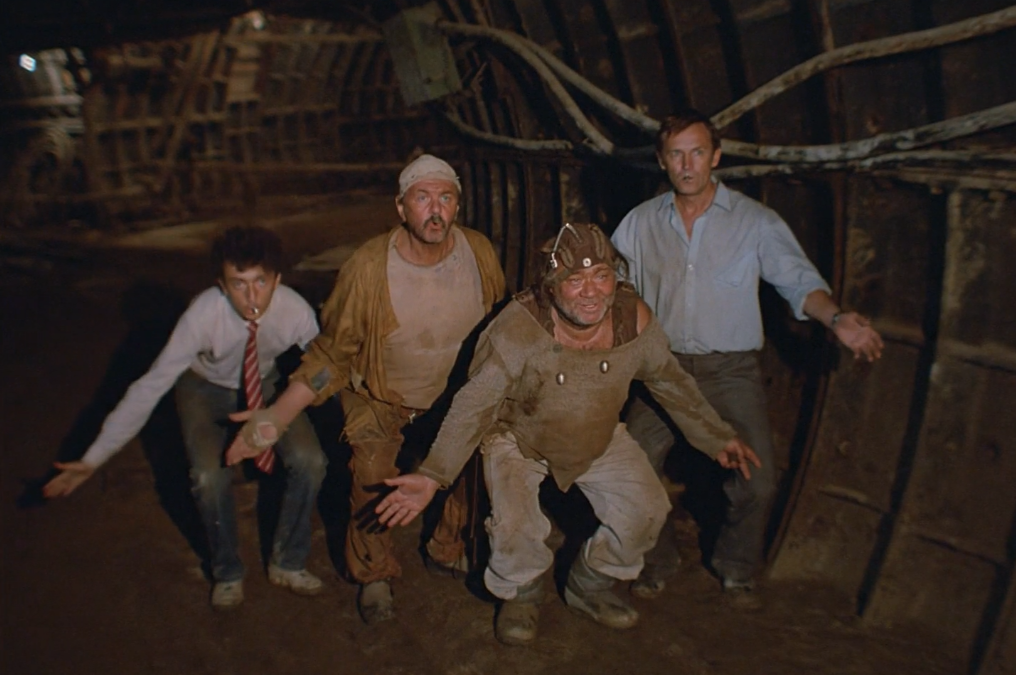
BY THE WAY: One of the scenes from Georgy Danelia’s film “Kin-dza-dza!” (1986) was filmed in the tunnel of the Polyanka metro station during the construction of the section from Serpukhovskaya to Borovitskaya. The object is captured at the 83rd minute of the film. The tunnel played the role of an illegal entrance to a shopping center on the planet Plyuk, through which the heroes went to get gravitsapa.