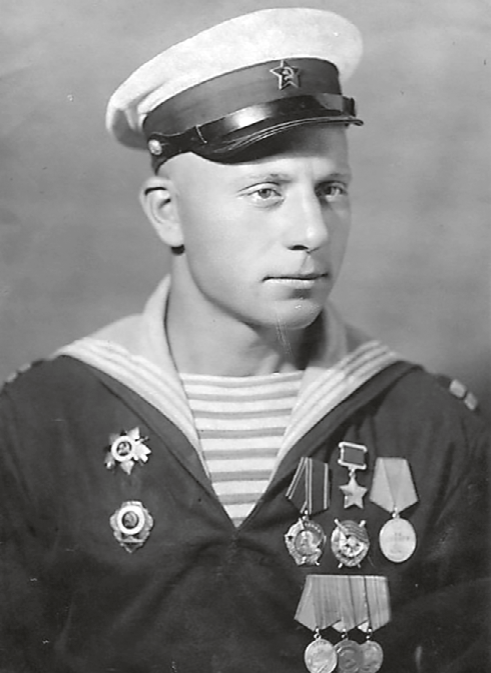
The Hero of the Soviet Union returned to Metrostroy after the war
“Evenings” recalls what the newspaper wrote about the metro on this day many years ago. Today – material from July 31, 1945.
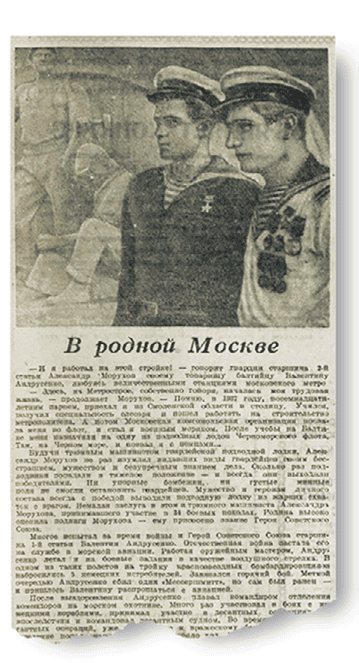
The article, signed “Captain V. Korshunov,” was called “In native Moscow” and began like this:
“And I worked at this construction site! - Guard Sergeant Major 2nd Article Alexander Morukhov says to his fellow Baltic Valentin Andrusenko, admiring the majestic Moscow metro stations.
“Here, at Metrostroy, in fact, my working life began,” continues Morukhov. — I remember in 1937, as an eighteen-year-old boy, I came from the Smolensk region to the capital. I studied, received a specialty as a mechanic and went to work on the construction of the metro..."
The author could not know that for Alexander Sergeevich Morukhov (1919–2001) this was only the “first call” in his work in Metrostroy. In January - November 1939, Sasha participated in the construction of tunnels from the Airport to the Sokol. Then he was drafted into the navy. From the first days of the Great Patriotic War, he became a bilge operator of the M-35 submarine of the Black Sea Fleet. Participated in the defense of Sevastopol and the Caucasus, in the liberation of Crimea. He was on 34 military campaigns, during which 16 torpedo attacks were carried out, three enemy ships were sunk and one was damaged.
On September 16, 1942, Red Navy soldier Alexander Morukhov accomplished his first feat. The M-35 submarine, escaping the attack of an enemy aircraft, began to urgently dive. A trainee student mistakenly opened the manifold exhaust valve and water rushed into the boat. The ship sank to a depth twice as deep as it should have been (90 meters together 45). Then the bilge operator Morukhov, gathering all his strength, crawled to the emergency high-pressure air column and opened the required air valve, simultaneously connecting the emergency group of high-pressure cylinders. The air whistled into the aft tank and at once squeezed the water overboard. The ship and crew were saved.
The second feat occurred a little over a year later - on September 28, 1943. The submarine "M-113", on which Morukhov served, while on the surface, was blown up by a German floating mine. The bow of the ship was almost separated.
The bilge operator Morukhov, as stated in the documents, “with his competent actions created the conditions for a successful fight for the survivability” of the submarine.
On July 22, 1944, the senior guard of the Red Navy, Alexander Morukhov, was awarded the title of Hero of the Soviet Union with the Order of Lenin and the Gold Star medal.
Among the Heroes of the Soviet Union, sailors were generally in the minority. And according to some sources, there are only two awardees who did not belong to the command staff (the second is midshipman Ivan Perov [1910–1989]).
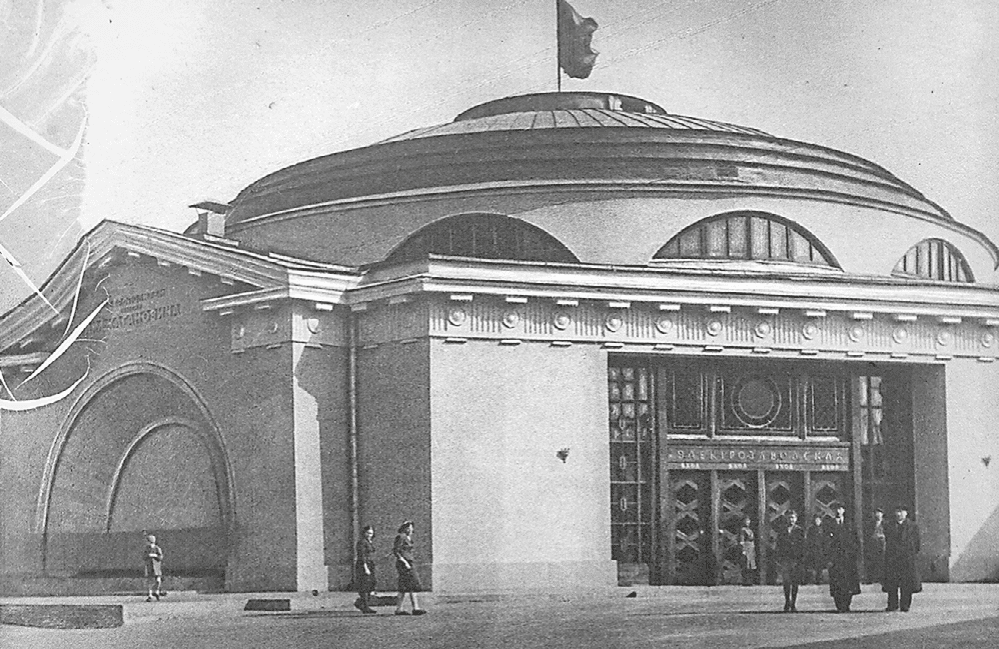
In the article “Evenings,” Morukhov is called a “former metro builder” who came to the capital on leave and shows his friend “metro stations, many of which he himself saw for the first time, because Muscovites built them without him, during the Great Patriotic War.” Indeed, Alexander Sergeevich still had almost a year left to serve on the submarines of the Black Sea Fleet.
But in June 1946, Alexander Sergeevich was demobilized with the rank of foreman of the 1st article and returned to Metrostroy. At first he worked as the head of the construction personnel department. Then
Graduated from technical courses and the Moscow Institute of Transport Engineers. He grew in position: he became a safety foreman (1957–1960), then a shift supervisor
construction and installation department No. 4 (until 1972), head of the mine construction site (until 1973), district mechanic (until 1976), shift engineer (until 1982), site mechanic (until 1988). At almost 70 years old, he retired, but for two more years he worked in the district party committee of the Leningrad region. And more than once he ended up on the pages of “Evenings”: both in connection with his exploits, and in connection with the construction of the next metro stations to which he was related.
DIRECT SPEECH
BORIS PRIGODA, Chairman of the Council of Veterans of Moscow Metrostroy:
“He was often asked the question: “Alexander Sergeevich, how did you, a young guy, save the submarine?” And he always said: “All this was automatic, but, probably, it helped me that before the war I was a mechanic at Metrostroy.”
Source:Evening Moscow